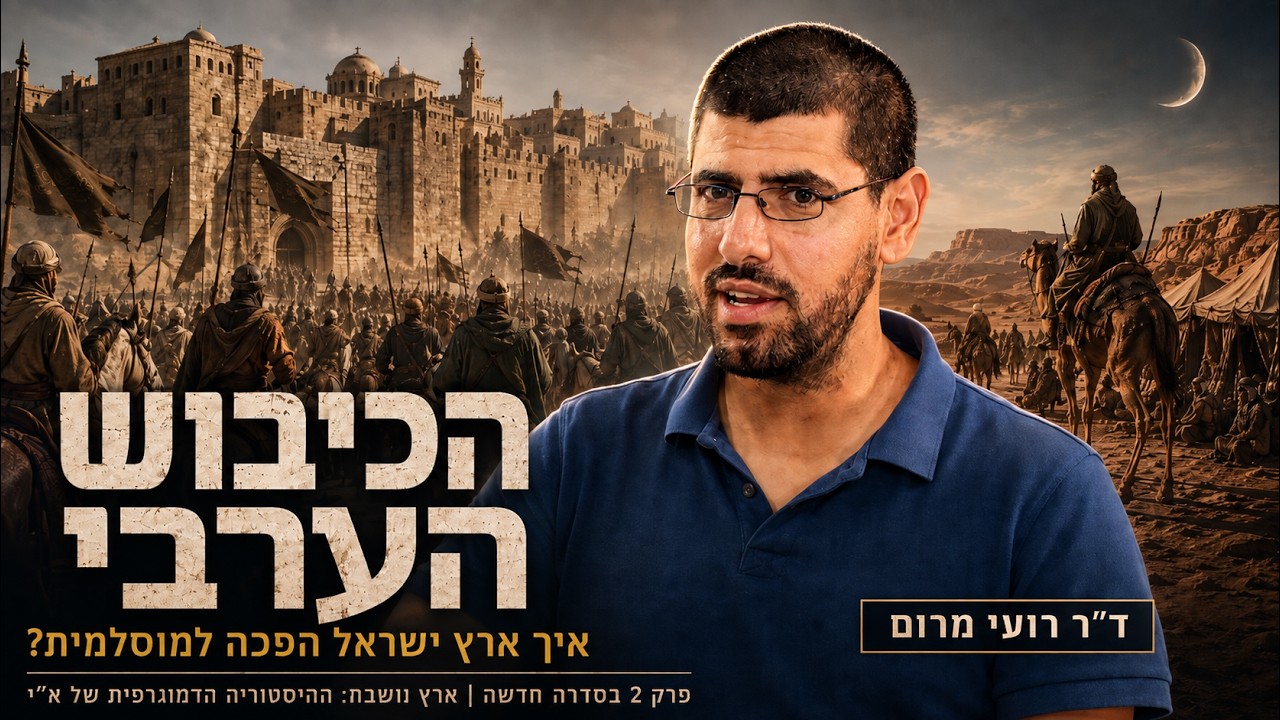
The Arab conquest did not flip the region from Byzantine Christian to Muslim overnight. It was not a clean before-and-after photo. It was a long, messy, fascinating transformation that took centuries.
People kept farming the same fields. Families remained in many of the same villages. Old city walls, columns, churches, roads, and markets did not vanish in a puff of smoke. But the political world around them changed dramatically. New rulers arrived. New tax systems appeared. Trade routes shifted. Arabic became the language of power, then daily life. And slowly, the religious and social map changed too.
The big historical changes are rarely a single moment. They are storms that keep bringing rain long after the first thunder.
That is the right way to approach the Arab conquest of the land between the Mediterranean and the Jordan River. It was a military conquest, yes. But it was also a change in geography, economy, identity, language, settlement, and everyday survival.
Takeaways
- The Arab conquest reshaped the land gradually through administration, trade, language, faith, and migration.
- Early Islamic rule preserved much of the old system before Arabic institutions became dominant.
- Conversion often followed taxation, patronage, inheritance, and social opportunity rather than immediate force.
- Jerusalem gained major Islamic importance, but Mecca and Medina remained the central holy cities.
A World Already Under Pressure
By the early seventh century, the Byzantine world was exhausted. The land had enjoyed extraordinary prosperity during the fifth and sixth centuries. There were bustling cities, cultivated farms stretching toward the desert, international trade, churches, monasteries, paved streets, and big public buildings.
But the good years had cracks underneath them. Byzantine and Sasanian Persian armies had fought huge wars. Epidemics had hit the eastern Mediterranean. Climate troubles and natural disasters added more pressure. The old order was still standing, but it was tired.
And history does not leave a political vacuum sitting around for long.
When an old order weakens, something new grows in the empty space.
Arab groups had been present in the region for centuries before the Arab conquest. Arabic-speaking communities lived around deserts, along trade routes, in frontier zones, and in cities. Nabataeans, for example, were Arabs who wrote largely in Aramaic. Arab names appear in inscriptions, even when the language of administration was Greek, Aramaic, or another local language.
So the Arab conquest did not bring an entirely unknown population into a sealed-off world. What changed was that Arabic-speaking elites became the ruling force, connecting the land to an enormous new political and commercial space.
Was It a Muslim Conquest or an Arab Conquest?
The labels matter because the early movement was still taking shape. Calling everything “Islamic” from day one can make the first decades look more organized and fully developed than they really were.
Muhammad was an Arab merchant from Mecca, connected to the wider routes between southern Arabia, Syria, and Yemen. He knew the religious world around him. Jewish and Christian traditions were not distant abstractions. They were part of the broader environment in which the early movement emerged.
But in Muhammad’s lifetime, the later legal systems, imperial institutions, and fully formed religious structures of Islam were not yet complete. The Arab conquest was therefore both Arab and Muslim, but neither term alone explains the whole story.
Traditional Islamic sources describe large, organized armies conquering Byzantine territory and establishing a coherent Muslim administration. Beginning in the 1970s, revisionist scholars challenged parts of this account. Some proposed that there was no straightforward conquest at all, or that the transition was mostly gradual and political.
Those debates were useful because they forced historians to examine every source carefully, including Christian chronicles, coins, inscriptions, manuscripts, archaeological evidence, and later Muslim writings. But they did not produce a stronger alternative explanation for the broad reality of the Arab conquest.
There were real battles. There were raids, destruction, and military takeovers. The battles of Yarmouk in the north and Ajnadayn in the south became major markers in the historical memory of the conquest.
The details can be debated without pretending that nothing happened.
Early non-Muslim sources describe Arab groups, sometimes called Tayyaye or Hagarites, attacking villages, taking goods, and burning places. At the same time, the conquest did not instantly erase the Byzantine system. For decades, coins still carried crosses and Greek inscriptions even as Arabic script began to appear.
A New World Opened Up
The Arab conquest closed one set of connections and opened another. The old Byzantine Mediterranean economy became harder to access because the sea was now part of a military frontier between rival powers. Pilgrimage, shipping, and old export networks declined.
But the land was now linked to a vast new zone stretching from North Africa through Syria, Iraq, Iran, Central Asia, and toward the Indus Valley. Similar coins, weights, administrative practices, and trade opportunities connected places that had previously belonged to different imperial systems.
That new world brought fresh goods and technologies into the region:
- Glazed ceramics and new pottery styles arrived from eastern trade networks.
- The textile industry, silk, sugarcane, and water buffalo became part of the changing economy.
- New coinage standards and carefully regulated weights supported trade across the Islamic world.
- Chicken became increasingly common as an everyday food, while pork consumption gradually declined.
One small object can tell a surprisingly big story. Early Islamic lamps and ceramics used new manufacturing methods, surface treatments, and floral designs. These were not just decorative changes. They show new production networks and new consumer habits.
But some older industries lost their foundation. Wine production was especially affected. The region had produced huge quantities of wine and olive oil during the Byzantine period, including for export across the sea. Islamic disapproval of alcohol did not make wine disappear completely, but it weakened a major economic pillar.
New opportunities arrived, but not necessarily in the same places or at the same scale as the old ones.
Jerusalem, Mecca & the New Sacred Geography
Jerusalem became one of the most important symbols of the Arab conquest. Early Muslim rulers understood that the city was already sacred to Judaism and Christianity. It was not an empty place waiting to be invented. It was loaded with memory, buildings, ruins, arguments, and religious prestige.
Early sources describe Jews joining the new rulers in cleaning the Temple Mount, which had been neglected during the Byzantine period. The site mattered intensely because it was associated with the ancient Temple and with the holy history shared, debated, and reinterpreted by Jews, Christians, and Muslims.
Under the Umayyads, especially during the reign of Abd al-Malik, Jerusalem became the site of a spectacular building project. The Dome of the Rock was built in the visual language of the Byzantine world, with its craftsmanship, wealth, mosaics, stonework, and monumental ambition.
The point was not to copy Byzantium mindlessly. It was to take the grand imperial style of the old world and use it for a new religious and political message.
The builders did not erase the old sacred landscape. They claimed it, reworked it, and gave it a new center of meaning.
The Dome of the Rock stood over the elevated platform identified with the former Temple area. The Dome of the Chain was constructed in the area associated with the altar. Umayyad palaces were also built south of the Temple Mount.
Still, Jerusalem did not become the supreme center of Islam. The project met resistance from Arab elites tied to Mecca and Medina, who insisted that the central holy place was in Arabia. Damascus became the Umayyad political capital. Jerusalem remained holy, usually ranked after Mecca and Medina, but its position was complex and contested.
That tension helps explain why early Islamic sacred geography cannot be reduced to one neat map. Prayer orientation, local Arabian traditions, Jerusalem’s prestige, and imperial politics all overlapped.
How Arabic Became the Language of Daily Life
The Arab conquest did not make a farmer stop speaking Aramaic or Greek the next morning. That is not how languages work.
Imagine a new administration arriving in a country. At first, homes continue to use familiar languages. Old names remain. Schools and local institutions continue as before. Documents may be bilingual. But over time, the language that brings jobs, status, influence, and access to government gains an advantage.
That was Arabic.
For the first generation after the Arab conquest, people could still speak Aramaic, Greek, Hebrew, Samaritan Aramaic, or other local languages. Their children and grandchildren increasingly encountered Arabic in taxes, official business, markets, army service, religion, and social mobility.
Names changed too. A person of Jewish, Christian, Greek, Aramaic, or Samaritan background could eventually bear an Arabic name and speak Arabic as a first language without having arrived from Arabia.
The same wheat was planted in the same field, but the words used for it slowly changed.
This Arabization was gradual. It took roughly four centuries to become deeply rooted across the population. Arabic eventually replaced Greek and Aramaic as the region’s primary living language, though older languages persisted for religious and liturgical use.
Conversion Was a Social Process, Not a Single Order
One of the biggest misunderstandings about the Arab conquest is the idea that everyone was immediately converted at swordpoint. The reality was more complicated.
There was generally no blanket policy forcing every Jew or Christian to become Muslim immediately. In fact, most of the Umayyad population was initially non-Muslim. Jewish, Christian, Samaritan, and other communities continued to exist.
But the system created powerful pressures. Non-Muslim communities paid the jizya, a poll tax imposed on protected non-Muslims. This was not a small inconvenience. It could be an extremely heavy burden on a household.
Conversion could therefore change a family’s economic position. It could reduce tax pressure, open paths into the ruling society, and protect property interests. There were also social benefits to joining the dominant culture.
A convert did not automatically become socially equal to an Arab tribesman. Often, the new Muslim became a mawla, a client attached to an Arab patron or tribe. The convert could adopt an Arabic name and acquire a tribal affiliation. Over generations, the older background could fade from public memory.
This was a huge engine of change. The Arab conquest did not simply replace local populations with newcomers. In many places, local people became Arabic-speaking Muslims within a new tribal and political framework.
Religious conversion could also mean a new name, a new network, new inheritance rules, and a new future for the family.
Inheritance added another incentive. If one member of an extended family converted, questions of property and succession could become urgent. Other relatives might convert in part to avoid losing family land or wealth. These pressures could spread conversion from one household to another.
Declining Cities & a Changing Countryside
The Arab conquest reshaped the urban system, but cities did not disappear immediately. Jerusalem, Caesarea, Beit Shean, Tiberias, Ashkelon, and other old cities continued for a time. Markets operated. Buildings were maintained. Public spaces remained useful.
Still, the ancient city was losing the system that had supported it. Population declined. Long-distance trade in older goods shrank. The classic Greco-Roman ideal of the polis, with forums, monumental planning, public baths, and civic institutions, gradually weakened.
Then came the devastating earthquake of 749. It destroyed or badly damaged many settlements just as the Umayyad dynasty fell and the Abbasids took power.
The Abbasid shift mattered enormously. Under the Umayyads, the land was relatively close to the political center in Damascus. Under the Abbasids, the center shifted to Mesopotamia, specifically Baghdad. Money, elite attention, and imperial investment flowed elsewhere.
Old urban structures were not always rebuilt. Their stones, columns, and carved blocks were reused. The landscape became full of Roman and Byzantine remains, now turned into building material for a different world.
Public bath culture gave way in part to the hammam. Markets remained, but their structure changed. The market inspector, or muhtasib, regulated fair weights and measures in line with Islamic principles. Coins and weights became notably standardized across the wider Islamic realm.
The coast also took on a new military role. Fortified sites and ribats appeared along the shoreline, reflecting the permanent conflict with Byzantium across the Mediterranean.
Ramla, Rural Change & Demographic Decline
The new rulers not only inherited cities. They built new ones. Ramla is the clearest example. It was founded near Lydda, or Lod, with water brought by an aqueduct. Its great White Mosque became one of the major monuments of the early Islamic landscape.
Ramla flourished, but it represented a different kind of urban world. It was smaller than the old Byzantine peak, connected to different trade patterns, and organized around different institutions.
The countryside changed too. Settlement shrank in some areas. Coastal cities became smaller. The Byzantine project of intensive Negev settlement faded, probably because the subsidies and economic systems that had sustained it weakened. Monastic life in the Judean Desert also declined.
At the same time, new agricultural estates appeared in the Jordan Valley, including those producing sugar. The land was not abandoned. It was reorganized.
Decline is not the same as emptiness. A smaller world can still be busy, creative, and deeply alive.
Demographic change varied by place. There was a clear Arab settlement in parts of the south, especially in areas linked to Arabian tribal migration. Arabic graffiti and names in former church spaces point to the presence of newcomers from Arabia in some locations.
But in much of Samaria, Galilee, and the northern coastal plain, the evidence points more strongly to local communities that gradually converted and adopted Arabic. The Arab conquest was not a single demographic formula applied everywhere.
Jews, Samaritans, Christians & New Muslim Communities
The old Byzantine landscape had been mostly Christian, with substantial Jewish and Samaritan minorities. The Arab conquest did not erase this mosaic. It made it more complicated.
Samaritan communities faced heavy pressures from taxation, political instability, raids, and conversion. Over time, many Samaritans concentrated more tightly around Nablus and the central Samarian highlands.
Jewish communities remained active in the Galilee and southern areas for centuries. In some places, archaeological evidence shows continuity of settlement alongside religious change. At Susiya, for example, the synagogue became a mosque while the settlement itself continued. That is a striking picture of local conversion rather than simple population replacement.
Christian communities often became more urban and concentrated in places where communal institutions could survive. Lebanon retained strong Christian populations, including Maronites, while other religious groups also developed clearer regional centers.
Shia communities appeared in parts of the region by the tenth century. Druze communities emerged around the beginning of the eleventh century from a movement centered on the Fatimid caliph al-Hakim. They established lasting communities in the Galilee, the Golan, Mount Hermon, southern Lebanon, and nearby areas.
The point is not that every modern community can be traced through a single straight line. The point is that the Arab conquest created a new framework in which local populations changed religion, language, identity, and geography over many generations.
When Did the Land Become Mostly Muslim?
There is no exact year when someone can place a pin on a calendar and say, “That was the moment.” The sources are simply not detailed enough for the rural population.
Written Arabic geographical descriptions of the land became much more useful only around the tenth century. Earlier evidence comes in fragments: church chronicles, coins, inscriptions, papyri, tax receipts, contracts, archaeological layers, abandoned buildings, reused stones, and changing pottery.
The papyri from Nessana in the Negev are especially revealing. They show documents moving from Greek to mixed Greek and Arabic, then to Arabic. That is the transformation in miniature.
By around the eleventh century, the region was likely a Muslim majority. But that majority was built through a long chain of local conversions, Arabization, social mobility, taxation, migration, and political change.
The Arab conquest began with armies, but its deepest effects were carried forward by families, villages, markets, taxes, and language.
The End of One World & the Start of Another
By the end of this transformation, the old late-antique world had changed beyond recognition. The land was no longer primarily a Byzantine Christian space linked to Mediterranean pilgrimage, Roman-style cities, Greek administration, and massive wine exports.
It had become part of an Arabic-speaking Muslim world. Mosques stood where churches had once dominated. Arabic replaced Greek and Aramaic in ordinary life. New foods, goods, ceramics, markets, and religious institutions appeared. The countryside was more fragmented, city life was different, and the region’s political center lay elsewhere.
But this was not simply a story of destruction. The Arab conquest created new connections from North Africa to Central Asia and beyond. It brought new technologies, new trade networks, new sacred landscapes, and new intellectual worlds.
Jewish life changed too. Rabbinic Judaism became increasingly institutionalized as texts were written down and authority shifted between the Land of Israel and Babylon. The Cairo Geniza later preserved remarkable evidence of Jewish trade and communication across the medieval Islamic world. Karaite movements also emerged as important rivals within Jewish society.
The Arab conquest therefore marks the end of one civilization in the land and the beginning of another. Not better or worse in one simple sentence. Just different, layered, and full of consequences that still shape the region.
This is why the Arab conquest matters: it was not only about who won battles. It changed what people spoke, prayed, paid, planted, traded, built, remembered, and became.
RESOURCES:
This article was created from the video Arab Conquest: How the Land Gradually Became Muslim (Pt3 Heb) | https://www.youtube.com/watch?app=desktop&v=lZYBC_D04Ug#fauxfullscreen with the help of AI. | PHOTOS & VIDEOS Use According to Section 27 A
Watch More: Jewish History...
- Abraham – One Man Chose a Different Path
- Timeline of Jewish History
- Tower of Babel & the Origin of Languages
- 1177 BC: How the First Globalized World Fell Apart
- Nineveh: The Greatest City Erased from History
- Babylon in 570 BC: Inside the City That Shaped the World
- Nebuchadnezzar, Solomon’s Temple & the Fire that Changed Jerusalem
- Hezekiah’s Tunnel: Faith, Fear & Water Beneath Jerusalem
- “Rivers of Babylon” Written in Exile 2600 Years Ago
- Nebuchadnezzar: The King Who Built Babylon, Lost Everything & Returned
- Secret of Jewish Survival & Esther’s Courage
- Canaan to Rome: The Ancient History of Israel
- Arch of Titus: Rome’s Monument of Triumph & Jewish Heartbreak
- Roman Empire: The Rise, The Madness, The Fall of a Civilization
- Fall of Rome: How the Ancient World’s Greatest Empire Changed Shape
- When Nations Turn Against Israel, What Happens to Them?
- ‘All Things Are Mortal But the Jew’ – Mark Twain
- 7 Wonders of Jewish History: A Story That Should Not Be Possible
- Samaritans: Last 800 Guardians of Mount Gerizim
- Amalek Command: Why It's Misunderstood
- PART 1 | The Land of Israel & Ottoman Palestine (HEB)
- Part 2 | The Land Reached Its Peak & Byzantine Palestine’s Demographic High Point (HEB)
- PART 3 | Arab Conquest: How the Land Gradually Became Muslim (HEB)
- 5000 Years of Jewish History (5-Min Clips)