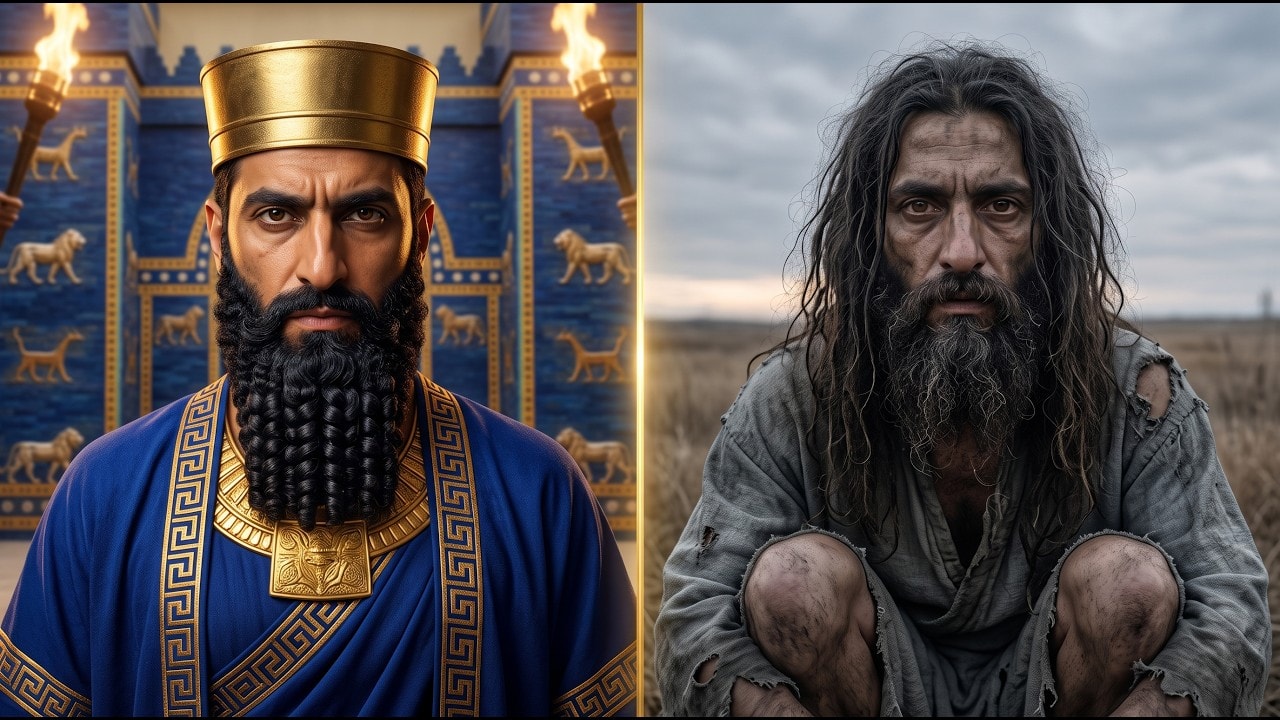
Picture Nebuchadnezzar at the absolute height of power. His empire stretched from the Persian Gulf toward Egypt. Kings paid tribute. Armies feared his name. Babylon, already ancient when he inherited it, became a city of blue-glazed gates, towering temples, massive walls, and royal ambition on a scale almost too big to picture.
Then comes the image that has outlived nearly everything else about him: Nebuchadnezzar, the king of Babylon, living in the open field for seven years, eating grass like an ox.
The fall only makes sense when you understand the height he fell from.
This is a story of conquest, construction, destruction, dreams, pride, illness, faith, and a return nobody can fully explain. It can be read through history, theology, psychology, or all three at once. Either way, the arc hits hard.
Takeaways
- Nebuchadnezzar secured Babylon’s power after his decisive victory over Egypt at Carchemish in 605 BC.
- His rebuilding projects made Babylon a physical monument to imperial strength, religious devotion, and royal ambition.
- The destruction of Jerusalem created the Babylonian Exile and permanently shaped Jewish religious memory.
- His seven-year collapse remains historically contested, but its warning about pride has endured for millennia.
A Prince Raised in Chaos
Nebuchadnezzar II was born into a world breaking apart. Around 634 BC, the Assyrian Empire, which had dominated the Near East for centuries, was collapsing. Nineveh had fallen. The old order was gone, and every ambitious power in the region was scrambling for the empty space it left behind.
His father, Nabopolassar, rose from uncertain origins to found the Neo-Babylonian Empire. He was practical, ruthless when needed, and deeply aware that power usually goes to the person who moves first and thinks clearly.
That was the education Nebuchadnezzar received. Not a sheltered royal childhood. War was the classroom. Campaigns were the homework.
As a young commander, Nebuchadnezzar did not become famous by charging wildly into battle for a dramatic story later. He thought about supply lines, terrain, timing, administration, and the psychology of enemies. That kind of patient, organized thinking would help him hold one of the most dangerous thrones in the ancient world for 43 years.
Carchemish Changed the Ancient World
The decisive test came in 605 BC at Carchemish, near the Euphrates River on the modern Syria and Turkey border. Egypt’s Pharaoh Neco II marched north to claim influence in the Levant after Assyria’s collapse. This was no minor clash. Egypt was still a major power, and the future of the region was on the line.
Nebuchadnezzar, then crown prince, led the Babylonian army against Egypt and shattered it. The Babylonian Chronicles record the victory in the cold, official language of a state archive. Egypt’s forces were routed and pursued.
Carchemish was the moment Babylon stopped being a rising power and became the power everyone else had to reckon with.
Then, right after this enormous victory, word arrived that Nabopolassar had died. Nebuchadnezzar handed command to senior officers, crossed the desert, and hurried back to Babylon to secure the throne before rivals could move.
He was in his early twenties. He had just beaten Egypt. Now he was king.
Building Babylon Into a Statement of Power
Nebuchadnezzar spent much of his reign doing two huge things at once: fighting to secure his empire and rebuilding Babylon into a city designed to overwhelm anyone who entered it.
The city was not simply meant to function. It was meant to make a statement. Babylon was the center of the world, and Nebuchadnezzar wanted every visitor, merchant, diplomat, captive, and rival king to feel it in their bones.
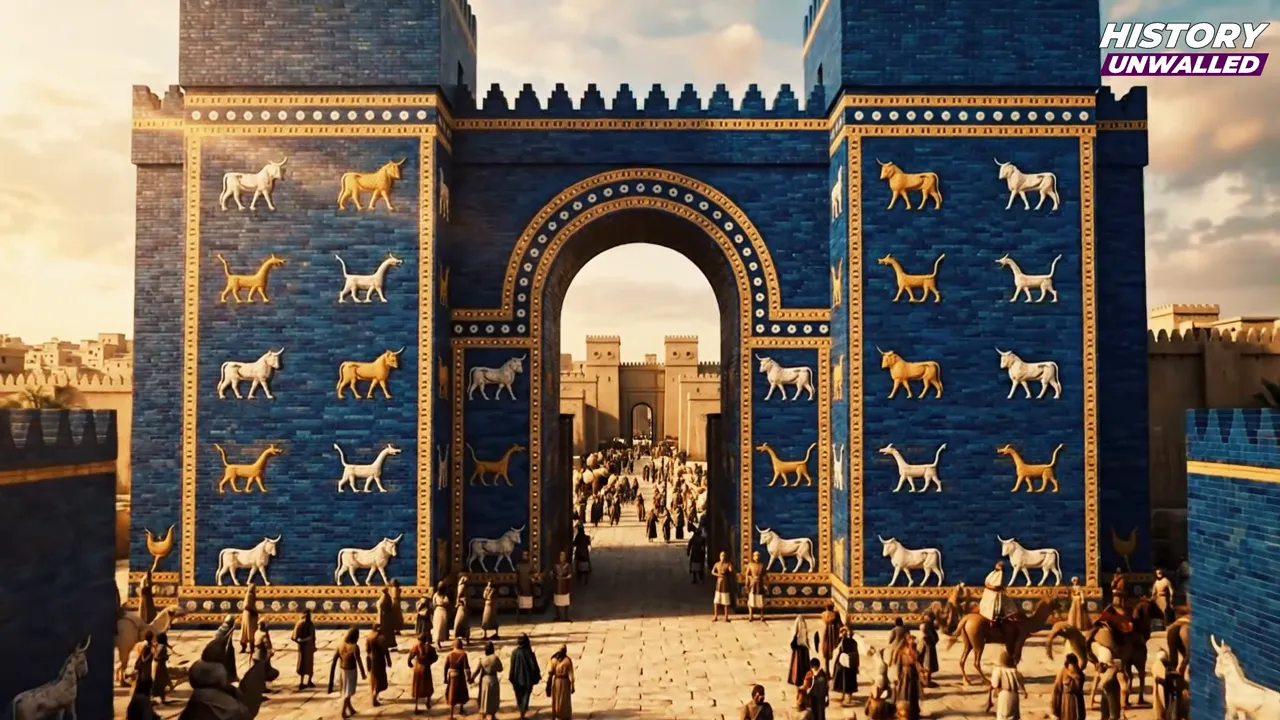
Among his most famous projects
- Rebuilt city walls, reportedly broad enough for two chariots to pass on top.
- The Processional Way, lined with yellow lions on deep blue glazed brick.
- The Ishtar Gate, decorated with bulls and serpentine dragons.
- The Great Ziggurat of Babylon, often associated with the Tower of Babel tradition.
- Royal palaces and temples built at stunning scale.
His surviving inscriptions make his goals plain. Nebuchadnezzar built for Marduk, Babylon’s chief god. He built to show that Babylon stood at the center of civilization. And he built to show what power looked like when it believed it had no equal.
The architecture was not subtle. It was supposed to make people feel small.
Then there are the Hanging Gardens. Ancient tradition links them to Nebuchadnezzar and to his wife Amytis, a Median princess who supposedly missed the green hills of her homeland. The story says he built terraced gardens, irrigated by water lifted from the Euphrates, to give her mountains in a flat and sunbaked city.
Whether the gardens actually stood within Babylon’s walls remains debated. Some scholarship places them in Nineveh instead. But the association tells us something true about Nebuchadnezzar’s reputation: he did not think in small terms.
Jerusalem, Exile & Imperial Violence
Babylon’s empire did not run on goodwill. It ran on tribute, oversight, hostages, trained officials, military force, and the clear understanding that rebellion would bring consequences.
Judah was caught in the middle of this system. Its location between Babylon and Egypt made it strategically vital. Its rulers repeatedly looked to Egypt for help against Babylon. Nebuchadnezzar repeatedly saw that as rebellion.
In 597 BC, after King Jehoiakim stopped paying tribute, Nebuchadnezzar marched on Jerusalem. Jehoiakim died during the crisis. His son, Jehoiachin, surrendered quickly. Nebuchadnezzar took the king, skilled workers, soldiers, administrators, and temple treasures back to Babylon. He left Zedekiah as a new client king.
But Zedekiah eventually negotiated with Egypt. In 589 BC, Babylonian forces surrounded Jerusalem again. The final siege lasted 18 months.
When Jerusalem fell in 587 or 586 BC, the result was catastrophic. Zedekiah was captured near Jericho after attempting to flee. His sons were killed before his eyes. Then he was blinded and taken to Babylon in chains. The Temple of Solomon was burned. Jerusalem’s walls were torn down. Many survivors were deported in what became known as the Babylonian Exile.
From an imperial point of view, this was a rebellion crushed. From inside Jerusalem, it was the end of a world.
Both perspectives matter. Nebuchadnezzar’s policy followed the brutal logic of ancient empire: make a second revolt impossible. But for the Jewish people, the destruction of the Temple raised a devastating question: what does it mean when the place where God dwells burns?
Nebuchadnezzar stands at the center of both histories. To Babylon, he was conqueror and king. In Jewish memory, he was the destroyer who burned the Temple and scattered the people.
Daniel’s Dreams & a King Who Would Not Listen
The Book of Daniel adds another dimension to the story of Nebuchadnezzar. Early in his reign, the king has a dream that terrifies him, yet he cannot remember it. He demands that Babylon’s sages tell him both the dream and its meaning. When they cannot, he threatens them with execution.
Daniel, a Jewish exile educated in Babylon’s court, asks for time. He prays, then tells the king what he saw: a giant statue with a head of gold, chest and arms of silver, belly and thighs of bronze, legs of iron, and feet mixed from iron and clay. A stone strikes its feet. The statue collapses. The stone grows until it fills the earth.
Daniel tells Nebuchadnezzar that the gold head is him. Other kingdoms will follow. And eventually, divine authority will outlast every human empire.
Nebuchadnezzar rewards Daniel and praises Daniel’s God. It sounds like a breakthrough. But then he builds a giant gold statue and commands the empire to bow before it.
He hears that human power is temporary, then immediately acts as if the warning applies to everyone else.
Then comes the second dream. This time Nebuchadnezzar sees an enormous tree at the center of the earth. It provides shelter and food for all kinds of creatures. A heavenly messenger commands that the tree be cut down, while leaving its stump bound with iron and bronze. Its mind will become like that of an animal for seven years.

Daniel is shaken before he delivers the meaning. The tree is Nebuchadnezzar. The judgment is coming.
But Daniel also gives him a practical way forward:
Practice justice. Show mercy to those who are suffering.
A full year passes. Babylon continues to grow. The empire holds. No disaster comes. And then Nebuchadnezzar stands on the roof of his palace, looks over the city, and takes credit for all of it.
That is the moment the warning arrives.
Seven Years in the Field
The Book of Daniel describes Nebuchadnezzar being driven from human society. He lives outdoors. He eats grass like an ox. Dew soaks his body. His hair grows long like eagle feathers. His nails become like bird claws. Seven years pass.
What actually happened is one of the most contested questions in ancient history.
Babylonian administrative records from this period are notably thin. There are gaps in the royal archive. A fragmentary Dead Sea Scrolls text called the Prayer of Nabonidus preserves a similar tradition involving a Babylonian king afflicted by severe illness for seven years and restored after contact with a Jewish exile.
That does not settle the question. But it does show that this was not a late story floating alone in the air.
Modern researchers have suggested several possibilities:
- Boanthropy, a rare psychiatric condition in which someone believes they are an ox or other bovine animal.
- Severe depression with psychosis.
- Stroke-related personality or behavioral changes.
- Psychosis triggered by extreme stress or physical illness.
Maybe one of those explanations is right. Maybe none is. The honest answer is simple: nobody knows with certainty.
Something real and severe seems to have happened between Nebuchadnezzar’s greatest strength and his return.
And here is the truly strange part. The Babylonian Empire kept functioning. No obvious coup. No rival king storming the palace. No public collapse of the state. The army, administration, temple economy, and tribute system continued.
Perhaps Nebuchadnezzar’s officials were remarkably loyal. Perhaps they hid his condition from foreign rivals. Perhaps his name alone scared off challengers. It may have been some combination of all three.
But seven years is a long time for an empire to hold together while its king is absent from the throne room.
The Return of Nebuchadnezzar
At the end of the seven years, the story says Nebuchadnezzar raises his eyes to heaven, and his reason returns. His response is striking because of who he had been: a king who built Babylon, defeated Egypt, destroyed Jerusalem, and commanded millions through fear and authority.
He acknowledges that heaven rules over earthly kingdoms. He recognizes that power can be given and removed by an authority no king controls.
For a man who had spent his life making the world bend around him, this was a complete reversal.
His advisers and nobles restore Nebuchadnezzar to the throne. His splendor returns. The empire takes him back.
We know less about his final years. He died around 562 BC after reigning for 43 years. His later inscriptions are fewer. His military campaigns appear to quiet down. Maybe the empire was stable enough not to require constant war. Or maybe a person who loses everything and gets it back sees power differently afterward.
A Legacy Bigger Than an Empire
Nebuchadnezzar’s empire did not last long after him. His successors were weaker and less stable. In 539 BC, Cyrus the Great of Persia arrived at Babylon, and the city opened to him with barely a fight. The Neo-Babylonian Empire ended roughly 23 years after Nebuchadnezzar died.
Babylon itself survived. It remained an important cultural and commercial city under Persian rule, then under Alexander the Great, who died there in 323 BC, and under later kingdoms.
Still, the empire Nebuchadnezzar spent his life building did not outlast him by a full generation.
His inscriptions remain scattered through the archaeological record of modern Iraq. They speak of temples, Marduk, Babylon’s walls, campaigns, and the proper relationship between king and divine power. They are full of confidence. You can feel the certainty through the centuries.
But the world remembers Nebuchadnezzar most clearly for something else.
Not only the Ishtar Gate. Not only Carchemish. Not only the city he rebuilt or the Temple he destroyed.
It remembers the king in the field.
Power that cannot recognize its limits eventually finds them.
Nebuchadnezzar rose. He built. He destroyed. He fell. And, somehow, he returned.
That return is why the story refuses to disappear. It leaves room for the terrifying possibility that pride can break a person. But it also leaves room for something rarer: that a broken person can come back with a different understanding of who they are.
Picture Nebuchadnezzar at the absolute height of power. His empire stretched from the Persian Gulf toward Egypt. Kings paid tribute. Armies feared his name. Babylon, already ancient when he inherited it, became a city of blue-glazed gates, towering temples, massive walls, and royal ambition on a scale almost too big to picture.
Then comes the image that has outlived nearly everything else about him: Nebuchadnezzar, the king of Babylon, living in the open field for seven years, eating grass like an ox.
The fall only makes sense when you understand the height he fell from.
This is a story of conquest, construction, destruction, dreams, pride, illness, faith, and a return nobody can fully explain. It can be read through history, theology, psychology, or all three at once. Either way, the arc hits hard.
Takeaways
- Nebuchadnezzar secured Babylon’s power after his decisive victory over Egypt at Carchemish in 605 BC.
- His rebuilding projects made Babylon a physical monument to imperial strength, religious devotion, and royal ambition.
- The destruction of Jerusalem created the Babylonian Exile and permanently shaped Jewish religious memory.
- His seven-year collapse remains historically contested, but its warning about pride has endured for millennia.
A Prince Raised in Chaos
Nebuchadnezzar II was born into a world breaking apart. Around 634 BC, the Assyrian Empire, which had dominated the Near East for centuries, was collapsing. Nineveh had fallen. The old order was gone, and every ambitious power in the region was scrambling for the empty space it left behind.
His father, Nabopolassar, rose from uncertain origins to found the Neo-Babylonian Empire. He was practical, ruthless when needed, and deeply aware that power usually goes to the person who moves first and thinks clearly.
That was the education Nebuchadnezzar received. Not a sheltered royal childhood. War was the classroom. Campaigns were the homework.
As a young commander, Nebuchadnezzar did not become famous by charging wildly into battle for a dramatic story later. He thought about supply lines, terrain, timing, administration, and the psychology of enemies. That kind of patient, organized thinking would help him hold one of the most dangerous thrones in the ancient world for 43 years.
Carchemish Changed the Ancient World
The decisive test came in 605 BC at Carchemish, near the Euphrates River on the modern Syria and Turkey border. Egypt’s Pharaoh Neco II marched north to claim influence in the Levant after Assyria’s collapse. This was no minor clash. Egypt was still a major power, and the future of the region was on the line.
Nebuchadnezzar, then crown prince, led the Babylonian army against Egypt and shattered it. The Babylonian Chronicles record the victory in the cold, official language of a state archive. Egypt’s forces were routed and pursued.
Carchemish was the moment Babylon stopped being a rising power and became the power everyone else had to reckon with.
Then, right after this enormous victory, word arrived that Nabopolassar had died. Nebuchadnezzar handed command to senior officers, crossed the desert, and hurried back to Babylon to secure the throne before rivals could move.
He was in his early twenties. He had just beaten Egypt. Now he was king.
Building Babylon Into a Statement of Power
Nebuchadnezzar spent much of his reign doing two huge things at once: fighting to secure his empire and rebuilding Babylon into a city designed to overwhelm anyone who entered it.
The city was not simply meant to function. It was meant to make a statement. Babylon was the center of the world, and Nebuchadnezzar wanted every visitor, merchant, diplomat, captive, and rival king to feel it in their bones.
Among his most famous projects
- Rebuilt city walls, reportedly broad enough for two chariots to pass on top.
- The Processional Way, lined with yellow lions on deep blue glazed brick.
- The Ishtar Gate, decorated with bulls and serpentine dragons.
- The Great Ziggurat of Babylon, often associated with the Tower of Babel tradition.
- Royal palaces and temples built at stunning scale.
His surviving inscriptions make his goals plain. Nebuchadnezzar built for Marduk, Babylon’s chief god. He built to show that Babylon stood at the center of civilization. And he built to show what power looked like when it believed it had no equal.
The architecture was not subtle. It was supposed to make people feel small.
Then there are the Hanging Gardens. Ancient tradition links them to Nebuchadnezzar and to his wife Amytis, a Median princess who supposedly missed the green hills of her homeland. The story says he built terraced gardens, irrigated by water lifted from the Euphrates, to give her mountains in a flat and sunbaked city.
Whether the gardens actually stood within Babylon’s walls remains debated. Some scholarship places them in Nineveh instead. But the association tells us something true about Nebuchadnezzar’s reputation: he did not think in small terms.
Jerusalem, Exile & Imperial Violence
Babylon’s empire did not run on goodwill. It ran on tribute, oversight, hostages, trained officials, military force, and the clear understanding that rebellion would bring consequences.
Judah was caught in the middle of this system. Its location between Babylon and Egypt made it strategically vital. Its rulers repeatedly looked to Egypt for help against Babylon. Nebuchadnezzar repeatedly saw that as rebellion.
In 597 BC, after King Jehoiakim stopped paying tribute, Nebuchadnezzar marched on Jerusalem. Jehoiakim died during the crisis. His son, Jehoiachin, surrendered quickly. Nebuchadnezzar took the king, skilled workers, soldiers, administrators, and temple treasures back to Babylon. He left Zedekiah as a new client king.
But Zedekiah eventually negotiated with Egypt. In 589 BC, Babylonian forces surrounded Jerusalem again. The final siege lasted 18 months.
When Jerusalem fell in 587 or 586 BC, the result was catastrophic. Zedekiah was captured near Jericho after attempting to flee. His sons were killed before his eyes. Then he was blinded and taken to Babylon in chains. The Temple of Solomon was burned. Jerusalem’s walls were torn down. Many survivors were deported in what became known as the Babylonian Exile.
From an imperial point of view, this was a rebellion crushed. From inside Jerusalem, it was the end of a world.
Both perspectives matter. Nebuchadnezzar’s policy followed the brutal logic of ancient empire: make a second revolt impossible. But for the Jewish people, the destruction of the Temple raised a devastating question: what does it mean when the place where God dwells burns?
Nebuchadnezzar stands at the center of both histories. To Babylon, he was conqueror and king. In Jewish memory, he was the destroyer who burned the Temple and scattered the people.
Daniel’s Dreams & a King Who Would Not Listen
The Book of Daniel adds another dimension to the story of Nebuchadnezzar. Early in his reign, the king has a dream that terrifies him, yet he cannot remember it. He demands that Babylon’s sages tell him both the dream and its meaning. When they cannot, he threatens them with execution.
Daniel, a Jewish exile educated in Babylon’s court, asks for time. He prays, then tells the king what he saw: a giant statue with a head of gold, chest and arms of silver, belly and thighs of bronze, legs of iron, and feet mixed from iron and clay. A stone strikes its feet. The statue collapses. The stone grows until it fills the earth.
Daniel tells Nebuchadnezzar that the gold head is him. Other kingdoms will follow. And eventually, divine authority will outlast every human empire.
Nebuchadnezzar rewards Daniel and praises Daniel’s God. It sounds like a breakthrough. But then he builds a giant gold statue and commands the empire to bow before it.
He hears that human power is temporary, then immediately acts as if the warning applies to everyone else.
Then comes the second dream. This time Nebuchadnezzar sees an enormous tree at the center of the earth. It provides shelter and food for all kinds of creatures. A heavenly messenger commands that the tree be cut down, while leaving its stump bound with iron and bronze. Its mind will become like that of an animal for seven years.
Daniel is shaken before he delivers the meaning. The tree is Nebuchadnezzar. The judgment is coming.
But Daniel also gives him a practical way forward:
Practice justice. Show mercy to those who are suffering.
A full year passes. Babylon continues to grow. The empire holds. No disaster comes. And then Nebuchadnezzar stands on the roof of his palace, looks over the city, and takes credit for all of it.
That is the moment the warning arrives.
Seven Years in the Field
The Book of Daniel describes Nebuchadnezzar being driven from human society. He lives outdoors. He eats grass like an ox. Dew soaks his body. His hair grows long like eagle feathers. His nails become like bird claws. Seven years pass.
What actually happened is one of the most contested questions in ancient history.
Babylonian administrative records from this period are notably thin. There are gaps in the royal archive. A fragmentary Dead Sea Scrolls text called the Prayer of Nabonidus preserves a similar tradition involving a Babylonian king afflicted by severe illness for seven years and restored after contact with a Jewish exile.
That does not settle the question. But it does show that this was not a late story floating alone in the air.
Modern researchers have suggested several possibilities:
- Boanthropy, a rare psychiatric condition in which someone believes they are an ox or other bovine animal.
- Severe depression with psychosis.
- Stroke-related personality or behavioral changes.
- Psychosis triggered by extreme stress or physical illness.
Maybe one of those explanations is right. Maybe none is. The honest answer is simple: nobody knows with certainty.
Something real and severe seems to have happened between Nebuchadnezzar’s greatest strength and his return.
And here is the truly strange part. The Babylonian Empire kept functioning. No obvious coup. No rival king storming the palace. No public collapse of the state. The army, administration, temple economy, and tribute system continued.
Perhaps Nebuchadnezzar’s officials were remarkably loyal. Perhaps they hid his condition from foreign rivals. Perhaps his name alone scared off challengers. It may have been some combination of all three.
But seven years is a long time for an empire to hold together while its king is absent from the throne room.
The Return of Nebuchadnezzar
At the end of the seven years, the story says Nebuchadnezzar raises his eyes to heaven, and his reason returns. His response is striking because of who he had been: a king who built Babylon, defeated Egypt, destroyed Jerusalem, and commanded millions through fear and authority.
He acknowledges that heaven rules over earthly kingdoms. He recognizes that power can be given and removed by an authority no king controls.
For a man who had spent his life making the world bend around him, this was a complete reversal.
His advisers and nobles restore Nebuchadnezzar to the throne. His splendor returns. The empire takes him back.
We know less about his final years. He died around 562 BC after reigning for 43 years. His later inscriptions are fewer. His military campaigns appear to quiet down. Maybe the empire was stable enough not to require constant war. Or maybe a person who loses everything and gets it back sees power differently afterward.
A Legacy Bigger Than an Empire
Nebuchadnezzar’s empire did not last long after him. His successors were weaker and less stable. In 539 BC, Cyrus the Great of Persia arrived at Babylon, and the city opened to him with barely a fight. The Neo-Babylonian Empire ended roughly 23 years after Nebuchadnezzar died.
Babylon itself survived. It remained an important cultural and commercial city under Persian rule, then under Alexander the Great, who died there in 323 BC, and under later kingdoms.
Still, the empire Nebuchadnezzar spent his life building did not outlast him by a full generation.
His inscriptions remain scattered through the archaeological record of modern Iraq. They speak of temples, Marduk, Babylon’s walls, campaigns, and the proper relationship between king and divine power. They are full of confidence. You can feel the certainty through the centuries.
But the world remembers Nebuchadnezzar most clearly for something else.
Not only the Ishtar Gate. Not only Carchemish. Not only the city he rebuilt or the Temple he destroyed.
It remembers the king in the field.
Power that cannot recognize its limits eventually finds them.
Nebuchadnezzar rose. He built. He destroyed. He fell. And, somehow, he returned.
That return is why the story refuses to disappear. It leaves room for the terrifying possibility that pride can break a person. But it also leaves room for something rarer: that a broken person can come back with a different understanding of who they are.
RESOURCES:
This article was created from the video He Ruled the Entire World. Then Lost His Mind for 7 Years. | Nebuchadnezzar | https://www.youtube.com/watch?v=A_gCnuL7pWU with the help of AI.
Watch More: Jewish History...
- Abraham – One Man Chose a Different Path
- Timeline of Jewish History
- Tower of Babel & the Origin of Languages
- 1177 BC: How the First Globalized World Fell Apart
- Nineveh: The Greatest City Erased from History
- Babylon in 570 BC: Inside the City That Shaped the World
- Nebuchadnezzar, Solomon’s Temple & the Fire that Changed Jerusalem
- Hezekiah’s Tunnel: Faith, Fear & Water Beneath Jerusalem
- “Rivers of Babylon” Written in Exile 2600 Years Ago
- Nebuchadnezzar: The King Who Built Babylon, Lost Everything & Returned
- Secret of Jewish Survival & Esther’s Courage
- Canaan to Rome: The Ancient History of Israel
- Arch of Titus: Rome’s Monument of Triumph & Jewish Heartbreak
- Roman Empire: The Rise, The Madness, The Fall of a Civilization
- Fall of Rome: How the Ancient World’s Greatest Empire Changed Shape
- When Nations Turn Against Israel, What Happens to Them?
- ‘All Things Are Mortal But the Jew’ – Mark Twain
- 7 Wonders of Jewish History: A Story That Should Not Be Possible
- Samaritans: Last 800 Guardians of Mount Gerizim
- Amalek Command: Why It's Misunderstood
- PART 1 | The Land of Israel & Ottoman Palestine (HEB)
- Part 2 | The Land Reached Its Peak & Byzantine Palestine’s Demographic High Point (HEB)
- PART 3 | Arab Conquest: How the Land Gradually Became Muslim (HEB)
- 5000 Years of Jewish History (5-Min Clips)