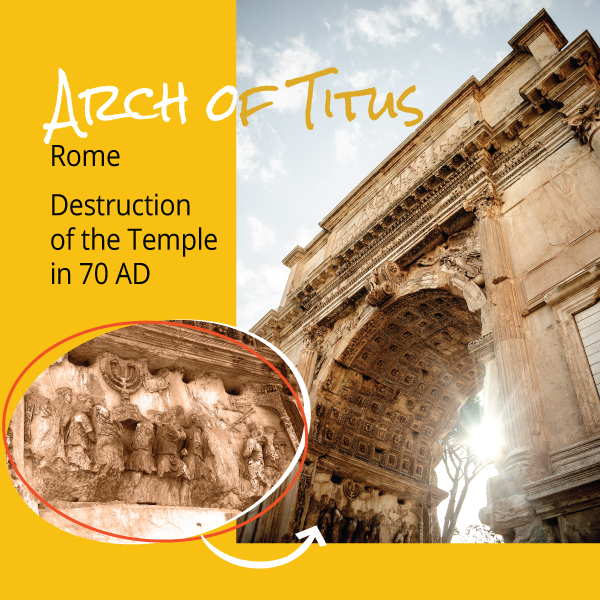
The Arch of Titus is one of those Roman monuments that grabs your attention right away. It is elegant, tall, richly carved, and beautifully placed at the edge of the Roman Forum. But this is no simple victory arch. The Arch of Titus tells a much bigger story about war, dynastic power, public memory, restoration, and an emperor becoming a god.
Built after Titus died in AD 81, the arch celebrates his greatest military achievement: the Roman conquest of Judea and the capture of Jerusalem. It also carries one of ancient Rome’s most powerful and complicated images, the menorah from the Second Temple of Jerusalem being carried in a Roman triumph.
The Arch of Titus celebrates a victory, but it also turns that victory into a permanent statement of imperial power.
To understand why this monument still matters so much, we need to look at Titus, his father Vespasian, his brother Domitian, and the remarkable artistic program carved into the marble.
Takeaways
- The Arch of Titus commemorates Rome’s conquest of Judea and Titus’s later deification.
- Its reliefs show Titus’s triumph, sacred spoils from Jerusalem, and his ascent to divinity.
- Domitian used the monument to strengthen the legitimacy of the Flavian dynasty.
- The arch combines ancient Pentelic marble with major nineteenth-century travertine restoration.
The Jewish War & the Rise of the Flavians
The story behind the Arch of Titus begins during the reign of Nero. In AD 66, a major uprising broke out in Judea. Nero sent his experienced general Vespasian to suppress it, and Titus, Vespasian’s older son, served alongside him.
Then Roman politics exploded. Nero died in June AD 68, and the empire lurched through the chaotic Year of the Four Emperors. Galba, Otho, Vitellius, and finally Vespasian all claimed imperial power. By December AD 69, Vespasian had emerged as the last man standing.
The war in Judea continued. Jerusalem fell in AD 71, and Vespasian and Titus returned to Rome for a triumphal procession. Titus’s younger brother, Domitian, accompanied them on horseback.
Josephus, the Jewish historian and eyewitness source for the war, described the extraordinary spoils displayed in that triumph. Among them was the menorah taken from the Temple in Jerusalem.
The triumph of AD 71 became the visual foundation for the Arch of Titus a decade later.
Vespasian’s return to Rome brought a burst of Flavian construction. He rebuilt the Temple of Jupiter Optimus Maximus after damage during the civil war. He created the Temple of Peace, where many treasures from Jerusalem, including the menorah, were displayed. And, of course, he began the Flavian Amphitheater, better known today as the Colosseum.
Titus also received a magnificent triple arch in the Circus Maximus in AD 71. Its surviving blocks and foundations are now visible in the Circus Maximus Archaeological Park. The Arch of Titus that stands near the Forum today is not that earlier arch. It is a later, more personal memorial.
Titus’s Brief Reign & a Difficult Moment for Rome
Titus succeeded Vespasian in AD 79. His reign was short, lasting only until AD 81, but it was packed with major events.
He began the Temple of the Divine Vespasian in the Forum and contributed to the area around the Colosseum by constructing the Baths of Titus on the Oppian Hill. He also inaugurated the Colosseum with one hundred days of games, famously celebrated by the poet Martial.
But Titus also had to respond to disaster after disaster. The eruption of Vesuvius devastated the Campanian region, including Pompeii, in the fall of AD 79. Then, in AD 80, a violent fire damaged the Campus Martius. Titus began rebuilding, but much of that work was taken over and completed by Domitian.
Titus’s reign was remembered for grand openings, public rebuilding, and urgent responses to catastrophe.
When Titus died of pneumonia in AD 81, his brother Domitian became emperor. Domitian deified both his father and his brother. He completed the Temple of Vespasian, now dedicated to the Divine Vespasian and the Divine Titus, on the Capitoline slopes overlooking the Forum.
And then Domitian created the Arch of Titus.
Why Domitian Built the Arch of Titus
The inscription on the Arch of Titus declares that the Senate and People of Rome dedicated it to the Divine Titus, son of the Divine Vespasian Augustus. It is a classic Roman public dedication, complete with the authority of SPQR.
But Domitian was clearly the driving force. The monument honored Titus, yes, but it also reinforced Domitian’s own position. He was the surviving member of the Flavian imperial family. By emphasizing the divinity of his father and brother, Domitian placed himself within a powerful sacred dynasty.
The arch remembers Titus, but it also promotes the Flavian family as Rome’s rightful ruling house.
This is why the Arch of Titus is much more than a military monument. It is a dynastic monument. It transforms a conquered city, a Roman triumph, and an emperor’s death into a carefully shaped message about power.
A Monument in a Carefully Chosen Place
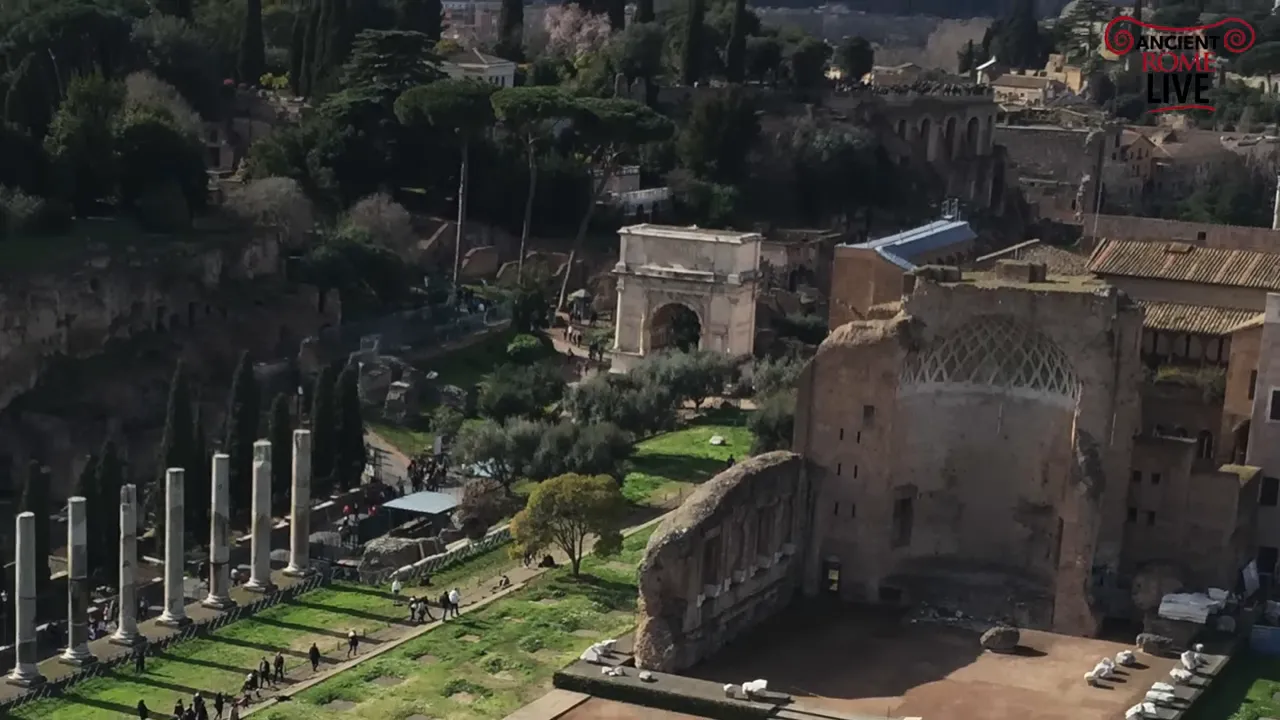
Location matters in ancient Rome. The Arch of Titus stands at the beginning of the Clivus Palatinus, the road that rises toward the Palatine Hill. That road led toward the great imperial palace developed by Domitian.
The arch stood on the Velia, near the Colosseum created by Vespasian. In antiquity, it was also close to Nero’s enormous Colossus. Later, the Velia changed dramatically when Hadrian built the Temple of Venus and Rome. Hadrian moved the colossal statue down toward the piazza beside the Colosseum.
Today, the Arch of Titus still stands more than 15 meters high and about 13 meters wide. Yet its scale is only part of the experience. Its setting ties together the Forum, the Colosseum, the Velia, and the Palatine.
The reliefs inside the arch add one more brilliant touch. The figures move toward the Roman Forum, following the same general route taken during Titus’s triumph in AD 71. The monument does not simply show movement. It makes movement part of its meaning.
The Arch of Titus turns Rome’s actual landscape into part of the story carved in stone.
Medieval Damage & a Remarkable Restoration
The Arch of Titus does not look exactly as it did in antiquity. During the Middle Ages, the Frangipani family incorporated it into a fortified wall circuit. The old monument became part of a practical defensive structure.
Its later history was difficult. By the eighteenth century, images by Piranesi show the arch in a badly damaged state. It was partly ruined, enclosed by later construction, and far from the crisp, freestanding form seen today.
Restoration began in 1817 under Giuseppe Valadier’s predecessor, Raffaele Stern. Valadier continued the work, and the project was completed in 1821 under Pope Pius VII.
This restoration is one of Rome’s great conservation achievements. The central interior portion of the arch is original Pentelic marble, while much of the outer structure was reconstructed in travertine. The contrast is not a flaw. It helps us see where the ancient monument ends and the nineteenth-century restoration begins.
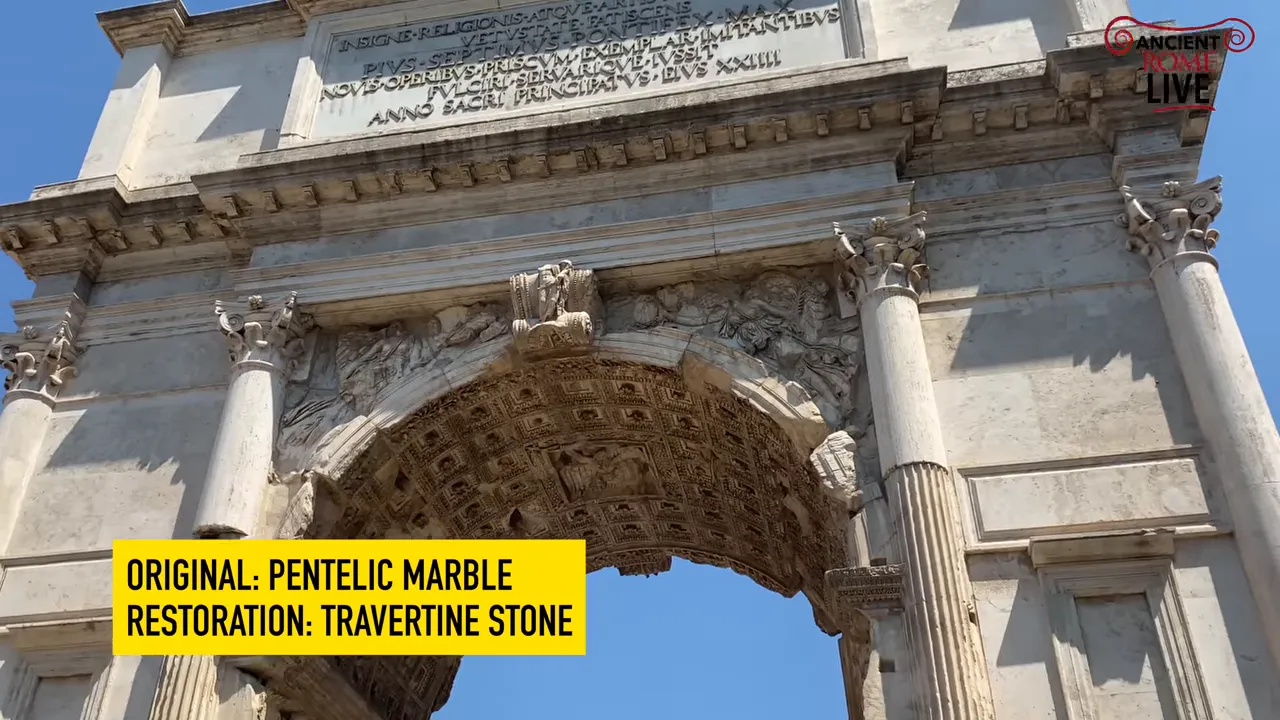
One side carries the original Roman inscription. The other carries the inscription of Pope Pius VII, recording the modern restoration. It is a wonderful reminder that ancient monuments often have long, messy, fascinating afterlives.
Reading the Exterior of the Arch
Before entering the Arch of Titus, look closely at its exterior decoration. Victories appear in the spandrels above the archway. The keystones carry divine figures. A small narrative frieze shows part of the triumphal procession.
Originally, the decorative program would have continued around the monument in full. Today, the surviving elements and reconstructed sections help us imagine the complete design.
The exterior feels orderly and ceremonial. But the real drama begins inside.
The Chariot Scene: Titus in Triumph
Inside the passageway, one relief panel shows Titus riding in a quadriga, a four-horse chariot. He is accompanied by the goddess Victoria, whose wings stretch behind him. This is no human performer in costume. The carving presents Victoria herself as physically present beside the emperor.
Another divine figure, Roma, leads the horses while looking back toward Titus. Beneath the chariot are symbolic figures representing the genius of the Roman people and the genius of the Roman Senate. The emperor is surrounded by divine and civic support.
This was a major artistic development in Roman historical relief. Gods and human beings appear together in the same event. The scene makes Titus’s military triumph feel larger than life, or rather, larger than mortal life.
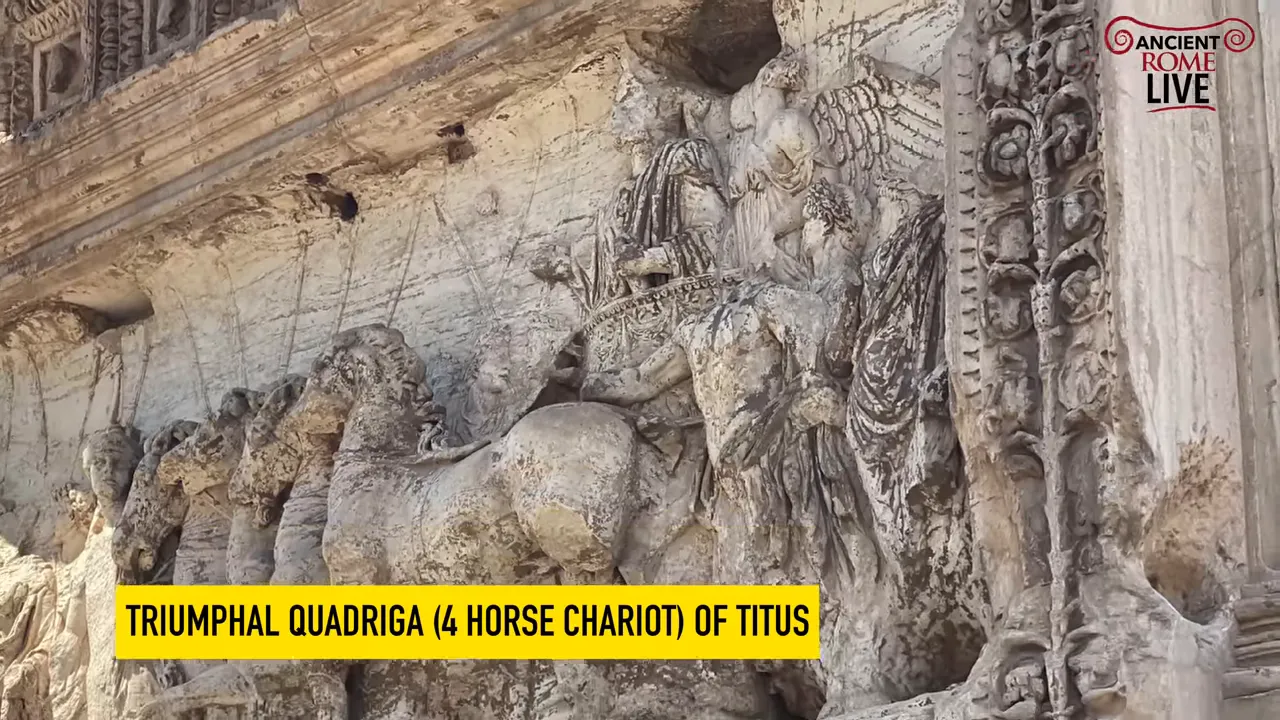
In the chariot relief, military victory becomes a divine event.
The Menorah, the Showbread Table & the Spoils of War
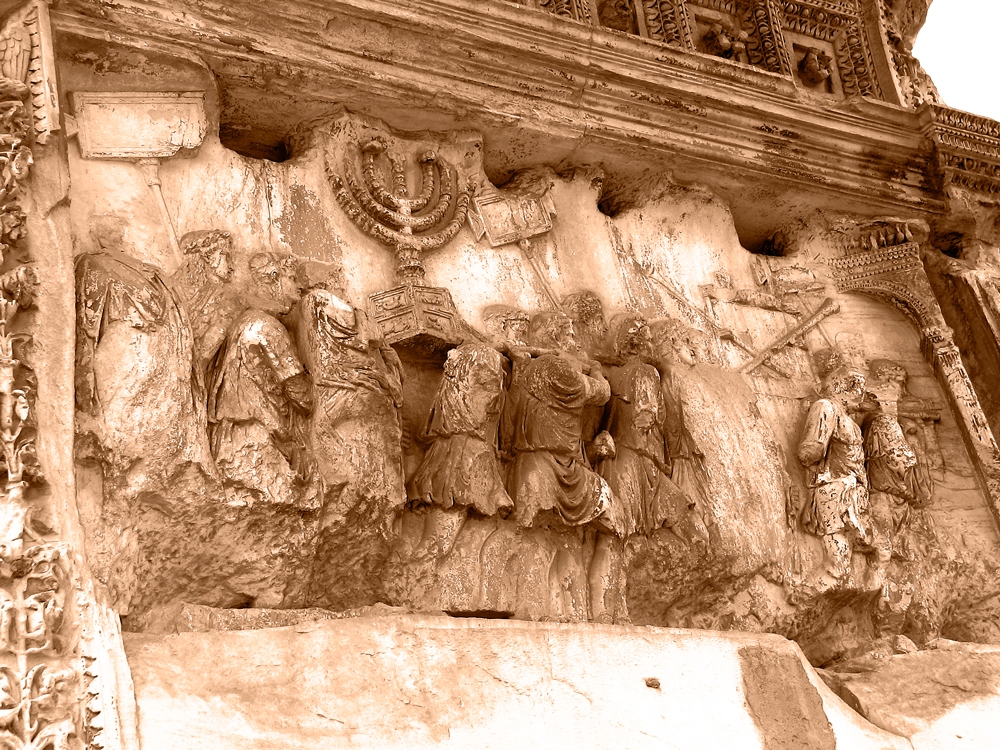
The opposite relief is among the most famous images from ancient Rome. Roman soldiers carry spoils from the Temple in Jerusalem during the triumph of AD 71.
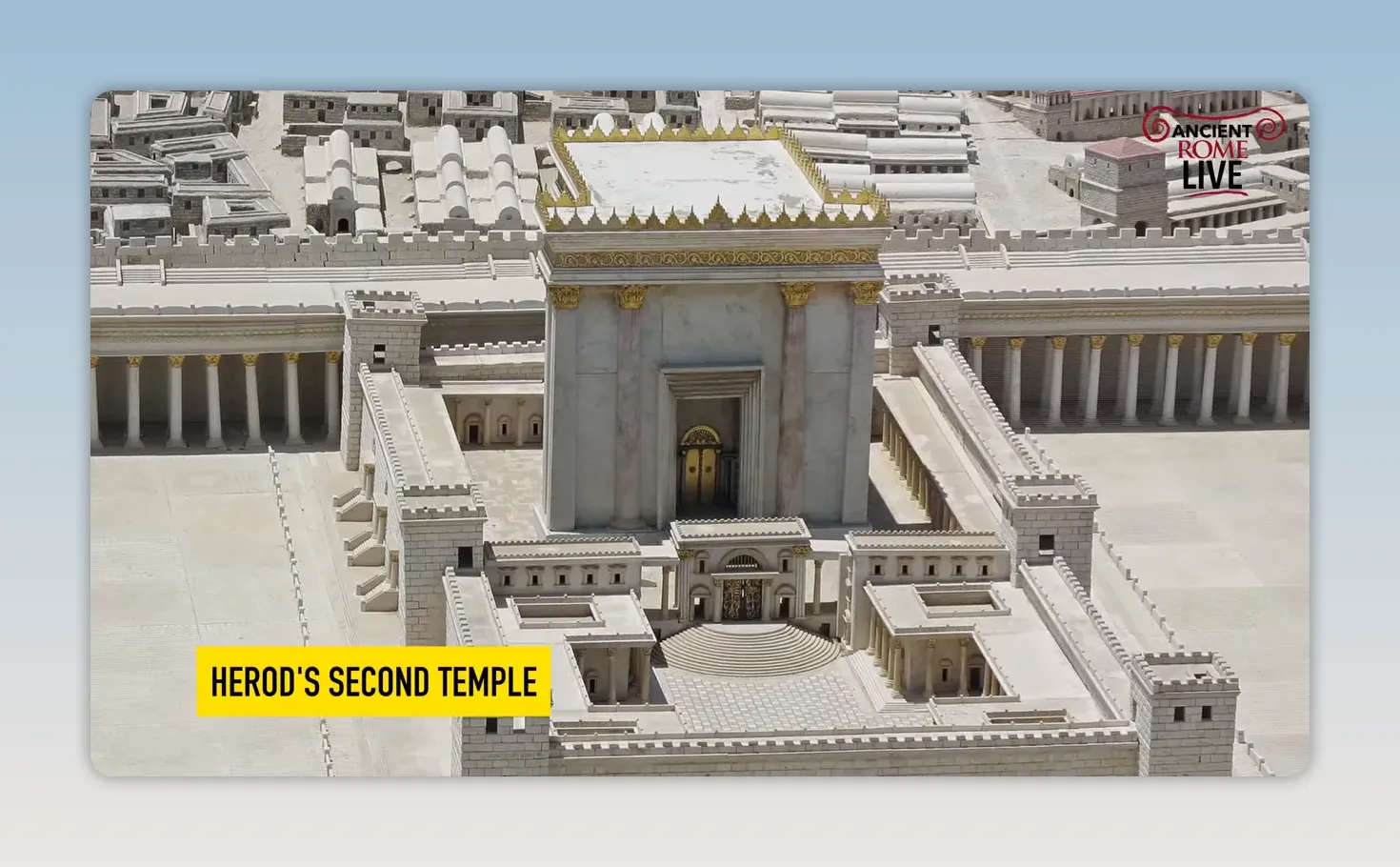
The most recognizable object is the seven-branched menorah. The panel also shows the table of showbread from the Second Temple. It was gilded, if not made of solid gold, and held deep religious importance. On the relief, however, these sacred objects are presented as trophies of Roman victory.
Soldiers carry the objects forward with placards that once would have displayed slogans. They pass beneath a representation of a triumphal arch, complete with two quadrigas and a single horse. That combination may reflect the triumph itself: Vespasian in one four-horse chariot, Titus in another, and Domitian on horseback.
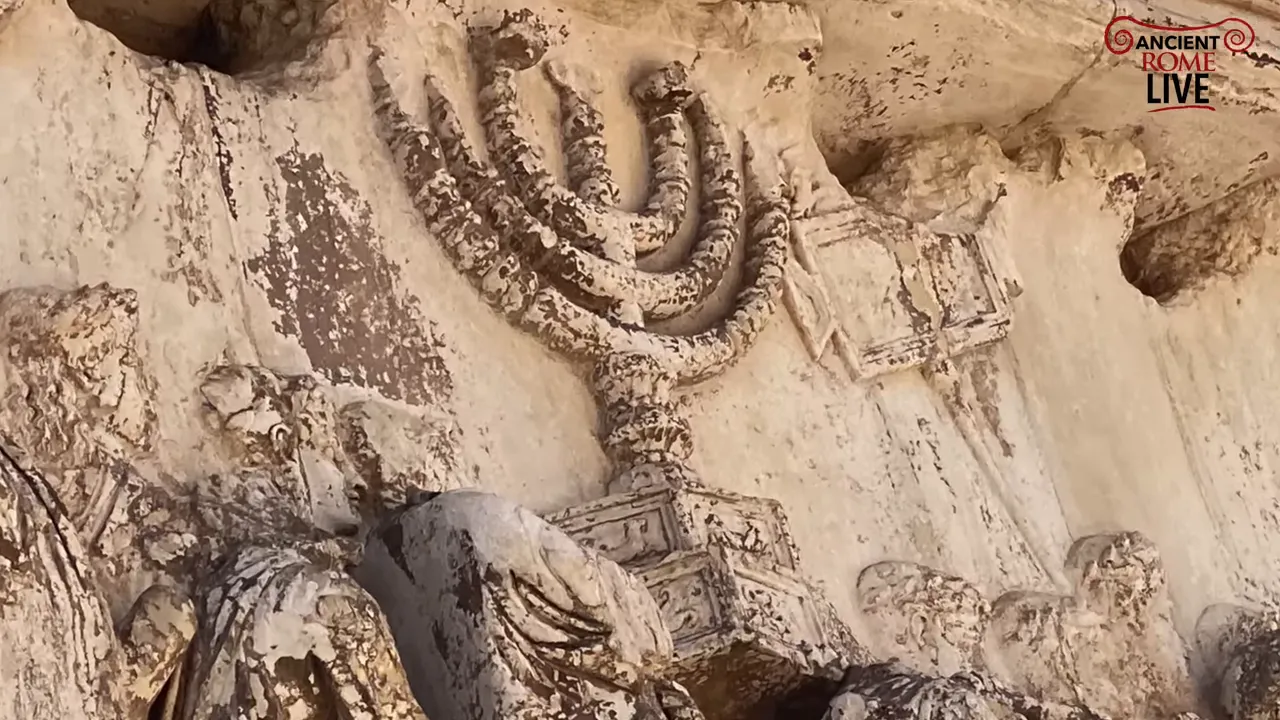
The Arch of Titus therefore preserves more than a Roman memory. It also preserves a visual record connected to ancient Judea and the religious meaning of the menorah.
The menorah panel is masterfully carved, historically important, and impossible to separate from the violence of conquest.
The Apotheosis of Titus
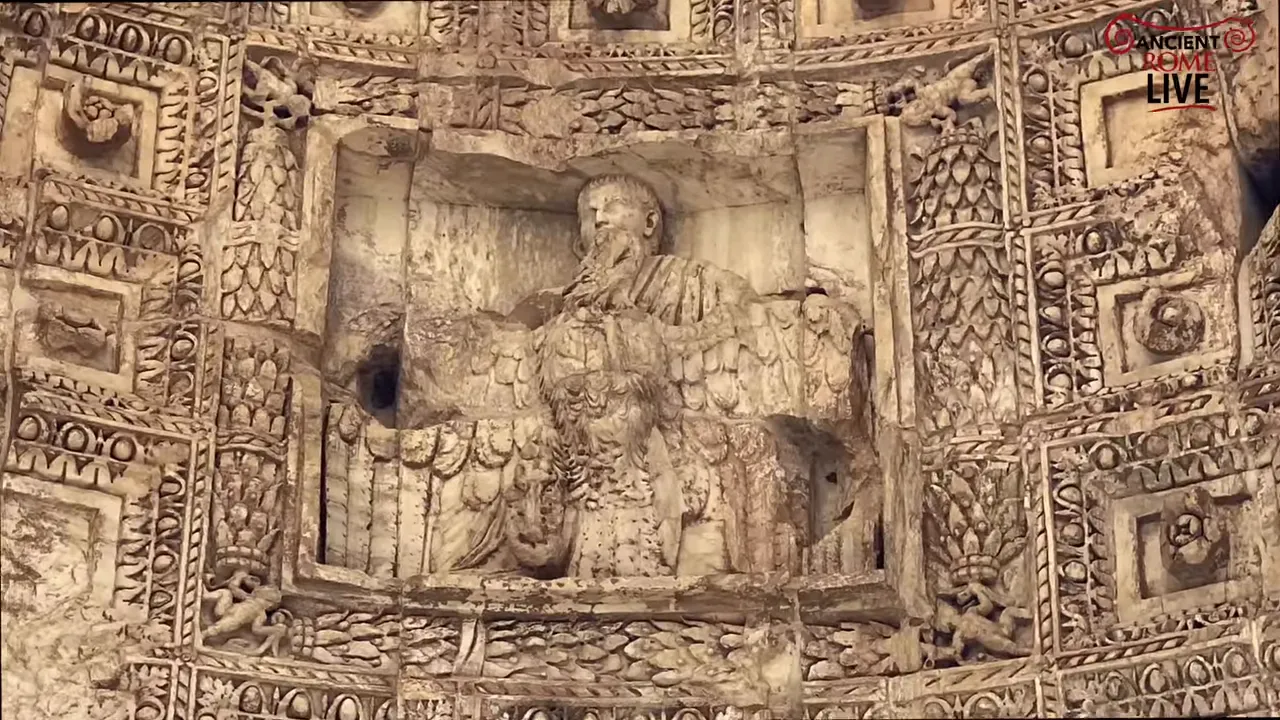
Look overhead in the vault of the Arch of Titus and another scene appears: the apotheosis of Titus. This is the moment of his deification.
In Roman funerary practice, an eagle could be released when an emperor’s funeral pyre was lit. The bird symbolized the emperor’s soul rising to the heavens. Here, Titus is shown physically ascending on the back of an eagle.
It is an extraordinary little image. The general who conquered Jerusalem is now becoming a god. This completes the monument’s message. Titus did not merely triumph in war. Through death and deification, he overcame mortality itself.
Why the Arch of Titus Still Matters
The Arch of Titus brings together the defining themes of the Flavian age: conquest, architecture, civic spectacle, family legitimacy, and divine rule. It also captures the brilliance of Flavian relief sculpture, where figures seem to push forward through space and history.
But the arch asks us to hold more than one idea at once. It is a beautiful work of Roman art. It is a monument to a short-lived emperor. It is a carefully planned statement by Domitian. And it is an enduring record of the Roman destruction of Jerusalem and the removal of sacred Jewish objects.
That complexity is exactly why the Arch of Titus remains so compelling. It is not frozen in one meaning. Its marble carries the memory of ancient Rome, ancient Judea, medieval change, nineteenth-century restoration, and the continuing significance of the menorah.
The Arch of Titus is a triumphal arch, a memorial arch, and a monument to the lasting power of historical memory.
Standing at the edge of the Roman Forum, the Arch of Titus still does what Domitian intended. It makes history feel immediate, monumental, and very much alive.
This article was created from the video Triumphal Arch of Titus | https://www.youtube.com/watch?v=POCW8QVjA28&t=32s with the help of AI.
Secrets of the Arch of Titus | BLP Connections: Rome | https://www.youtube.com/watch?v=dGJwBCM4JDY
Relief from the Arch of Titus, showing The Spoils of Jerusalem being brought into Rome | https://www.youtube.com/watch?v=2Pz_p8Tf24g
The Arch of Titus: Rome and the Menorah | https://www.youtube.com/watch?v=LOGWUJpWNSg
Jews in Rome sing Im Eshkachech Yerushalayim (If I forget you Jerusalem) under Arch of Titus | https://www.youtube.com/watch?v=hihNbtsv9r0
A postcard from Rome: Tisha b’Av at the Arch of Titus in Rome (English version) | https://www.youtube.com/watch?v=6IQ_waPBCMA
Arch of Titus | Bible Lands Museum | https://www.youtube.com/watch?v=-RywsHgh0GM
The Arch of Titus and the Temple Menorah From Jerusalem to Rome and back | https://www.youtube.com/watch?v=fqrst-VzZM4
Watch More: Jewish History...
- Abraham – One Man Chose a Different Path
- Timeline of Jewish History
- Tower of Babel & the Origin of Languages
- 1177 BC: How the First Globalized World Fell Apart
- Nineveh: The Greatest City Erased from History
- Babylon in 570 BC: Inside the City That Shaped the World
- Nebuchadnezzar, Solomon’s Temple & the Fire that Changed Jerusalem
- Hezekiah’s Tunnel: Faith, Fear & Water Beneath Jerusalem
- “Rivers of Babylon” Written in Exile 2600 Years Ago
- Nebuchadnezzar: The King Who Built Babylon, Lost Everything & Returned
- Secret of Jewish Survival & Esther’s Courage
- Canaan to Rome: The Ancient History of Israel
- Arch of Titus: Rome’s Monument of Triumph & Jewish Heartbreak
- Roman Empire: The Rise, The Madness, The Fall of a Civilization
- Fall of Rome: How the Ancient World’s Greatest Empire Changed Shape
- When Nations Turn Against Israel, What Happens to Them?
- ‘All Things Are Mortal But the Jew’ – Mark Twain
- 7 Wonders of Jewish History: A Story That Should Not Be Possible
- Samaritans: Last 800 Guardians of Mount Gerizim
- Amalek Command: Why It's Misunderstood
- PART 1 | The Land of Israel & Ottoman Palestine (HEB)
- Part 2 | The Land Reached Its Peak & Byzantine Palestine’s Demographic High Point (HEB)
- PART 3 | Arab Conquest: How the Land Gradually Became Muslim (HEB)
- 5000 Years of Jewish History (5-Min Clips)