When people hear 1177 BC, they often picture a date on a dusty timeline. But it marks something much bigger: the unraveling of a deeply connected world around the Mediterranean and ancient Near East.
This was the Late Bronze Age, roughly 1700 to 1200 BC. It was the age of New Kingdom Egypt, Hatshepsut, Akhenaten, and King Tut. It was also the age of the Mycenaeans, Minoans, Hittites, Assyrians, Babylonians, Cypriots, and Canaanites. These societies traded, exchanged royal brides, sent diplomats, and relied on one another for essential materials.
Then, around 1177 BC, that system began to come apart. Not in one dramatic afternoon. Not because of one villain. But through a messy pileup of drought, famine, migration, invasions, earthquakes, disease, political weakness, and broken supply chains.
The big lesson of 1177 BC is simple: connected systems can be wonderfully strong, right up until their connections become their weakness.Key Takeaways
- 1177 BC marked the breakdown of a highly interconnected Late Bronze Age international network.
- Drought, famine, migration, invasion, earthquakes, disease, and political instability compounded one another.
- Phoenicians and Cypriots transformed disruption into opportunity through trade, ironworking, and alphabetic writing.
- Resilient societies need redundancy, flexibility, innovation, water security, capable leadership, and social stability.
Key Takeaways
- 1177 BC marked the breakdown of a highly interconnected Late Bronze Age international network.
- Drought, famine, migration, invasion, earthquakes, disease, and political instability compounded one another.
- Phoenicians and Cypriots transformed disruption into opportunity through trade, ironworking, and alphabetic writing.
- Resilient societies need redundancy, flexibility, innovation, water security, capable leadership, and social stability.
Contents
- A Mediterranean World That Felt Surprisingly Modern
- Bronze, Gold & The Ancient Supply Chain
- The Sea Peoples Were Not the Whole Story
- The Perfect Storm Behind 1177 BC
- Earthquakes, Disease & Internal Revolt
- How Network Collapse Works
- After 1177 BC: Collapse, Transformation & Innovation
- The Winners & Losers Of The Collapse
- Seven Lessons From 1177 BC
- The Warning Signs Are Already Familiar
A Mediterranean World That Felt Surprisingly Modern
The Late Bronze Age was far more interconnected than most people realize. Think of it as an ancient G8, with major powers spread from Greece to Egypt and from Anatolia to Mesopotamia.
The Mycenaeans in Greece, Minoans on Crete, Hittites in Anatolia, Assyrians and Babylonians in Mesopotamia, Egyptians in the Nile Valley, Cypriots, Canaanites, and others all participated in the same broad network. They did not need to be direct neighbors to be connected. A Mycenaean could reach an Assyrian through a Hittite intermediary. That is a classic small-world network.
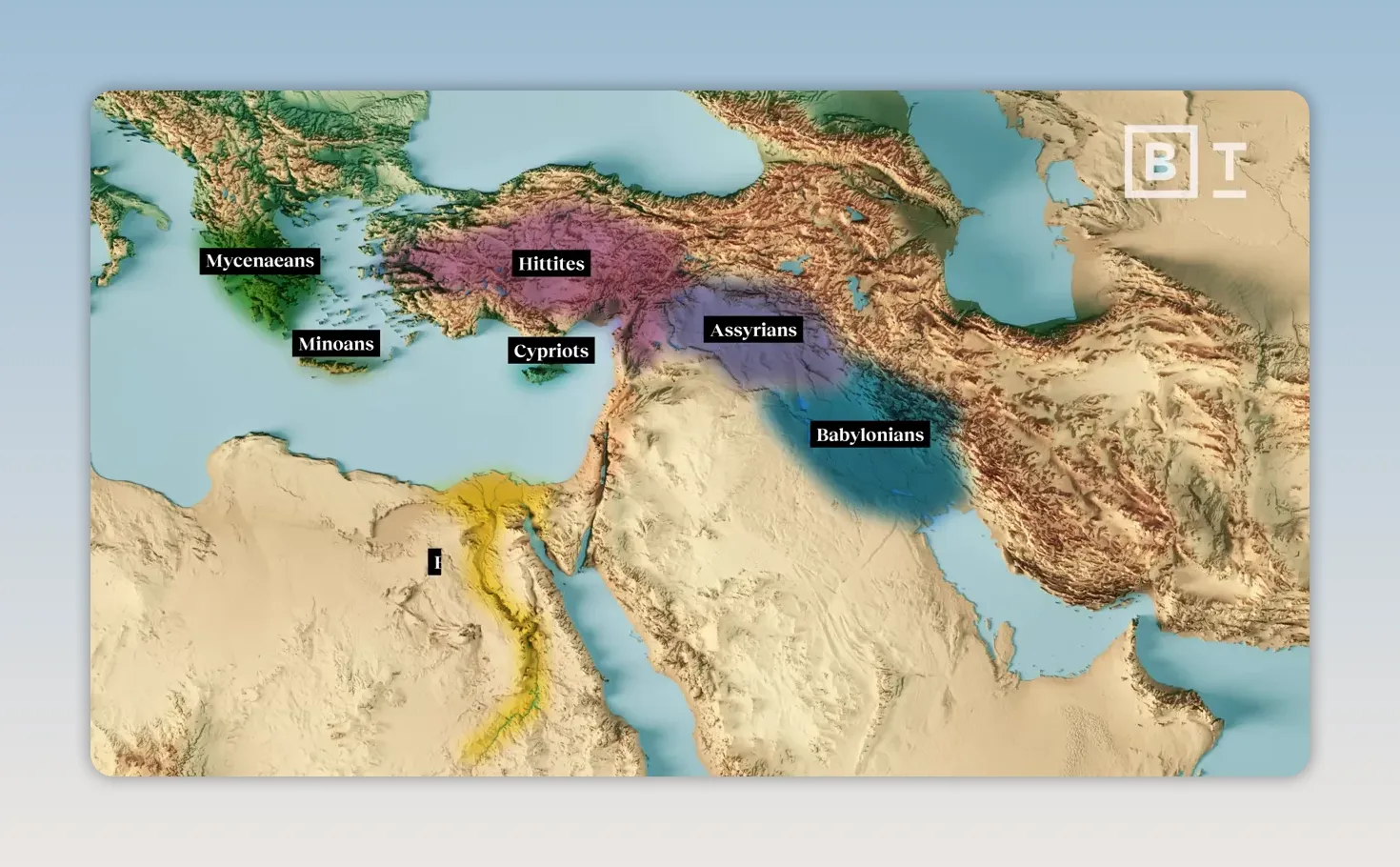
This is why 1177 BC matters. The people living then were not isolated little kingdoms bumping into each other once in a while. They had a system of commercial exchange, diplomacy, elite gift giving, and royal marriages that tied their fortunes together.
Globalization is not new. The technology changes, but dependence on distant people and distant resources is an old story.
And just as today, the network brought both prosperity and risk.
Bronze, Gold & the Ancient Supply Chain
None of the major powers was fully self-sufficient. Egypt controlled crucial sources of gold in Nubia. Cyprus supplied copper. Greece could provide silver. Tin arrived from far away, likely from multiple sources, with much of it originating in the Badakhshan region of modern Afghanistan.
That tin was not a luxury item. It was essential. Bronze is mostly copper mixed with about 10 percent tin. Cut off the tin, and bronze production becomes a major problem. No reliable bronze means trouble for tools, weapons, and the palace economies that organized production.
So the world before 1177 BC depended on long supply lines. Raw materials crossed huge distances. So did olive oil, wine, grain, leather goods, luxury objects, and elite gifts. One text even records leather shoes sent from Crete to Babylon for King Hammurabi, who apparently returned them. Why? Too small? Wrong style? We will never know. But the point is delightful and important: actual finished goods moved across the network too.
Diplomacy was just as intertwined. Great kings sealed agreements by marrying daughters into other royal houses. Egyptian pharaohs Amenhotep III and Akhenaten had wives from Mitanni and Babylonia. Treaties often had to be renegotiated when a new ruler came to power, and new marriages helped make those deals stick.
Trade, treaties, marriages, gifts, and raw materials were all part of the same international machine.
For centuries, that machine worked. The 14th and 13th centuries BC were, in many ways, the high point. But a tightly linked machine can also spread failure very quickly.
The Sea Peoples Were Not the Whole Story
For years, the simplest explanation for 1177 BC was that the Sea Peoples swept in and smashed the civilized world. Egyptian records from the reigns of Merneptah and Ramses III describe attacks in 1207 and 1177 BC by coalitions of outside groups. Modern scholars call them the Sea Peoples, although the Egyptians themselves gave individual group names.
Some names may hint at origins. The Shardana sound a little like Sardinia. The Shekelesh sound a little like Sicily. But those links remain uncertain. The one group that is more clearly identifiable is the Peleset, generally associated with the Philistines.
Archaeological evidence suggests that Philistine pottery resembled Mycenaean pottery in style but was made from local clay in Cyprus, Rhodes, and the Levant. That points to people from the Aegean moving east and settling in a new place.
The Sea Peoples may have been attackers, but they were also likely migrants searching for a safer, more livable future.
That distinction matters. If drought and hunger were pushing whole populations from their homes, then migration was not the root cause of collapse. It was part of the chain reaction. The Sea Peoples were not the lone monsters of 1177 BC. They may have been victims of a collapsing world too.
The Perfect Storm Behind 1177 BC
One cause is never enough to explain the Late Bronze Age collapse. The better explanation is polycausal. Several shocks hit close together, leaving societies no time to recover from one disaster before the next arrived.
The first major stressor was drought. Evidence now points to a mega-drought lasting at least 150 years and perhaps as long as 300 years. It appears in cave deposits, dry lakebeds, lagoons, riverbeds, pollen samples, and lake sediments across a huge area from Italy to Iran.
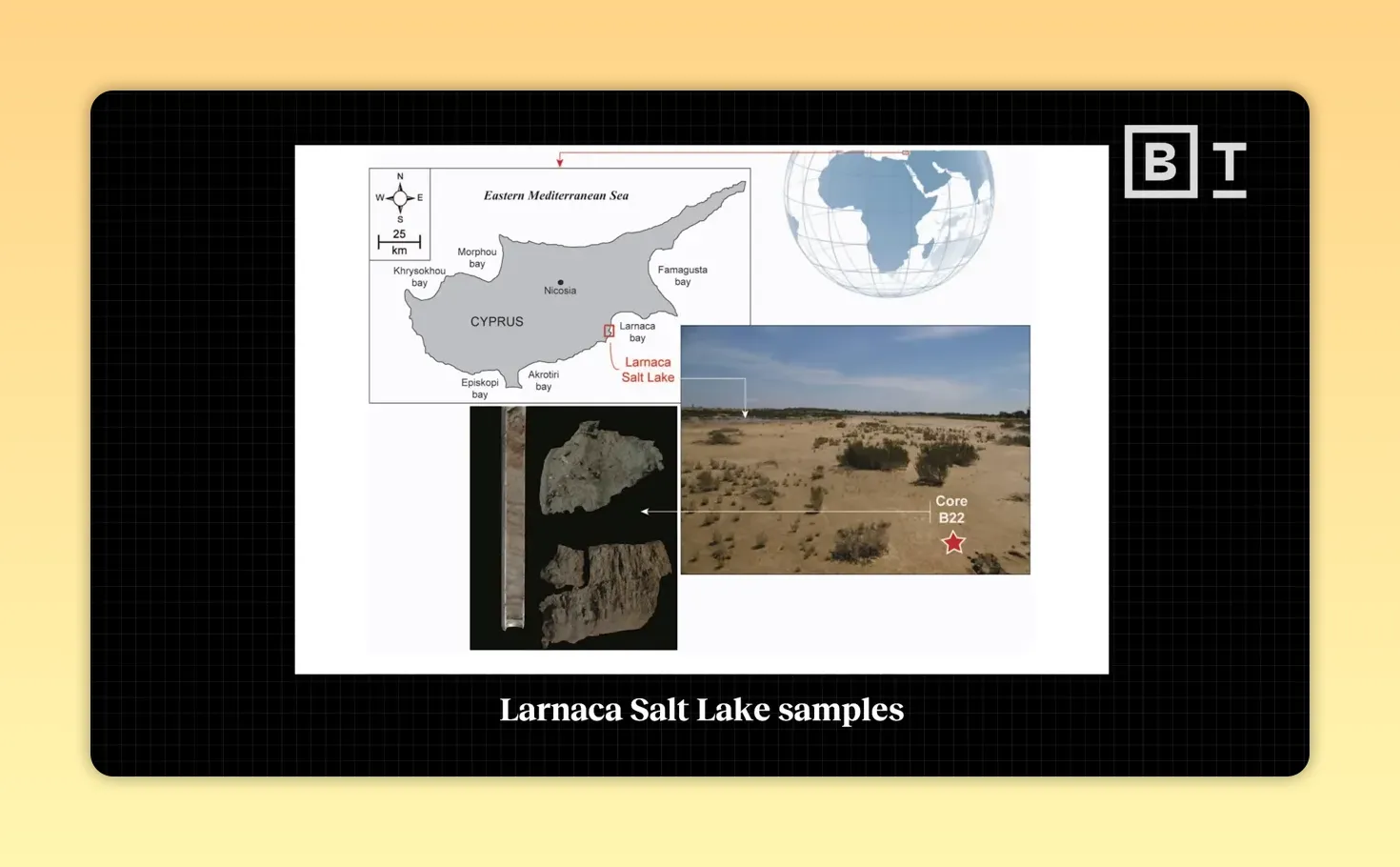
A drought that long brings famine right along with it. Texts from Ugarit, an important port in what is now Syria, plead for help because famine had struck the city. Hittite texts from Anatolia also describe hunger as a matter of life and death and ask Egypt to send grain. Egyptian relief shipments included grain and dried fish.
Then add migration. If the western Mediterranean communities were also suffering from drought, people may have left Italy, Sicily, Sardinia, and nearby regions in search of food and stability. But the eastern Mediterranean was struggling too. That turns movement into conflict very quickly.
And then there were invasions. A tablet from Ugarit warns that enemy ships had been sighted. Another says the enemy had landed, overrun a port city, and was moving toward Ugarit itself. Archaeology confirms a terrible end: destruction layers, arrowheads, bodies in the streets, and precious metals buried by people who never returned.
When drought becomes famine, famine becomes migration, and migration meets frightened societies already under stress, things can go bad in a hurry.
Earthquakes, Disease & Internal Revolt
Not every destroyed city was necessarily burned by invaders. Some may have been hit by internal rebellion. At Hazor, for example, the palaces and temples were burned while ordinary houses appear to have survived. That could suggest local people turned on institutions of power rather than an outside army burning everything in sight.
Some sites may have been damaged by earthquakes. The Aegean and eastern Mediterranean sit in a highly active seismic zone. Between roughly 1225 and 1175 BC, there may have been an “earthquake storm,” what seismologists today would call an earthquake sequence.
Troy VI is a striking example. Its walls and massive stones show signs consistent with earthquake destruction rather than battle. At Mycenae, archaeologists found a teenage girl crushed when her home collapsed, likely while she sought shelter in a doorway.
Disease belongs in the picture too. Epidemics often follow hunger, displacement, and disaster. A Hittite plague had devastated the royal family long before the main collapse. Then, after 1177 BC, Ramses V appears to have died from smallpox. Records describe an unusual delay in burials and the closing of the Valley of the Kings, something that looks remarkably like an early quarantine.
One problem might be survivable. Two are hard. By the third or fourth, a society can run out of room to maneuver.
How Network Collapse Works
The story of 1177 BC is not simply that individual kingdoms failed. The larger failure was the collapse of the network connecting them.
When copper from Cyprus, tin from distant regions, grain from Egypt, shipping routes, palace administration, and diplomatic relationships all depended on one another, trouble in one place could ripple outward. This is the multiplier effect. Each problem makes the next problem worse.
It is also a domino effect. If Cyprus cannot export copper, bronze production suffers elsewhere. If Ugarit falls, trade and communications through a key port are disrupted. If the Hittites fall at the same time, the network loses another major hub.
Computer modeling of the ancient network suggests that the simultaneous collapse of the Hittites and Ugarit could have been enough to break the larger system. Egypt and the Hittites collapsing together would also have been disastrous, but Egypt did not disappear. It struggled, withdrew, and endured.
Networks are often more resilient than they look. But when the wrong hubs fail at the wrong moment, everything changes.
This is what scholars call a systems collapse. Central governments weaken or vanish. Palatial economies fail. Elite structures lose their grip. Populations shrink through death and migration. Writing can disappear. Monumental building slows or stops. Life does not end, but the world people knew is gone.
After 1177 BC: Collapse, Transformation & Innovation
Was it really a collapse? Or was it a transformation? The honest answer is: both.
The international system collapsed after 1177 BC. But people did not simply vanish. Some societies disappeared as political entities, while survivors carried on in altered forms. The Hittite Empire ended, but Neo-Hittite states later appeared in northern Syria. Mycenaean palace society ended, but Greece was not empty. People kept farming, raising families, and rebuilding their lives under new conditions.
The centuries after 1177 BC are often called the first Dark Age. That label is too gloomy. Yes, many places suffered a steep drop in population, political organization, writing, and building. Linear B disappeared after the Mycenaean palace system fell.
But this was also a lively age of invention. Iron began replacing bronze as access to tin became difficult. The Phoenicians standardized an alphabet and carried it across the Mediterranean, helping shape both Greek and Latin writing. Cyprus helped spread ironworking technology.
An age that develops iron technology and spreads the alphabet is doing more than stumbling around in the dark.
Calling this era the Iron Age makes more sense. It describes a real technological shift without treating the people who lived through it as somehow less creative or capable.
The Winners & Losers of the Collapse
Not every society experienced 1177 BC in the same way. Some coped. Some adapted. Some transformed. Some disappeared.
- Phoenicians and Cypriots: The strongest performers. They flourished in the chaos, expanded trade, spread technologies, and were arguably anti-fragile.
- Assyrians and Babylonians: They adapted well. Their political and religious systems persisted, and they later became major imperial powers.
- Egyptians: Egypt survived, but it was no longer the towering New Kingdom power of Tutankhamun and Akhenaten. Rival rulers divided authority across the country.
- Mycenaeans and Minoans: Their palace systems broke down badly. Greece eventually rebuilt, but it took centuries.
- Hittites: The Hittite Empire did not make it. Internal divisions, environmental stress, and wider network failure proved too much.
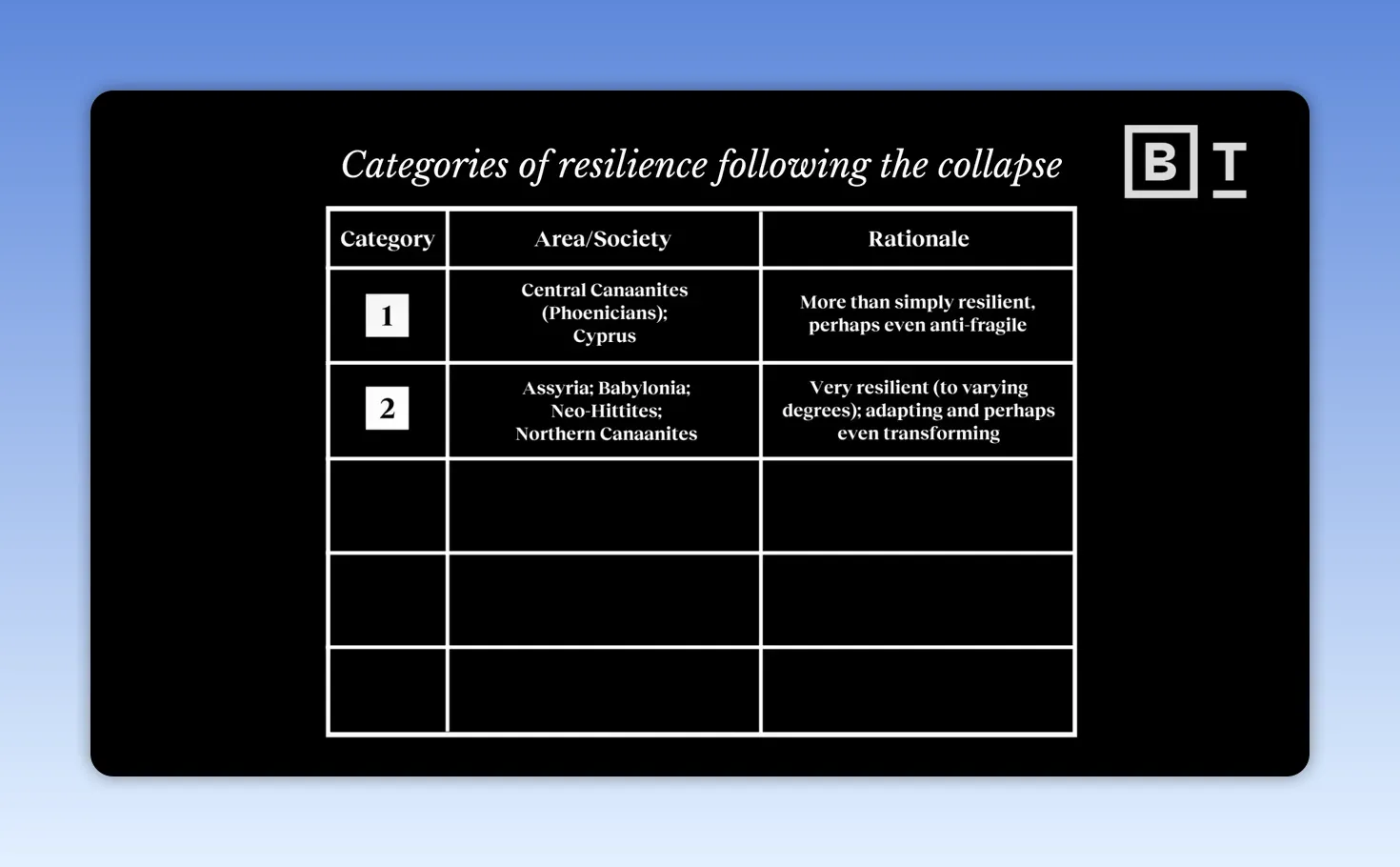
The Phoenicians are especially fascinating. With Ugarit destroyed and older powers weakened, they expanded throughout the Mediterranean. Chaos created opportunity. That is what “anti-fragile” means here: not just surviving stress, but finding ways to thrive because the old system has changed.
Seven Lessons From 1177 BC
The ancient world is not a crystal ball. But 1177 BC offers a useful warning about how complicated systems behave under pressure. Here are seven common-sense lessons.
- Build redundancy. Plan A is not enough. Societies need backups, alternatives, and multiple routes for essential supplies.
- Protect against invasion. Security still matters when people, resources, and borders are under stress.
- Know your allies. Self-sufficiency is useful, but isolation can be dangerous when crisis hits.
- Stay flexible. Rigid systems struggle when the world changes fast.
- Keep innovating. Iron replaced bronze because people found a new path when the old one became harder.
- Prepare for extreme weather. Long droughts can destabilize food, migration, trade, and political trust all at once.
- Keep working people from being crushed. Inequality and resentment can turn external pressure into internal rebellion.
The goal is not to pretend collapse cannot happen. The goal is to be ready to cope, adapt, and, ideally, transform.
Water deserves special attention. Egypt had the Nile. Assyria and Babylonia had the Tigris and Euphrates. The Hittites lacked a comparable major river system, and they were the one major power among those four that disappeared completely. Geography is not destiny, but it can be a massive advantage when drought arrives.
The Warning Signs Are Already Familiar
The point of 1177 BC is not that history repeats itself perfectly. It does not. But history often rhymes.
Supply-chain problems during the COVID pandemic showed how quickly shortages can spread through an interconnected economy. The ship stuck in the Suez Canal showed how a single blockage can disrupt trade far beyond a narrow waterway. Extreme weather, drought, disease, migration, political division, and pressure on vital resources are not ancient problems. They are current ones.
The scary part is not any single crisis. It is the possibility that several arrive together. A financial emergency, a pandemic, supply interruptions, and climate-driven disaster hitting at the same time could create the kind of multiplier effect that made 1177 BC so destructive.
No society is too large to fail. The real question is whether it will be fragile, resilient, or anti-fragile when the pressure comes.
That is the choice hidden inside the ruins of the Late Bronze Age. Do we become like the societies that could only cope from day to day? Or do we become more like the Phoenicians and Cypriots, ready to innovate, rebuild, and create something better from disruption?
The past does not hand us easy answers. Archaeology never does. New discoveries can change the story next year, next decade, or next century. But 1177 BC leaves us with one very useful habit: pay attention to warning signs before a system reaches its tipping point.
Know the past. Deal with the present. Build for the future.
RESOURCES:
This article was created from the video 1177 BC: The vanishing of the first globalized world | Eric Cline: Full Interview | https://www.youtube.com/watch?v=choxcHXhZhE with the help of AI.
Watch More: Jewish History...
- Abraham – One Man Chose a Different Path
- Timeline of Jewish History
- Tower of Babel & the Origin of Languages
- 1177 BC: How the First Globalized World Fell Apart
- Nineveh: The Greatest City Erased from History
- Babylon in 570 BC: Inside the City That Shaped the World
- Nebuchadnezzar, Solomon’s Temple & the Fire that Changed Jerusalem
- Hezekiah’s Tunnel: Faith, Fear & Water Beneath Jerusalem
- “Rivers of Babylon” Written in Exile 2600 Years Ago
- Nebuchadnezzar: The King Who Built Babylon, Lost Everything & Returned
- Secret of Jewish Survival & Esther’s Courage
- Canaan to Rome: The Ancient History of Israel
- Arch of Titus: Rome’s Monument of Triumph & Jewish Heartbreak
- Roman Empire: The Rise, The Madness, The Fall of a Civilization
- Fall of Rome: How the Ancient World’s Greatest Empire Changed Shape
- When Nations Turn Against Israel, What Happens to Them?
- ‘All Things Are Mortal But the Jew’ – Mark Twain
- 7 Wonders of Jewish History: A Story That Should Not Be Possible
- Samaritans: Last 800 Guardians of Mount Gerizim
- Amalek Command: Why It's Misunderstood
- PART 1 | The Land of Israel & Ottoman Palestine (HEB)
- Part 2 | The Land Reached Its Peak & Byzantine Palestine’s Demographic High Point (HEB)
- PART 3 | Arab Conquest: How the Land Gradually Became Muslim (HEB)
- 5000 Years of Jewish History (5-Min Clips)