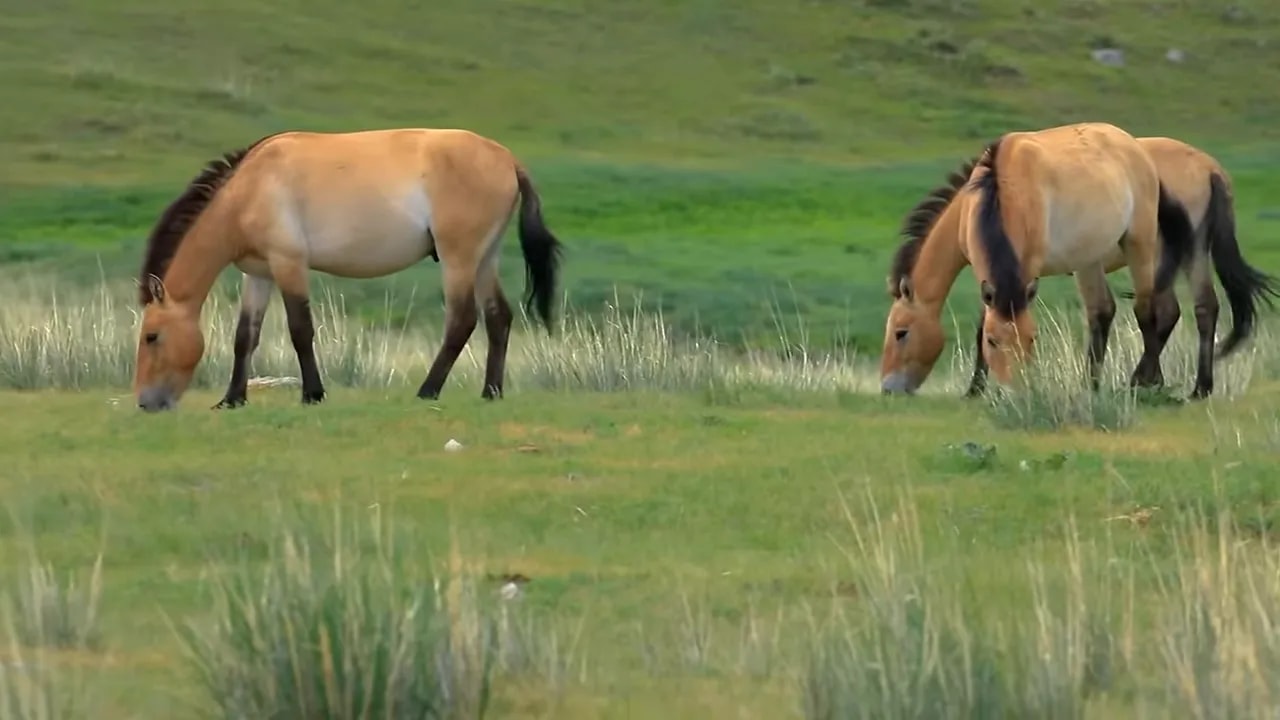
Przewalski’s horses are much more than rare, sturdy animals with a striking upright mane. They are the last living horse species never domesticated by humans, and their return to parts of Central Asia has become one of conservation’s most exciting experiments.
In carefully managed restoration areas, Przewalski’s horses can do something surprisingly powerful. Their grazing, movement, hooves, and manure may help damaged grasslands retain water, support plant growth, and sustain more wildlife. It is not as simple as putting horses in a desert and hoping for magic. But when the habitat, herd size, protection, and long-term monitoring are right, these horses can become major partners in the ecosystem.
Takeaways
- Przewalski’s horses are the only surviving horse species never domesticated by humans.
- Their hoof action, grazing, and manure can support the recovery of soil, plants, and wildlife.
- Responsible reintroduction requires habitat planning, genetic management, and long-term monitoring.
- Restoring native animals can rebuild ecosystem processes that technology cannot easily replace.
What Are Przewalski’s Horses?
Przewalski’s horses are wild equines native to the grasslands and semi-desert regions of Central Asia. They are often called the world’s last truly wild horses because, unlike feral mustangs or brumbies, they were never bred from domestic horses that later escaped or were released.
They look noticeably different from many familiar horse breeds. Przewalski’s horses are compact and powerfully built, with a dun-colored coat, a pale muzzle, dark legs, faint striping, and a short mane that stands straight up.
Quick distinction: A feral horse has domestic ancestors. Przewalski’s horses are a separate wild horse lineage.
Another key difference is genetic. Przewalski’s horses have 66 chromosomes, while domestic horses have 64. That does not make them relics frozen in time, but it does underline how distinct they are from the horses bred for riding, racing, farming, or work.
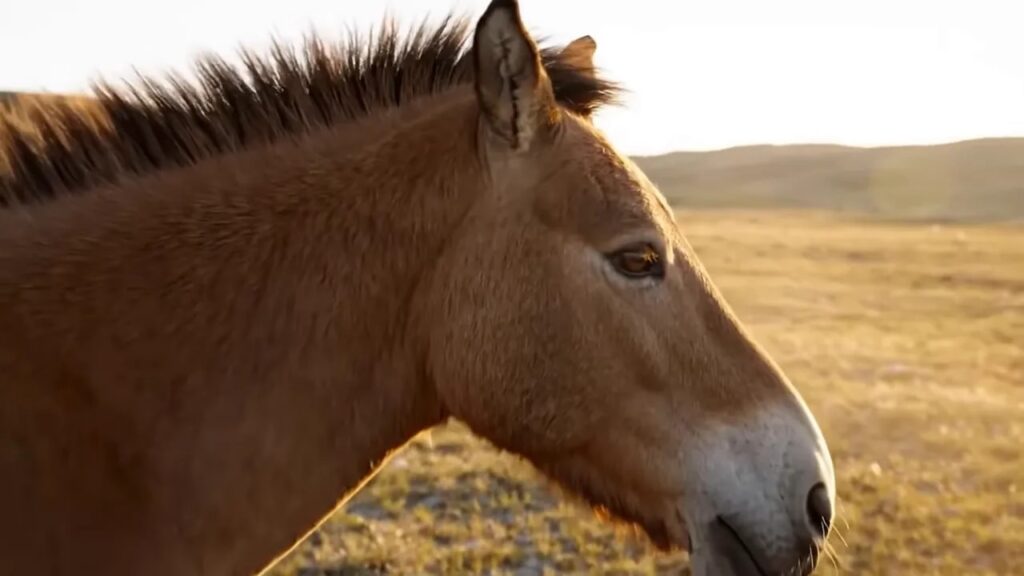
The short, upright mane and dun coat are classic features of Przewalski’s horses.
Why Przewalski’s Horses Nearly Disappeared
By the late twentieth century, Przewalski’s horses had disappeared from the wild. The global population survived only in captivity, following a severe genetic bottleneck. The remaining animals descended from a very small number of founders captured around the turn of the twentieth century.
After World War II, the population reportedly fell to as few as 31 horses, with only 9 capable of breeding. That is an incredibly narrow lifeline for an entire species.
Zoos and breeding centers in Europe and North America became essential to the survival of Przewalski’s horses. Careful studbook management helped conservation teams choose breeding pairs that preserved as much genetic diversity as possible and reduced the risks of inbreeding.
Saving a species in captivity is only the first step. The bigger challenge is helping it thrive again in a functioning wild ecosystem.
That second step requires patience. Animals born behind fences may need time in large semi-wild areas before they can handle harsh weather, find food and water, form stable social groups, and avoid danger without constant human support.
Why Reintroducing Wild Horses Matters
Przewalski’s horses are not simply passengers in a landscape. They can act as ecosystem engineers. That means their everyday behavior changes habitat conditions in ways that affect plants, soils, insects, birds, mammals, and predators.
In dry grasslands, life depends on tiny advantages. A shallow hoof mark can collect rain. A patch of grazed grass can regrow differently. A pile of manure can move nutrients and seeds. Put thousands of these little changes together over time, and the landscape may begin to behave differently.
Healthy grasslands are not empty spaces. They are busy systems shaped by grazing, movement, weather, soil organisms, and countless small interactions.
The reintroduction work in Xinjiang, China, followed a staged model: imported horses were acclimated at a breeding center, moved into extensive semi-wild enclosures, and later released into the Kalamaili Nature Reserve. This gradual approach matters because it gives a small founder population a better chance to adapt before full release.
How Przewalski’s Horses Help Restore Land
The restoration story centers on three connected processes: hoof action, grazing patterns, and seed dispersal. None of these works in isolation. Together, they can make dry ground more biologically active.
Hooves Can Help Rain Soak into Hard Ground
Severely degraded soil can develop a hard crust. When rain hits that surface, water may run away rather than soak in. Seeds struggle to root, and plants cannot easily return.
As Przewalski’s horses walk, graze, and travel across the landscape, their hooves can break up compacted surface layers and leave small depressions. Those hoofprints can catch water during scarce rainfall events.
In the reported restoration results, grazed areas showed greater moisture retention because hoof marks created numerous small collection points across the ground. That moisture gives dormant seeds and recovering plants a better shot at growing.
Think small: One hoofprint is tiny. Thousands of hoofprints spread across a habitat can change how water moves through the soil.
This does not mean every kind of trampling is helpful. Too many animals in too small an area can damage vegetation and compact soil further. The benefit depends on appropriate herd density, room to roam, and habitat management.
Grazing Creates a Patchwork of Habitats
Przewalski’s horses do not graze every spot in exactly the same way. They move through the landscape, feeding intensively in one area before shifting elsewhere. This creates a mosaic of short grass, taller grass, bare ground, and recovering vegetation.
That variety is good news for biodiversity. Different insects, birds, and small mammals use different vegetation heights and ground conditions. A uniform grassland offers fewer options. A patchwork landscape offers many more niches.
Grazing can also trigger compensatory growth in grasses. When grazing is not excessive, some grasses regrow vigorously after being clipped. In the early restoration findings described for the Xinjiang project, biomass in grazed areas was reported to be higher than in ungrazed comparison plots.
Manure Moves Seeds & Nutrients
It may not be glamorous, but manure is a big part of the ecological story. Przewalski’s horses eat plants in one place, travel, and deposit nutrients and seeds somewhere else. Their dung can carry viable seeds from many plant species.
The trip through the digestive system may also help some seeds germinate by weakening hard seed coats. And the manure itself provides a nutrient-rich place for seedlings to get started.
In the reported field findings, horse dung contained viable seeds from more than 20 plant species. Dung also supports insects such as dung beetles, which bury organic material and further improve soil.
What looks like waste can be a mobile package of seeds, nutrients, microbes, and future plant life.
That is why Przewalski’s horses can connect fragmented plant populations. Their daily movement carries seeds across terrain where plants might otherwise remain isolated.
What Happened After Horses Returned to Xinjiang?
The early years were difficult. Przewalski’s horses, brought from captivity, faced parasites, harsh winters, deep snow, limited water, and unfamiliar terrain. Some animals suffered frostbite, and breeding losses occurred.
But the herds also began showing behaviors needed for survival in a cold, dry landscape. They broke ice to reach water, dug through snow for grass, used sheltered slopes during storms, and selected warmer south-facing areas for bedding.
As the population settled, ecological changes were reported. Grass species began appearing in grazed areas. Soil moisture retention increased. Nitrogen levels rose as manure and soil life returned to the system. Insects, birds, small mammals, and predators followed the recovering vegetation.
By 2023, the source material reports that the original group of 11 horses had grown to 534 in the broader program area. It also reports that restoration zones used by the horses showed a retreat of desertification and an expansion of vegetation patches.
The important lesson is not that horses can fix every dry landscape. Restoring a missing native species can restart ecological processes that people cannot easily replicate with machines.
Can Przewalski’s Horses Survive Extreme Winters?
Yes, Przewalski’s horses are adapted to a tough continental climate, but survival is never guaranteed. Their native range includes intense seasonal swings, with hot summers and extremely cold winters.
Winter success depends on access to forage, water, sheltering terrain, social behavior, and enough space to move. The horses grow dense winter coats and use group behavior to reduce exposure during severe weather.
Still, reintroduction teams cannot assume captive-bred horses will immediately cope with every condition. Acclimation areas, veterinary oversight, disease management, careful release timing, and monitoring are all part of responsible conservation work.
Why Managed Grazing Beats a Simple Release
A common misunderstanding is that conservation means opening a gate and walking away. Successful reintroduction is much more thoughtful than that.
Before bringing Przewalski’s horses into an area, conservation teams need to consider:
- Habitat quality: Is there enough food, water, cover, and seasonal range?
- Herd size: Can the land support the animals without overgrazing?
- Genetic planning: Are breeding decisions protecting diversity?
- Disease risk: Are parasites and livestock diseases being tracked?
- Protection: Is the herd safe from poaching, disturbance, and harmful development?
- Monitoring: Can teams measure horse health, births, movement, vegetation, and other wildlife?
GPS collars, camera traps, field surveys, and regular population checks help managers understand whether the horses are using the landscape as expected. Those tools also help reveal problems early.
What Other Reintroduction Projects Can Learn
The return of Przewalski’s horses offers a hopeful idea for restoration: sometimes the missing piece is not another engineered structure. Sometimes it is the animal that evolved with the place.
Similar projects have been pursued in Mongolia, where horses were released in Hustai National Park, and in Kazakhstan through efforts to restore wild horses to the Golden Steppe. Each location has its own climate, land use pressures, predators, and conservation challenges. So no project should copy another without adapting the plan.
Still, the core principle travels well. Native grazers can help shape vegetation, move nutrients, spread seeds, and support food webs. Bison, wolves, elephants, whales, and other large animals can also have outsized effects on their ecosystems.
Conservation works best when it restores relationships, not just animal numbers.
The Future of Przewalski’s Horses
The future of Przewalski’s horses depends on more than population growth. A herd can increase in number yet remain vulnerable if genetic diversity is low, habitat is fragmented, or human pressure increases.
China’s reported long-term goal is to expand the Kalamaili reserve and support 2,500 wild horses by 2040. If that happens, the horses could help restore a much larger area of degraded land while strengthening the species’ place in its historic range.
That would be a huge conservation milestone. More importantly, it would show what can happen when restoration goes beyond planting trees or building barriers and instead rebuilds the natural processes that sustain grasslands.
Takeaway: A Wild Horse with a Big Job
Przewalski’s horses survived one of the closest calls imaginable. From a tiny captive population, they have returned to protected landscapes where their presence may help land recover from degradation.
They do not restore ecosystems through one dramatic act. They do it hoofprint by hoofprint, grazing patch by grazing patch, and seed by seed. That slow work is exactly what makes it so powerful.
For anyone interested in wildlife conservation, desertification, or grassland restoration, Przewalski’s horses offer a bright reminder that nature already has some remarkably skilled engineers.
Are Przewalski’s Horses the Same as Mustangs?
No. Mustangs are feral horses descended from domestic horses, while Przewalski’s horses are a distinct wild horse species that was never domesticated.
Where Do Przewalski’s Horses Live Today?
Przewalski’s horses live in protected and managed areas in Central Asia, including reintroduction sites in China and Mongolia. Additional restoration efforts have also been developed in Kazakhstan.
Why Do Przewalski’s Horses Have Upright Manes?
Their short, upright mane is one of their characteristic physical features. It gives them a very different silhouette from many domestic horse breeds with long, falling manes.
Do Przewalski’s Horses Help Stop Desertification?
In suitable, carefully managed grassland and semi-desert habitats, they may support recovery by
- Improving water infiltration
- Spreading seeds
- Recycling nutrients
- Maintaining varied vegetation
They are not a universal solution for every desertified landscape.
RESOURCES:
This article was created from the video China Released Horses Into a Barren Desert With No Grass — What Happened Next | https://www.youtube.com/watch?v=55cPLrfV5iM with the help of AI.
WIKIPEDIA: Przewalski’s horse – https://en.wikipedia.org/wiki/Przewalski%27s_horse
PHOTOS & VIDEOS Use According to Section 27 A