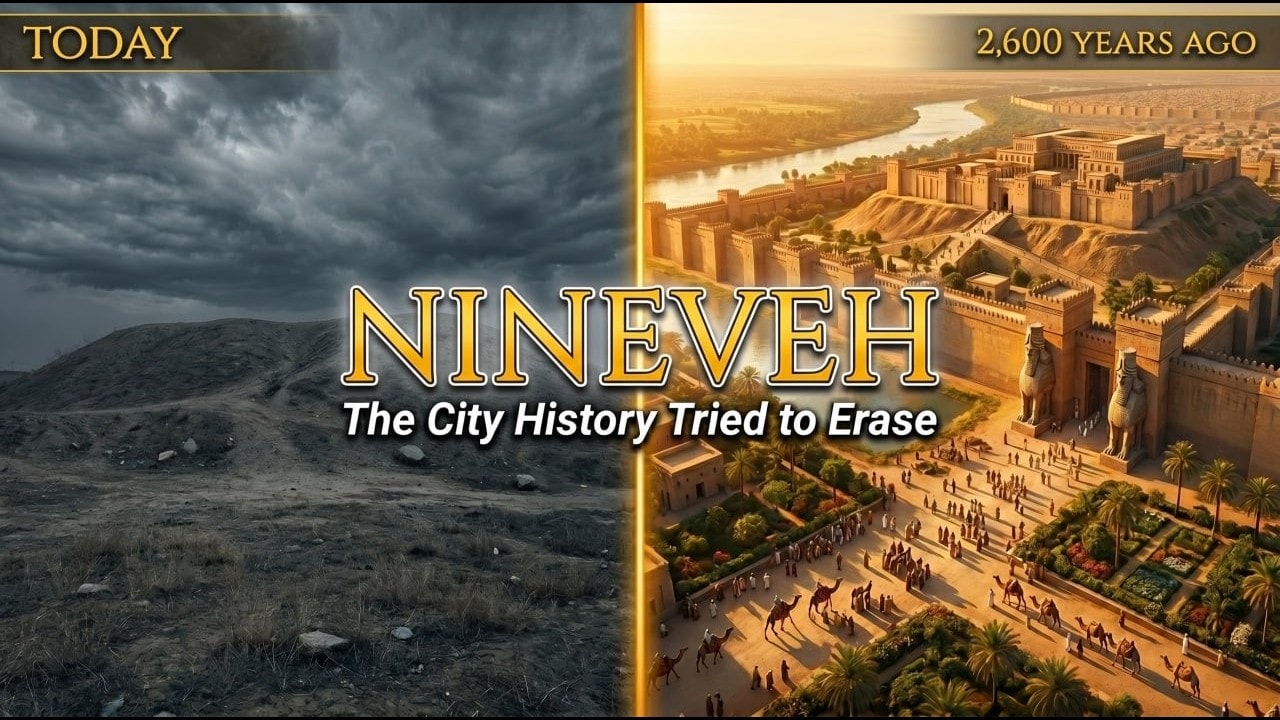
On the outskirts of Mosul in northern Iraq, there is a low, crumbling mound of dirt. It is easy to pass without giving it a second thought. But beneath that earth lies Nineveh, once the largest, richest, most terrifying city in the world.
At its height, around 2,500 years ago, Nineveh had a population of roughly 100,000. Its walls ran for 12 kilometers. Its palace was covered in miles of carved stone stories. Its library preserved thousands of clay tablets, including the Epic of Gilgamesh, the oldest surviving great work of literature.
Then, in 612 BC, this giant was destroyed in just three months.
Nineveh was a city of stunning achievement, built on shocking suffering. Both things are true at once.
Takeaways
- Nineveh grew from an ancient sacred settlement into the Assyrian Empire’s immense capital.
- Sennacherib transformed Nineveh with walls, canals, gardens, roads, and the Palace Without Rival.
- Ashurbanipal’s library preserved over 30,000 tablets, including the Epic of Gilgamesh.
- The 612 BC destruction of Nineveh erased the city, but fire helped preserve its clay tablet library.
A City Older Than History
To understand Nineveh, start with Mesopotamia, the land between the Tigris and Euphrates rivers. This was one of the great cradles of civilization. Cities, writing, temples, markets, governments, and organized trade all took shape here very early.
Nineveh stood on the eastern bank of the Tigris. People had settled at the site by around 6000 BC. That means it had already been inhabited for thousands of years before the Assyrian Empire made it famous.
Its earliest importance was religious. Nineveh was sacred to Ishtar, the goddess of love, war, and fertility. Her temple, E-mashmash, drew pilgrims, merchants, and caravans from far away. Trade followed devotion. And little by little, a holy place became a serious city.
Over centuries, Akkadians, Babylonians, Hittites, and Hurrians controlled the area at different times. Each group left something behind. In Mesopotamia, old cities were often not cleared away. New buildings simply rose over old ones.
That is why the main mound at Nineveh, called Kuyunjik, rose about 20 meters above the surrounding plain. It was not a natural hill. It was a tell, built from compressed layers of human life, mud brick, walls, streets, temples, and homes.
Under the mound were the remains of thousands of years of people building, rebuilding, and refusing to disappear.
How Assyria Built a Machine of Conquest
The Assyrians did not begin as unstoppable conquerors. For much of the second millennium BC, they were a smaller northern Mesopotamian power squeezed between larger rivals. But they learned from every defeat.
Over time, Assyria created something unusual for the ancient world: a professional, year-round military. Other states often relied on farmers called up for a campaign and then sent home for harvest. Assyria built specialized units of heavy infantry, cavalry, chariots, engineers, and siege experts.
Iron weapons helped. So did the willingness to invest in the ugly work of breaking walls, taking cities, and making resistance feel hopeless before an army even arrived.
Under Ashurnasirpal II, who ruled from 883 to 859 BC, terror became a deliberate political tool. His own royal inscriptions described atrocities against defeated enemies. They were not hidden. They were advertised. The message was brutally simple: surrender now, or suffer later.
His successors pushed even farther. Tiglath-Pileser III reformed the empire and used mass deportation as a weapon of control. Entire communities were uprooted, moved across great distances, and mixed with other displaced people. It made coordinated regional resistance far harder.
When Sargon II conquered Samaria in 722 BC, tens of thousands of people from the northern Israelite kingdom were deported into Assyrian and Media territory. This catastrophe sits behind the biblical memory of the lost tribes of Israel.
Assyria did not merely win battles. It broke the social roots that let conquered communities organize again.
That vast empire needed a capital with the same energy: intimidating, dazzling, and impossible to ignore. That capital would become Nineveh.
Sennacherib Rebuilds Nineveh
Sargon II had built a new capital called Dur-Sharrukin. But in 705 BC, he was killed in battle, and his body was never recovered. In Assyrian belief, that was a deeply troubling sign. A king without a body could not receive a proper burial or complete his journey to the afterlife.
His son Sennacherib saw disaster in the making. He abandoned Dur-Sharrukin, moved the royal center about 20 kilometers south, and chose Nineveh instead. It was ancient, sacred, and already established. Then he turned it into something enormous.
Sennacherib enclosed Nineveh with walls about 12 kilometers long and nearly 25 meters thick in places. Fifteen massive gates punctuated the defenses, each named for an Assyrian deity. This was a city built to endure attack and project raw confidence.
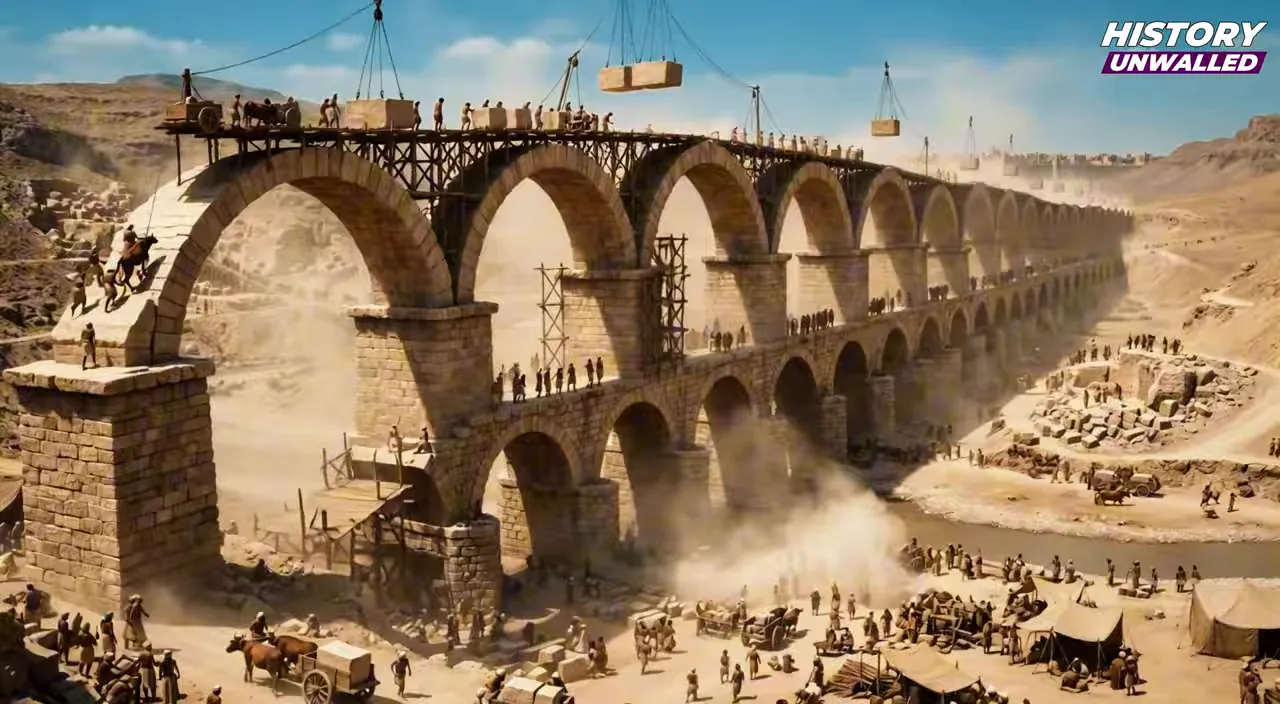
He also transformed the landscape around the city. Eighteen canals helped bring water from the hills toward Nineveh. At Jerwan, roughly 65 kilometers upstream, an aqueduct required more than two million stone blocks and used a true arch. Parts of it still stand.
And Sennacherib did not stop at practical infrastructure. He planted parks and orchards with plants gathered from across the empire. He imported animals such as lions, bears, and ostriches. Nineveh was supposed to contain a version of the whole known world.
Wide roads were a royal priority too. Sennacherib’s law for anyone whose new building intruded on a royal road was grotesque but effective. The roads stayed wide.
The Palace Without Rival
At the heart of Nineveh stood Sennacherib’s great palace, which he called the Palace Without Rival. This was not casual royal bragging. The complex had a main access route around 500 meters long and at least 80 rooms.
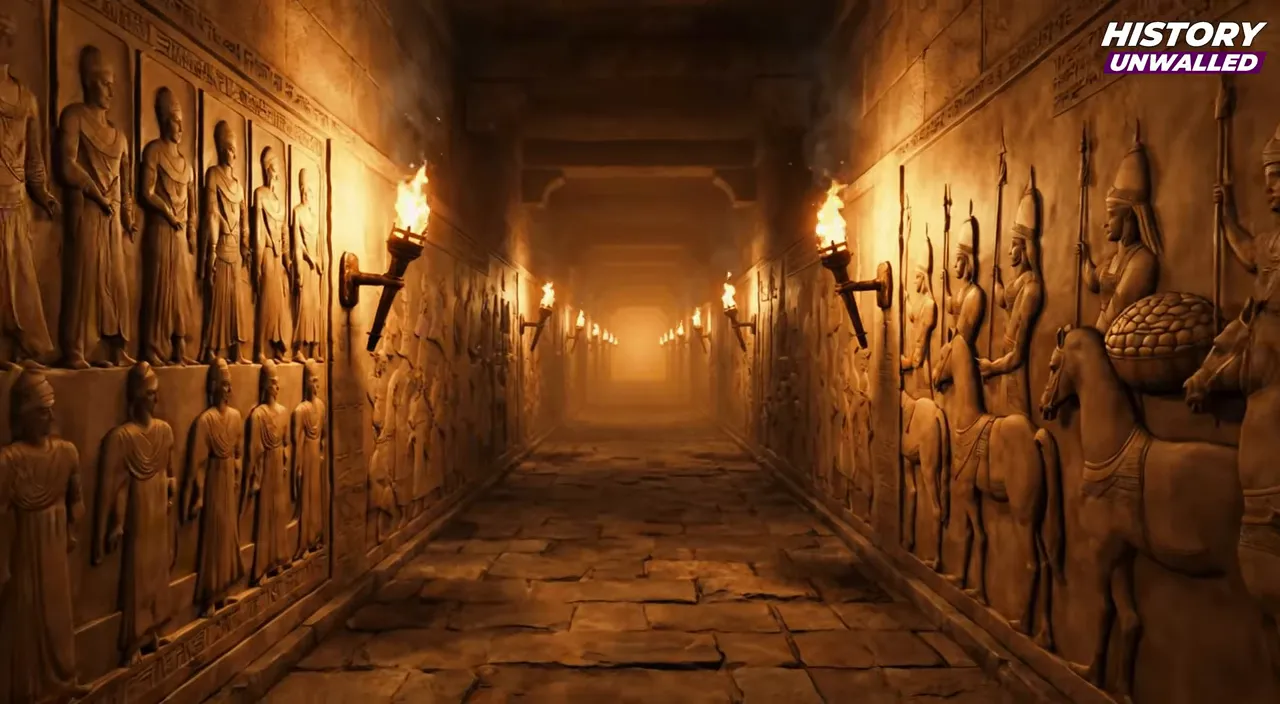
The entrance featured bronze columns resting on bronze lions and bulls, each reportedly weighing 43 tons. Inside, nearly three kilometers of stone reliefs covered the walls. They showed warfare, hunting, construction, royal ceremony, and conquest in obsessive detail.
At the throne room stood the Lamassu, giant winged bulls with bearded human heads. About four meters tall, they were guardian spirits. They were also a statement. Walk through this doorway and feel small.
Everything in the Palace Without Rival was built to make power feel physical.
There may be one more wonder connected to Sennacherib’s Nineveh. Historian Stephanie Dalley has made a serious case that the famous Hanging Gardens, traditionally placed in Babylon, may actually have stood here. No clear archaeological evidence for them has been found in Babylon, while Nineveh had the waterworks, gardens, and royal ambition to fit ancient descriptions.
The idea is debated, not proven. But if it is right, one of antiquity’s most famous wonders may be buried beneath the soil of Nineveh.
Life Inside the World’s Largest City
At its peak, Nineveh covered roughly 1,800 acres. It sat at the crossroads of major north-to-south and east-to-west trade routes. Its streets would have been loud, crowded, and packed with languages: Akkadian, Aramaic, Hebrew, Elamite, Egyptian, and more.
There were scribes writing contracts and official records on clay tablets. There were temple rituals, workshops, taverns, markets, homes, animals, carts, and merchants moving through dense streets. Markets were even held atop the huge city walls.
But this lively picture has a hard edge. Much of Nineveh’s grandeur depended on forced labor. Deportees from Israel, Babylonia, the Levant, and many other conquered lands built, maintained, and served the imperial capital.
Some palace reliefs appear to show Judean captives hauling Lamassu statues. Sennacherib turned captured labor into part of the palace’s own message.
Nineveh was not just rich because it conquered. It was rich because conquered people were forced to help build it.
A King Who Collected Knowledge
Ashurbanipal, Sennacherib’s grandson, took the throne in 668 BC. Under him, the Assyrian Empire reached its greatest territorial extent, even briefly holding Egypt in the 660s BC.
He was one of history’s great contradictions. His wars were exceptionally violent. He crushed revolts, destroyed cities, and celebrated victory with the same harsh language used by earlier Assyrian kings.
But Ashurbanipal was also personally literate in Sumerian and Akkadian, a rare achievement for a king of his age. He was proud of it. And he used that skill to create something extraordinary: the Library of Ashurbanipal.
He sent scholars and scribes throughout the empire to collect texts. They brought medical diagnoses, astronomy, mathematics, legal documents, religious rituals, myths, hymns, flood stories, and epic poetry to Nineveh.
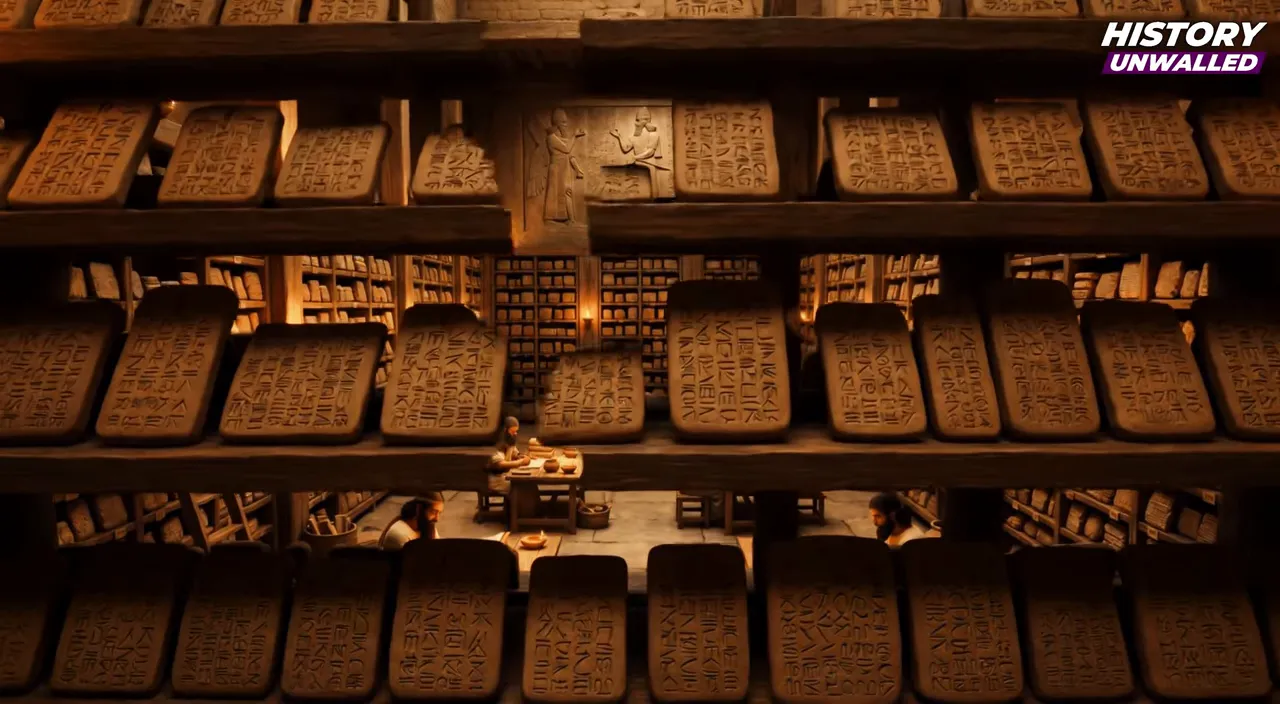
The result was more than 30,000 clay tablets in the North Palace, the first systematically organized library in recorded history. Among them were copies of the Epic of Gilgamesh.
Gilgamesh tells of a king who loses his closest friend and searches desperately for eternal life. He fails. It is a story about grief, mortality, and the limits of power. That feels almost painfully fitting for Nineveh.
One tablet includes a great flood story with striking parallels to the biblical story of Noah. When George Smith translated it in 1872, the discovery caused a sensation across Europe.
The Three-Month Fall of Nineveh
Ashurbanipal died around 627 BC. After that, the empire began to crack. His sons fought over the throne. Generals took sides. Civil war drained the army and weakened the administrative system that had kept the empire together.
Fear had held Assyria together for centuries. But fear needs constant force behind it. Once that force wavers, old enemies remember every injury.
In Babylonia, Nabopolassar declared himself king after seizing Babylon. To the east, Cyaxares rebuilt Median power. In 616 BC, Nabopolassar invaded Assyria. In 614 BC, the Medes destroyed Assur, Assyria’s original sacred capital. Then the Babylonian and Median alliance turned toward Nineveh.
In spring 612 BC, their combined armies surrounded the city. The walls were formidable. The Tigris guarded the western flank. But the siege lasted three months, and pressure grew inside the city.
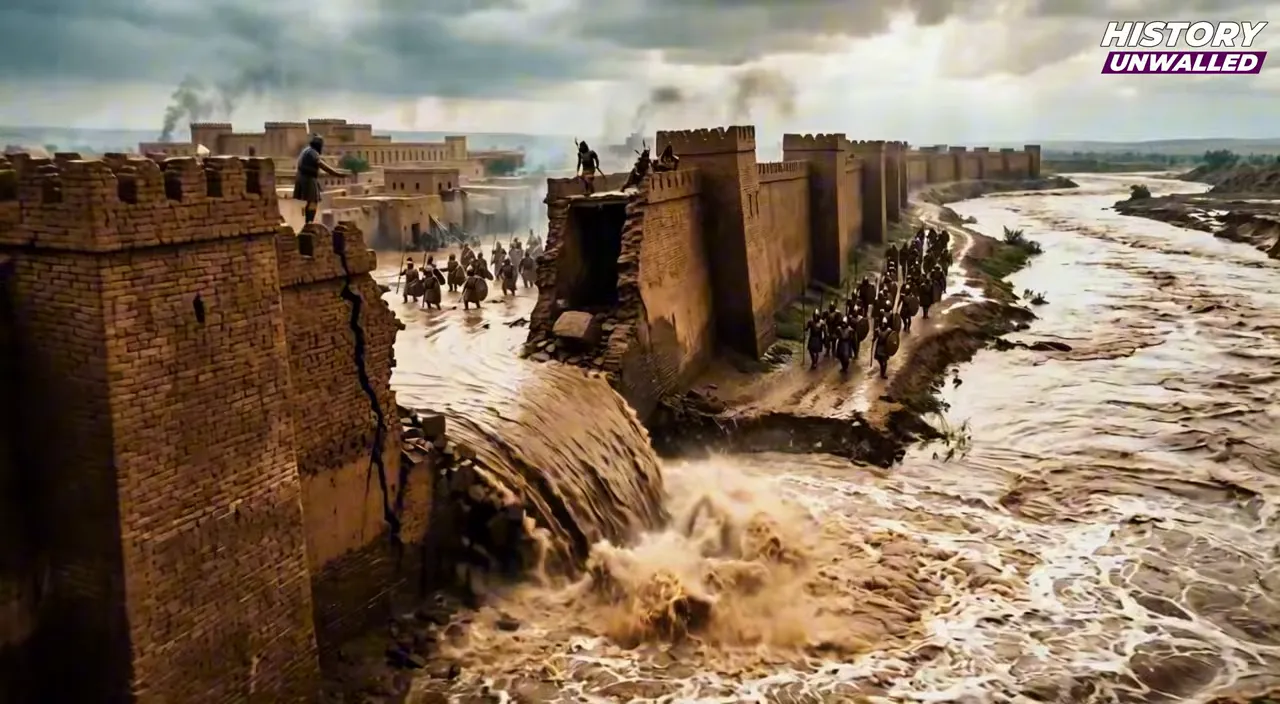
Ancient accounts say a heavy rainstorm flooded the Tigris and partially collapsed a section of the wall. The prophet Nahum had predicted that an overflowing flood would bring Nineveh to an end. Whatever the exact sequence, the defenses were breached.
The fighting became brutal and close. Archaeologists at the Halzi Gate found unburied remains scattered through the gateway, mixed with ash and rubble. They were people trying to escape the final chaos.
The last king, Sinsharishkun, died during the fall. One later account says he burned himself in his palace rather than surrender, though that cannot be confirmed. What is certain is that he did not escape.
How Destruction Saved a Library
The conquerors sacked Nineveh methodically. Sennacherib’s palace burned. Archaeologists have found ash layers dating to 612 BC across the palace mound. The upper sections of wall reliefs were destroyed or removed. The Lamassu were smashed.
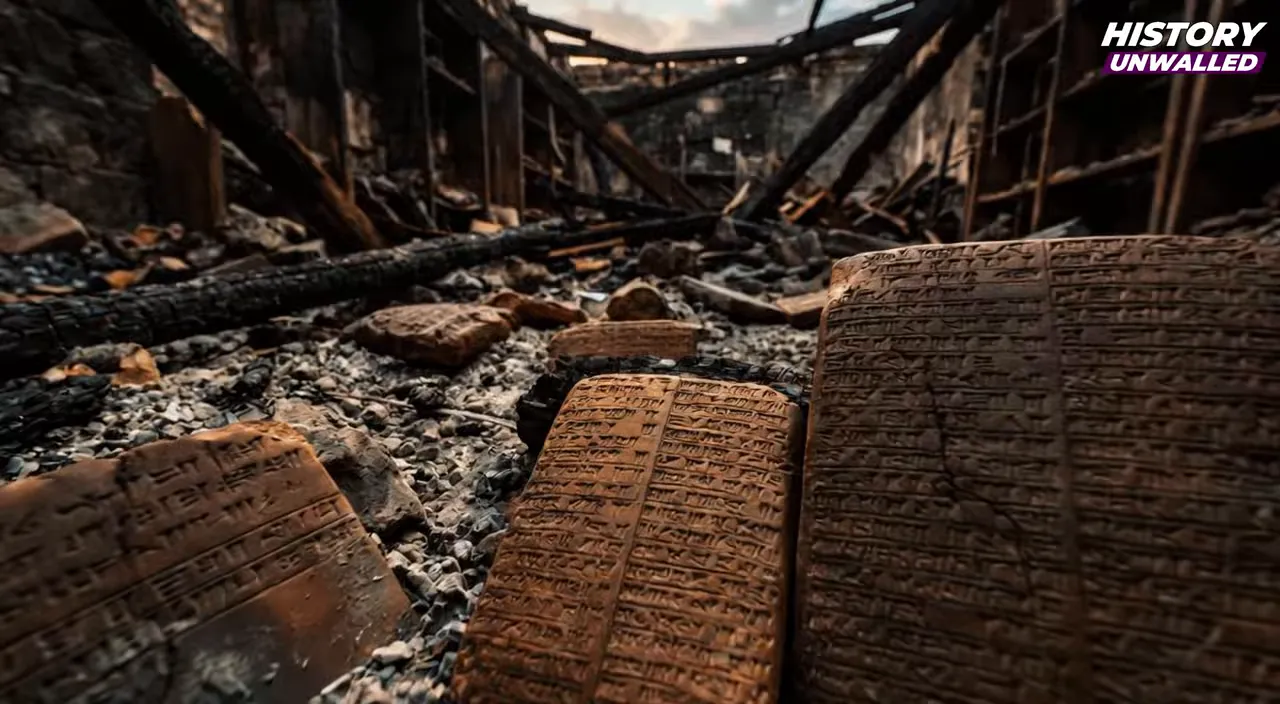
But here is the strange miracle of Nineveh. The fire baked many clay tablets in Ashurbanipal’s library. Clay hardens in heat. The catastrophe that erased the city helped preserve its intellectual treasure.
Nineveh’s greatest gift to the future survived because the city around it burned.
Those who survived the assault were killed or dispersed into smaller settlements. The conquerors were determined not merely to defeat Assyria but to prevent any future Assyrian revival.
And they succeeded. Two centuries later, in 401 BC, Xenophon marched past the ruins with his Greek army. He recorded the site under another name and did not realize he was passing the remains of Nineveh.
Rediscovery, Loss & the Strange Survival of Nineveh
For more than 2,000 years, Nineveh lay largely forgotten. Then, in 1847, Austen Henry Layard excavated Kuyunjik and entered the remains of Sennacherib’s palace. He uncovered scorched Lamassu, carved reliefs, and thousands of cuneiform tablets.
Many of the winged bulls were sent to the British Museum, where they remain today. The tablets opened a window into a world people had nearly lost completely.
But Nineveh suffered again in 2014, when the Islamic State seized Mosul, attacked ancient sites, damaged reconstructed gates, tunneled through mounds to loot, and destroyed heritage in the Mosul Museum. A Lamassu that had survived roughly 2,500 years was attacked with sledgehammers.
History does not move in a neat upward line. Things survive. Then they are threatened again. But the tablets remain. Gilgamesh is still read. Assyrian art is still studied. And Nineveh still asks a difficult question.
When a brutal empire falls, is that justice? Or is something irreplaceable lost with it?
Maybe the only honest answer is both. The fall of Nineveh ended generations of conquest, deportation, and terror. It also destroyed a city of staggering engineering, art, literature, and memory.
That is why Nineveh matters. It shows what power can build when it has no limits. It shows how quickly even the greatest city can fall. And it shows that sometimes the most fragile things, a clay tablet in a burning palace, can outlast an empire.
Bible Story of Jonah & the Whale
One of the greatest prophets during the time of Jeroboam II was Jonah, the son of Amitai, who, as a prophet-disciple, had anointed Jehu and therefore enjoyed the king’s benevolence.
Once God commanded Jonah to go to Nineveh, one of the largest cities of that time and foretell its destruction, because the evil of its inhabitants had reached the limit. The mission, however, was not to Jonah’s liking.
Nineveh was a bitter enemy of Israel, and Jonah would have liked to see its destruction. If he should succeed in his mission and Nineveh were spared, it would remain a constant threat to Israel. Jonah therefore decided to seek an escape. He boarded a ship that sailed for Tarshish, hoping to forget about his mission.
Once the prophet was on the high seas, God sent a storm that threatened to tear the ship asunder. The sailors were frightened, and each one prayed to his god. Jonah, however, lay down to sleep. The captain of the ship, seeing the sleeping man, went over to him and reprimanded him for sleeping in that fateful hour instead of praying to God.
Meanwhile the sailors drew lots to find out whose fault it was that this misfortune had been brought upon them. The lot fell upon Jonah. When the sailors questioned him as to who he was, whence he had come, and what his business was, he told them that he was a Jew and a servant of God, the Creator of heaven and earth.
Then the sailors asked what they should do to quiet the raging sea and save their ship with all aboard. Jonah replied that all they had to do was throw him overboard, and the storm would immediately die down, since it had been caused by his refusal to obey God’s command. At first, the sailors did not want to do as Jonah asked. But the storm grew fiercer, and the end was seemingly unavoidable. Very reluctantly, the sailors threw Jonah into the water, and the storm ceased at once.
As soon as Jonah was in the water, God sent a large fish to swallow Jonah alive. Three days and three nights, Jonah stayed within the fish. In distress, he prayed to God to save him, and God ordered the fish to eject Jonah and set him on dry land.
Jonah in Nineveh
Again God ordered Jonah to go to Nineveh to convey the Divine message. This time the prophet obeyed and traveled to Nineveh to carry out his mission.
Upon his arrival in the city, Jonah stepped right into the middle of the busy thoroughfare and announced that the city would perish in forty days. The prophet’s solemn warning electrified the city. The residents believed the prophecy and repented. They fasted and wore sackcloth. Even the king himself took off his royal robes and put on the garb of mourning.
Everyone in the city honestly and sincerely decided to abandon his evil past. All the people truly tried to mend their ways. Possessions unjustly acquired were returned to their rightful owners, and false judgments were revised. God saw that they were sincere in their repentance and accepted it. Nineveh was saved.
Jonah was displeased at this change of events. He had hoped that the doom of Nineveh, had the inhabitants of that city not repented, would forever rid his people Israel of one of its bitter enemies.
He built himself a hut outside the city in which to live the life of a recluse. Jonah was anxious to know what the fate of the city would be. It was a very hot day, and God made a plant grow to give Jonah shade and protect him from the scorching sun. Jonah was overjoyed with the plant. Then God sent a worm that stung the plant, causing it to wither. When the protection of the plant had been withdrawn, the sun beat mercilessly upon Jonah’s head until he became faint and wished to die.
Then the weary prophet heard God’s words: “You are sorry for the plant for which you have neither labored, nor made it grow; which came up in one night and perished in the next; shall I not then, spare Nineveh, the great city, wherein more than twelve times ten thousand people live, who do not know how to discern between their right and their left hand (i.e. children), and many animals in addition?”
Story’s Source: “The Prophet Jonah” by Jacob Isaacs | Published by Kehot Publication Society
Life in Nineveh: The Cruelest City on Earth Before Destruction
RESOURCES:
This article was created from the video The Entire History of Nineveh: The Largest City on Earth, Erased From History | https://www.youtube.com/watch?v=-dDh1nL4P7Q with the help of AI.
Watch More: Jewish History...
- Abraham – One Man Chose a Different Path
- Timeline of Jewish History
- Tower of Babel & the Origin of Languages
- 1177 BC: How the First Globalized World Fell Apart
- Nineveh: The Greatest City Erased from History
- Babylon in 570 BC: Inside the City That Shaped the World
- Nebuchadnezzar, Solomon’s Temple & the Fire that Changed Jerusalem
- Hezekiah’s Tunnel: Faith, Fear & Water Beneath Jerusalem
- “Rivers of Babylon” Written in Exile 2600 Years Ago
- Nebuchadnezzar: The King Who Built Babylon, Lost Everything & Returned
- Secret of Jewish Survival & Esther’s Courage
- Canaan to Rome: The Ancient History of Israel
- Arch of Titus: Rome’s Monument of Triumph & Jewish Heartbreak
- Roman Empire: The Rise, The Madness, The Fall of a Civilization
- Fall of Rome: How the Ancient World’s Greatest Empire Changed Shape
- When Nations Turn Against Israel, What Happens to Them?
- ‘All Things Are Mortal But the Jew’ – Mark Twain
- 7 Wonders of Jewish History: A Story That Should Not Be Possible
- Samaritans: Last 800 Guardians of Mount Gerizim
- Amalek Command: Why It's Misunderstood
- PART 1 | The Land of Israel & Ottoman Palestine (HEB)
- Part 2 | The Land Reached Its Peak & Byzantine Palestine’s Demographic High Point (HEB)
- PART 3 | Arab Conquest: How the Land Gradually Became Muslim (HEB)
- 5000 Years of Jewish History (5-Min Clips)