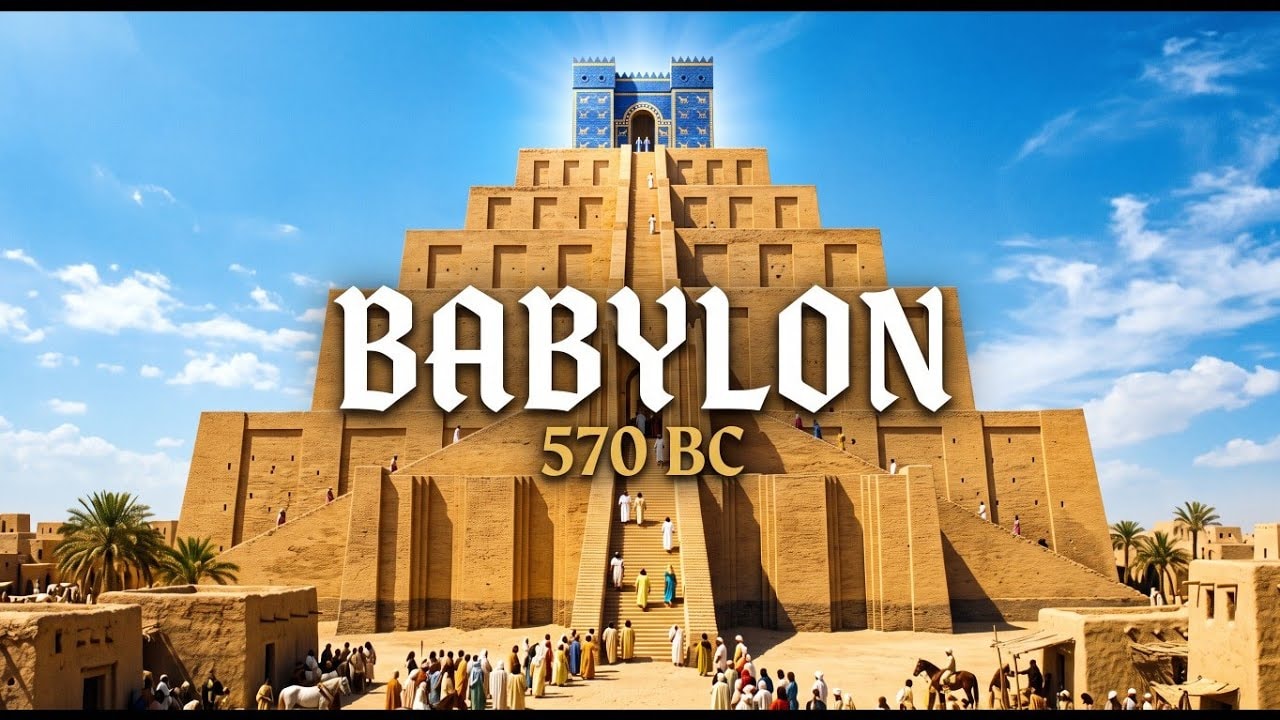
Picture it. The year is 570 BC. You have crossed weeks of desert, your sandals are finished, and then it rises from the Mesopotamian plain: Babylon.
This is not a quiet little ancient settlement. Babylon is loud, crowded, and fragrant with bread, spices, river water, and livestock. Somewhere around 50,000 to 60,000 people live behind its walls, possibly more. The Euphrates cuts through the city. Canals feed green fields beyond it. And above the rooftops stands a giant stepped temple that seems to touch the sky.
Babylon was built to make an impression. It still does.
At its peak under Nebuchadnezzar II, Babylon was one of the greatest cities on Earth. It was a place of extraordinary engineering, international trade, written contracts, astronomy, law, religion, wealth, fear, beauty, slavery, exile, and raw imperial power. All at once.
Takeaways
- Babylon reached its peak in 570 BC through ambitious building, water engineering, trade, and imperial power.
- The Ishtar Gate, Processional Way, and Etemenanki made Babylon’s political and religious authority impossible to ignore.
- Babylonian astronomy and mathematics helped shape the 24-hour day, 60-minute hour, and 360-degree circle.
- Babylon’s achievements existed alongside slavery, conquest, exile, and profound human suffering.
The Greatest City in the Ancient World
Babylon stood on the Euphrates in what is now central Iraq. By 570 BC, it had already been inhabited for more than 2,000 years. But this was its big moment. The Neo-Babylonian Empire was at its height, and Nebuchadnezzar II had spent four decades remaking the capital into something enormous.
He had not simply inherited a magnificent Babylon. He had built one.
The city covered roughly 200 square miles, a space compared to modern Chicago. The river divided Babylon in two, while bridges, canals, and irrigation channels stitched it back together. This water system was not a lucky accident. It came from generations of people learning how to direct, store, and use water in a land where summer heat could be merciless.
Babylonian engineers made the desert productive. They kept fields green. They moved people and goods. They turned a difficult landscape into the foundation of an empire.
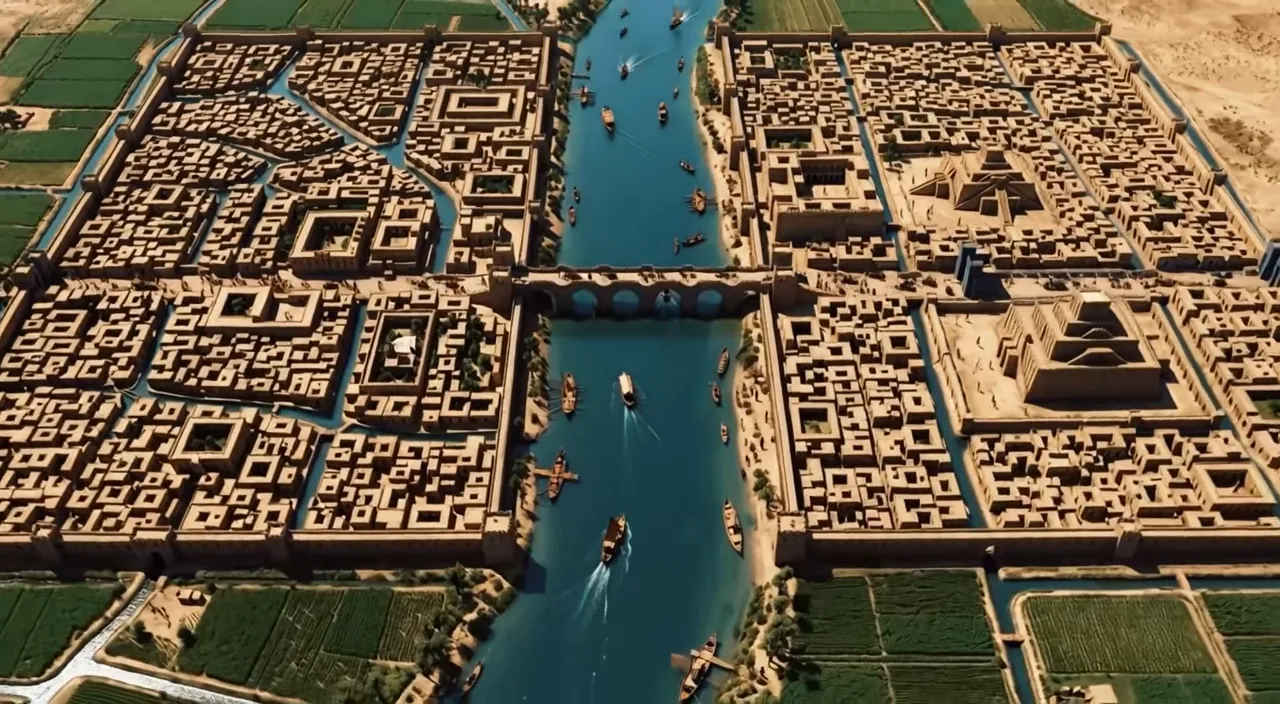
The walls made the same point in a much louder way. Babylon had three rings of fortifications, with walls roughly 40 feet high. Herodotus later claimed a four-horse chariot could turn around on top of them. The exact measurement may be debatable, but the message is not.
Nothing enters Babylon unless Babylon allows it.
The Ishtar Gate & Processional Way
Enter Babylon from the north, and the first great statement of power is the Ishtar Gate, completed around 575 BC. It stood nearly 40 feet high and gleamed with deep blue glazed bricks, the color of lapis lazuli. Against the pale desert, it must have looked almost impossible.
The gate was covered in reliefs of divine animals. There were aurochs, wild bulls linked to Adad, the weather god. And there were mushhushshu, dragon-like creatures with serpent heads, lion bodies, and eagle talons, linked to Marduk, Babylon’s chief god. Around 575 of these figures covered the gate and its antechamber.
Even the cedar doors mattered. Cedar had to be imported from Lebanon at enormous cost. This was architecture doing politics. Every brick told diplomats, traders, enemies, and displaced people exactly who held power here.
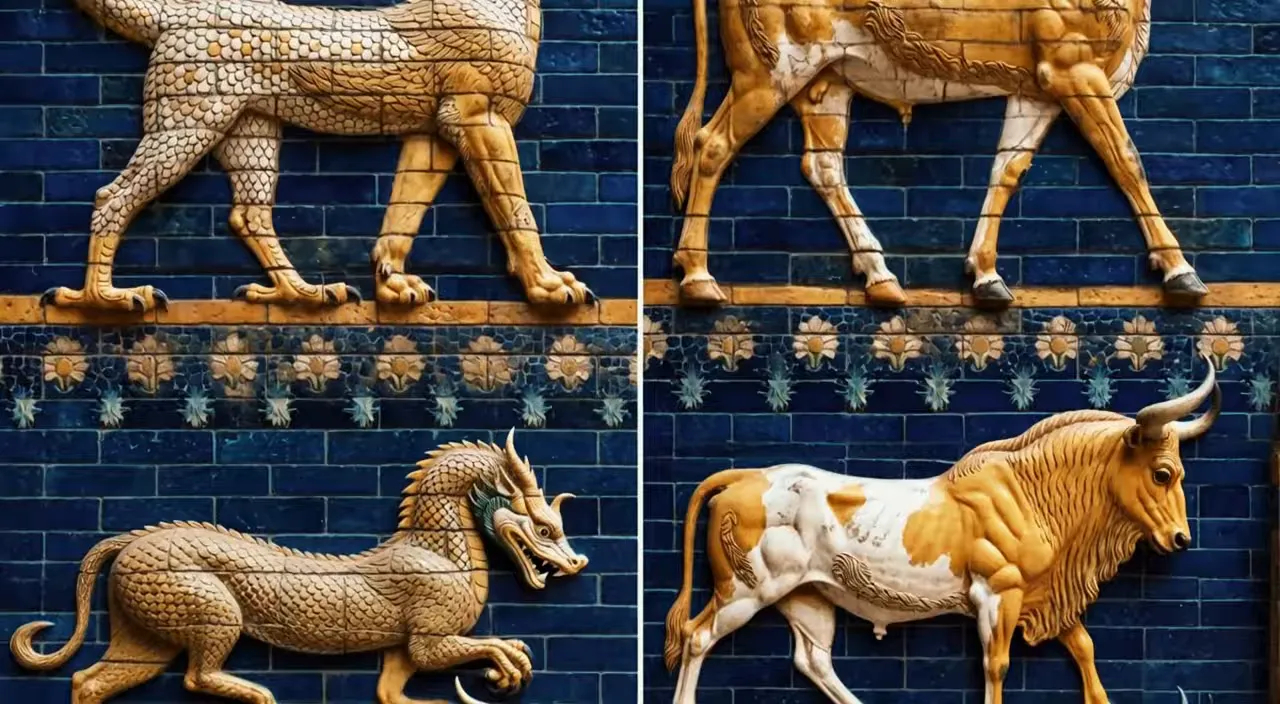
Beyond the gate ran the Processional Way, Babylon’s ceremonial avenue. It stretched more than half a mile toward the temple complex. Along its sides, 120 glazed lions moved forward in blue and yellow brick relief. They represented Ishtar, goddess of war and desire.
On ordinary days, this was a busy route. On festival days, it became the heart of Babylon. Priests, soldiers, merchants, families, foreign traders, enslaved people, and officials packed the avenue as divine statues passed by on golden litters.
That is smart city planning, by the way. Defensive walls, royal spaces, public ceremony, and religion all connected along one deliberate axis. Babylon was planned with purpose 2,500 years ago.
The Tower of Babel & the Mystery of the Gardens
At the end of the Processional Way stood the Etemenanki, whose name means the House of the Foundation of Heaven and Earth. Most people know it by another name: the Tower of Babel.
The Etemenanki was a ziggurat, a stepped temple platform. At its height, it may have risen 90 to 100 meters, about the height of a 25-story building. A shrine to Marduk stood at the summit, accessible only to the highest priests.
For the people of Babylon, Marduk was not an abstract idea. He was believed to live in the temple. The city’s survival, military success, and future depended on keeping him satisfied.
The tower was not just tall. It was a meeting point between earth, gods, power, and fear.
For the thousands of Jewish exiles living in Babylon, the structure carried a different weight. Nebuchadnezzar had destroyed Jerusalem’s temple in 586 BC, only 16 years earlier. The Etemenanki towered above them daily, a powerful reminder of the empire that had taken their home.
The biblical story of Babel may draw on memories of this monument. It is not hard to understand why a structure like this could inspire a story about human beings reaching too far toward heaven.
Then there are the Hanging Gardens of Babylon, perhaps the most famous mystery of all. Did they exist? Honestly, we do not know.
No Babylonian text confirms them. Greek and Roman writers mention them centuries later, and no definite archaeological remains have been found. They may have been legend. Or they may have stood elsewhere, perhaps in Nineveh.
The ancient story says Nebuchadnezzar created terraces filled with trees, flowers, and flowing water for his wife Amyitis, a Median princess from a greener, cooler land. Water would have been lifted from the Euphrates using chains or screws.
Whether the gardens were real or not, the idea reveals something true about Babylonian prestige.
Power was not only about conquering land. It was about making a green mountain rise from the desert.
The People Who Made Babylon Work
Babylon was not only temples and kings. Its real story lived in its streets, markets, workshops, courts, and homes.
At the top stood the king, royal family, high priests, and senior officials. They held wealth, influence, servants, guards, palaces, cedar beams, and glazed tiles.
Below them were free citizens, including merchants, landowners, craftspeople, teachers, and administrators. They could own property, sign contracts, borrow money, and bring cases to court. Babylon had lawyers, courts, and a long tradition of written law.
Then came free laborers without land. They worked farms, building sites, and textile workshops. Clay tablets recorded their names and rations, often barley, sometimes oil or wool. Their names survived, but their choices were limited.
And then came slavery. Babylonian slavery was widespread and brutal. People became enslaved through war, debt, or desperate families selling children they could not feed. Some enslaved people could earn money, own small property, or buy freedom. Debt slaves were released after a set period under Babylonian law.
That legal framework does not make slavery acceptable. Not even close. But it shows how Babylon organized even its deepest injustices through rules and records.
Babylon was sophisticated. Babylon was also cruel. Both facts belong in the same sentence.
Women had more legal standing in Babylon than women in many later societies. They could own property, borrow money, run businesses, and appear in court. Widows could manage estates. Priestesses could hold serious economic power through temple institutions. They were not equals in the modern sense, but they were not invisible.
Markets, Temples & the Akitu Festival
Babylon stood where major trade routes met. Merchants could buy copper from Cyprus, cedar from Lebanon, lapis lazuli from Afghanistan, cotton textiles from the Indus Valley, and grain from Babylonian floodplains.
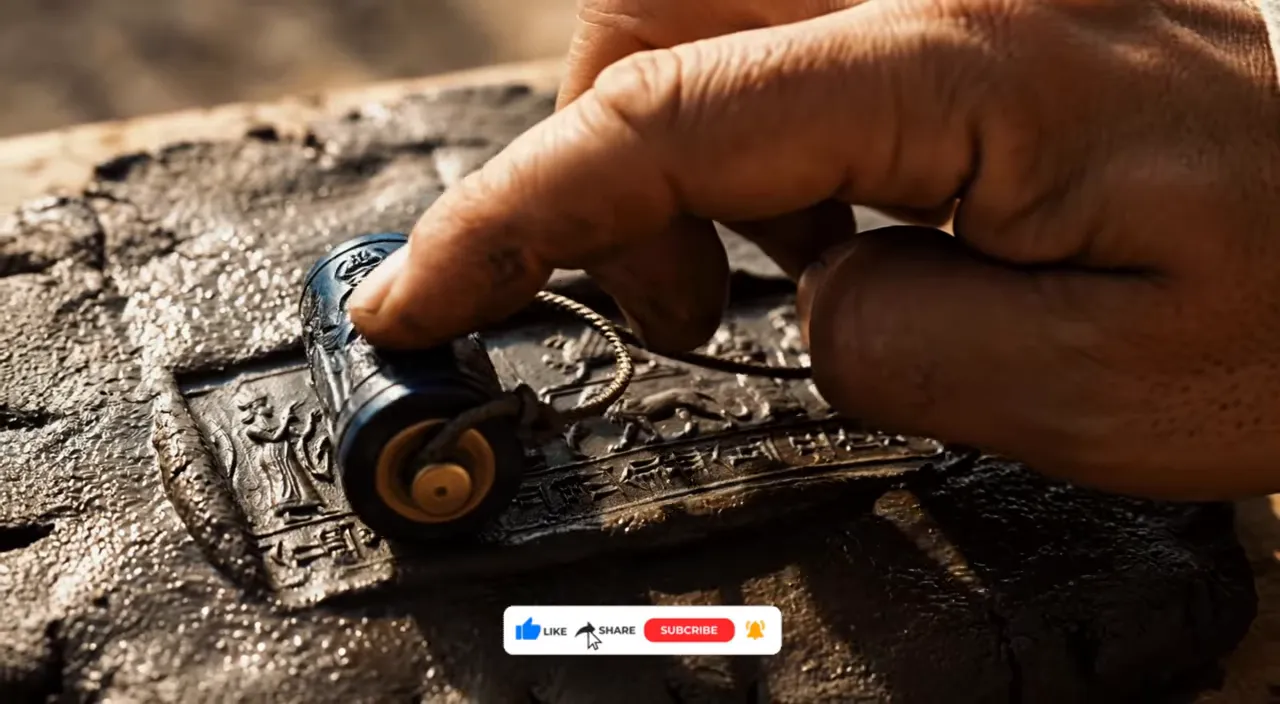
Coins were not yet the usual method of payment. Trade ran mostly on weighed silver, measured in shekels on small balances. Agreements went onto clay tablets and were sealed with cylinder seals rolled into wet clay. Part signature, part legal stamp, part anti-fraud system. Pretty clever.
Religion ran through all of this. It was not a once-a-week activity. It was Babylon’s operating system.
Marduk stood above dozens of other gods, including Ishtar, Shamash, Sin, and Nabu. At the foot of the Etemenanki was the Esagila, Marduk’s temple complex. Priests and temple workers cared for Marduk’s cult statue as though the god physically lived there. It was dressed, fed three meals a day, given beer and wine, adorned with jewelry, and put to bed at night.
Temples were also economic giants. They owned land, employed workers, collected grain taxes, and made interest-bearing loans. A temple could be a sacred space, bank, landlord, archive, and political powerhouse all at once.
Each spring, Babylon celebrated Akitu, the New Year Festival. It lasted 11 days and renewed the order of the world.
The king faced a startling ritual. Before Marduk’s high priest, he had his royal regalia removed, received a strike across the face, and had to declare that he had not neglected the city or temples. If he cried, that was a good omen.
Even the king of Babylon had to be reminded that his power was not entirely his own.
Afterward, statues of the gods traveled along the Processional Way, crossed the river by boat, and were brought to a garden temple outside the city. There, Babylon’s divine order was renewed for another year. The city feasted. Normal divisions relaxed a little. For a few days, king and laborer shared one enormous public story.
Babylonian Science & Written Law
Babylon’s legacy is not only massive gates and legends. It also reaches right into the clock on your phone.
Priest-astronomers maintained detailed astronomical diaries, recording the moon, sun, planets, eclipses, and celestial patterns. They calculated the lunar cycle at roughly 29.5 days. They could predict eclipses with impressive accuracy.
Babylonian scholars did not separate astronomy from astrology. The sky could help explain both the motion of Jupiter and the future price of grain. A lunar eclipse might be treated as a warning about a king. Still, inside that unified worldview, they made genuine mathematical observations.
One famous clay tablet shows Babylonian astronomers using the area of a trapezoid to track Jupiter’s motion, a remarkably advanced geometric method.
The 24-hour day, the 60-minute hour, and the 360-degree circle all came down to us through Mesopotamian systems that Babylon helped standardize and pass on.
Our hours are Babylonian hours. Our circles still carry Babylonian math.
The city also inherited one of history’s most famous legal traditions: the Code of Hammurabi, written around 1750 BC. The code contained 282 legal rulings covering wages, land, divorce, adoption, medical malpractice, and criminal punishment.
It was harsh. The famous principle of an eye for an eye comes from this legal world. Punishments also changed according to social rank, producing some deeply unequal outcomes. But the larger idea mattered: laws should be written down, publicly known, and applied through a recognizable system rather than a ruler’s whim.
Babylon did not create justice as we would define it. But it made a lasting contribution to the argument that power needs visible rules.
Nebuchadnezzar, Exile & the Fall of Babylon
Nebuchadnezzar II ruled from 605 to 562 BC. He defeated Egypt at Carchemish, attacked Jerusalem twice, destroyed the Temple of Solomon in 586 BC, and deported thousands of Jewish people to Babylon.
He was a military commander with a brutal record. He was also the builder whose name appeared on bricks across the capital, including the Ishtar Gate, Processional Way, palace, and Etemenanki.
To many Babylonians, he was a restorer chosen by Marduk. To the people he killed, displaced, and enslaved, he was something else. History has room for both perspectives because history rarely belongs to one side.
The Jewish exile became one of the most important chapters in Jewish history. Tablets dated between 595 and 570 BC record foreign captives and include Jewish names. Jehoiachin, the exiled king of Judah, received oil and grain rations while held with his court.
Many exiles could preserve communal and religious life. Some entered trade and Babylonian society. But Jerusalem was destroyed. Their temple was gone. Their freedom was limited.
By the rivers of Babylon, grief became memory. And memory became scripture.
After Nebuchadnezzar died, Babylon’s stability cracked. Short-reigned kings followed. Nabonidus spent years away in Arabia and missed the Akitu Festival, a shocking break with Babylonian religious expectations.
In 539 BC, Cyrus the Great of Persia entered Babylon with little resistance. Babylonian priests resented Nabonidus and effectively opened the gates. Cyrus presented himself as a liberator, respected Marduk’s temples, and allowed Jewish exiles to return to Jerusalem.
Babylon remained important under Persian rule. Herodotus admired it. Alexander the Great hoped to make it his capital, but died in Nebuchadnezzar’s palace in 323 BC. Over centuries, trade moved, populations shifted, the Euphrates changed course, and mud-brick walls dissolved into the earth.
Why Babylon Still Matters
Today, Babylon’s ruins lie near Hilla in Iraq. The original Ishtar Gate is in Berlin’s Pergamon Museum, while a reconstruction stands at the site. Preservation remains difficult after conflict and poorly managed development, but the work matters.
Babylon gave the world urban planning, systematic astronomy, international trade, codified law, and ways of measuring time that still shape ordinary life.
It also practiced slavery, destroyed cities, and deported whole communities.
That contradiction is the point. Babylon was never a simple symbol of human greatness or human evil. It was both. A dazzling city built by real people, under real pressure, with remarkable skill and terrible power.
We walk on Babylonian foundations more often than we realize.
Their stars are still our stars. Their hours are still our hours. Their stories survive in some of humanity’s oldest books. And their city, once the largest on Earth, still asks the same big question: what do we do with power once we have it?
RESOURCES:
This article was created from the video A Tour of Babylon in 570 BC – The Tower of Babel Was Real | Documentary History | https://www.youtube.com/watch?v=bg4mVHIPY_Y with the help of AI.
Watch More: Jewish History...
- Abraham – One Man Chose a Different Path
- Timeline of Jewish History
- Tower of Babel & the Origin of Languages
- 1177 BC: How the First Globalized World Fell Apart
- Nineveh: The Greatest City Erased from History
- Babylon in 570 BC: Inside the City That Shaped the World
- Nebuchadnezzar, Solomon’s Temple & the Fire that Changed Jerusalem
- Hezekiah’s Tunnel: Faith, Fear & Water Beneath Jerusalem
- “Rivers of Babylon” Written in Exile 2600 Years Ago
- Nebuchadnezzar: The King Who Built Babylon, Lost Everything & Returned
- Secret of Jewish Survival & Esther’s Courage
- Canaan to Rome: The Ancient History of Israel
- Arch of Titus: Rome’s Monument of Triumph & Jewish Heartbreak
- Roman Empire: The Rise, The Madness, The Fall of a Civilization
- Fall of Rome: How the Ancient World’s Greatest Empire Changed Shape
- When Nations Turn Against Israel, What Happens to Them?
- ‘All Things Are Mortal But the Jew’ – Mark Twain
- 7 Wonders of Jewish History: A Story That Should Not Be Possible
- Samaritans: Last 800 Guardians of Mount Gerizim
- Amalek Command: Why It's Misunderstood
- PART 1 | The Land of Israel & Ottoman Palestine (HEB)
- Part 2 | The Land Reached Its Peak & Byzantine Palestine’s Demographic High Point (HEB)
- PART 3 | Arab Conquest: How the Land Gradually Became Muslim (HEB)
- 5000 Years of Jewish History (5-Min Clips)