
Jewish history is not a neat little timeline where one kingdom rises, falls, and gets filed away in a museum. It is a wild, improbable, sometimes painful, sometimes joyful story that refuses to end.
Think about the basic facts. A people that has survived for millennia. It is driven from its homeland, scattered across the globe, kept small in number, repeatedly hated, and yet remains profoundly influential. Then, after centuries of exile, a large part of that people returns to its ancient land and rebuilds national life there. That is not ordinary history. That is Ripley’s Believe It or Not territory.
Jewish history is a combination of trends that seem to contradict each other, yet somehow all happen together.
That tension is the heart of this framework. The Hebrew Bible makes recurring promises and warnings about the Jewish people. The claim here is not merely that these passages exist, but that the remarkable patterns they describe have unfolded across Jewish history.
For people of faith, that is powerful evidence of Divine involvement. For anyone studying Jewish history, it is at the very least an invitation to pause, zoom out, and ask: how did this tiny people remain so visible, so durable, and so consequential?
Takeaways
- Jewish history combines survival, exile, small numbers, hostility, influence, land, and return in one extraordinary pattern.
- The Jewish people preserved identity across centuries without political sovereignty or a permanent homeland.
- Antisemitism is uniquely persistent, intense, universal, and irrational in the framework presented here.
- The modern return to Israel gives Jewish history its most visible and hopeful contemporary chapter.
The First Wonder: An Eternal Nation
The first theme is simple: the Jewish people will endure. In Genesis 17:7, the covenant with Abraham is described as lasting through his descendants. Leviticus adds an even more striking idea: even in the lands of their enemies, the people will not be utterly destroyed.
Now, that is a bold claim. Ancient history is full of peoples whose names survive only on stone tablets, in archaeology books, or on museum placards. Egyptians, Babylonians, Persians, Greeks, Romans, Crusaders, and more have shaped the world. But empires come and go. Civilizations flare up, make a lot of noise, and eventually fade.
The Jewish people are still here. Not as a historical footnote. Not as an ancient costume party. Still here.
Most ancient peoples are found in museums. Jews are found everywhere.
Jewish identity is also hard to squeeze into one box. Jews are not a race. Jews come in every shade, size, and background, and conversion is possible. But Jews are not simply a religion either. Jewish identity carries religion, peoplehood, culture, family, memory, law, and nationhood all at once. That layered identity is part of what makes Jewish history so resilient.
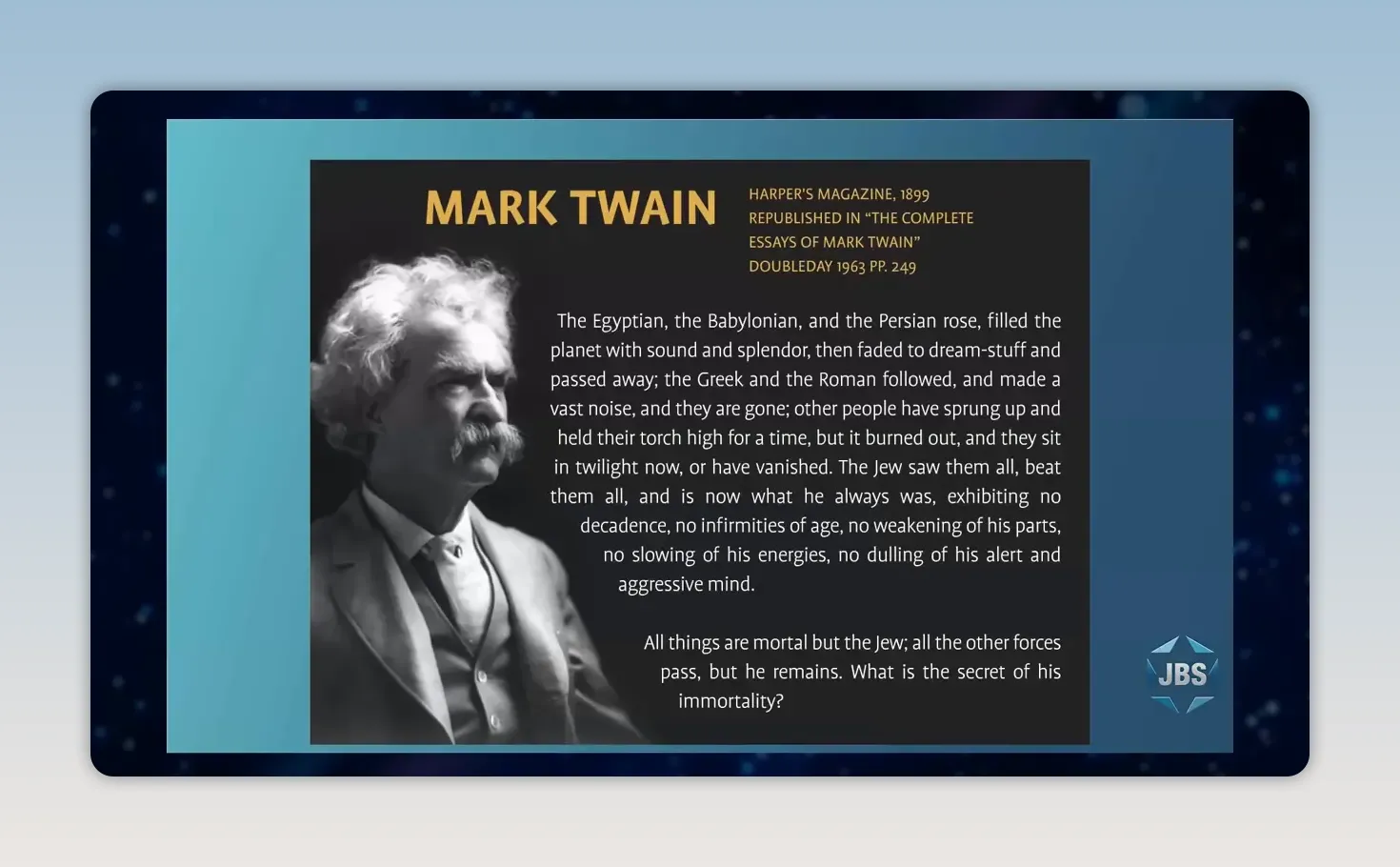
Mark Twain noticed the puzzle. In his famous essay on the Jews, he compared the long disappearance of great powers with the continued presence of the Jewish people and asked what explained their endurance. Leo Tolstoy made a similar observation, calling the Jew an emblem of eternity. These were not Jewish apologetics writers. They were outsiders looking at a very strange historical fact.
The Second Wonder: Exile & Dispersion
Here comes the first giant contradiction. If a people is meant to last forever, the logical prediction would be permanent life in its homeland. Land is usually the strongest anchor of national identity. Nations fight wars over it. Families tell stories about it. Cultures grow roots in it.
But Jewish history takes the opposite road.
Leviticus and Deuteronomy describe a people scattered among the nations. And that is exactly what happened. The Babylonian destruction of Jerusalem brought exile in the sixth century BCE. After the Second Temple period and the Roman suppression of Jewish revolts, Jewish communities became dispersed across North Africa, Europe, the Middle East, and eventually far beyond.
Exile is not just moving house. It means living as a minority, often without political power, surrounded by other languages, customs, and faiths. It means trying to pass on a distinct identity without a homeland at the center of daily life.
Take any nation, remove it from its land, scatter it everywhere, and normally it disappears within a few generations.
That is why the Jewish diaspora is so unusual. Jewish communities did not merely survive one displacement. They experienced repeated exiles, repeated dislocations, and a global dispersion lasting roughly two thousand years.
And somehow, whether in Baghdad, Fez, Vilna, Salonika, New York, Johannesburg, Buenos Aires, Mumbai, or Kathmandu, Jewish life kept showing up. There is a reason the joke works: the three most ubiquitous things on earth are Jews, Coca-Cola, and McDonald’s.
The Third Wonder: Few in Number
Now make the formula even less likely. A people that is ancient, religiously committed to family life, and spread around the world might be expected to become enormous. Historically, Jewish families often married young and had many children. So where are the hundreds of millions of Jews?
They are not there.
At the beginning of the Common Era, estimates suggest that roughly six to eight million Jews lived in the world. That was a huge presence in the Roman Empire, where Jews may have represented around 10 percent of the population overall and an even larger share in the eastern part of the empire.
Today, the global Jewish population is roughly 14 to 15 million. It is a tiny fraction of the world population. This is especially striking beside other ancient peoples whose populations grew dramatically over time.

Of course, numbers never tell the whole human story. Jewish demographic history includes persecution, massacres, forced conversion, assimilation, disease, war, migration, and the catastrophe of the Holocaust. But the broad pattern is still startling: a people small enough to be statistically fragile has persisted through every age.
Jewish history is not the story of a giant population rolling forward by sheer numbers. It is the story of survival on a razor-thin margin.
The Fourth Wonder: Antisemitism
This is the darkest wonder, and it has to be handled honestly. The Torah describes fear, insecurity, exile, and hostility in foreign lands. Jewish history contains far too many examples: special taxes, expulsions, ghettos, forced badges, pogroms, humiliations, massacres, and genocide.
Antisemitism is not just ordinary prejudice with a different label. The word was coined in 1879 by the German Antisemite Wilhelm Marr, and it refers specifically to hostility toward Jews. The term does not mean hostility toward all Semitic-language peoples.
What makes Antisemitism so disturbing is its strange ability to mutate. Jews have been accused of being too rich and too poor, too religious and too secular, too capitalist and too communist, too separate and too influential, and too weak and too powerful. The accusations do not even have to agree with each other.
That irrationality is part of the problem. Antisemitism has appeared in Christian, Muslim, nationalist, racial, political, and conspiratorial forms. It is old, adaptable, and dangerous. The United States Holocaust Memorial Museum offers helpful background on its historical development and deadly consequences.
When every opposite accusation can be used against the same people, the issue is not evidence. The issue is hatred.
The remarkable point in this Jewish history framework is not that suffering somehow becomes good. It does not. The point is that even this long and vicious hatred did not achieve its goal of erasing the Jewish people.
The Fifth Wonder: A Light to Nations
Here the story gets even stranger. A tiny, scattered, frequently persecuted people should not be a major source of civilization-wide ideas. Usually, empires spread their values with armies, roads, taxes, and conquest. Rome had legions. Greece had armies. The Jewish people had exile.
Yet the Hebrew Bible describes Israel as a “light to the nations.” The argument is that Judaism’s greatest contribution was not bagels, junk bonds, or Hollywood. Those may be entertaining contributions, but they are not the big one.
The big one is ethical monotheism: one God and one ultimate moral standard for every human being. That idea reshaped the moral vocabulary of much of the world.
Jewish thought introduced and sustained ideas about the dignity of human beings, moral responsibility, justice for the vulnerable, limits on rulers, the value of education, and the belief that history has meaning. Judaism did not invent every good idea on earth. But it played an outsized role in carrying a particular moral vision into world civilization.
The Jewish people did not conquer much of the world. But Jewish ideas traveled very far.
John Adams, America’s second president, praised the Hebrews as a major force in civilizing humanity. His point was not about military power. It was about the influence of biblical ideas on morality and public life.
That is a major theme in Jewish history: influence out of all proportion to numbers. A fraction of one percent of the world population has made an impact in religion, philosophy, science, law, medicine, literature, business, and public life. But the deepest impact, in this view, is spiritual and ethical.
The Sixth Wonder: The People & the Land
Israel is a small country. On a map, it is easy to miss. But geographically, it sits on a critical land bridge connecting Africa, Asia, and Europe. In the ancient world, that made it strategically important. It was also, by historical descriptions, a productive agricultural land.
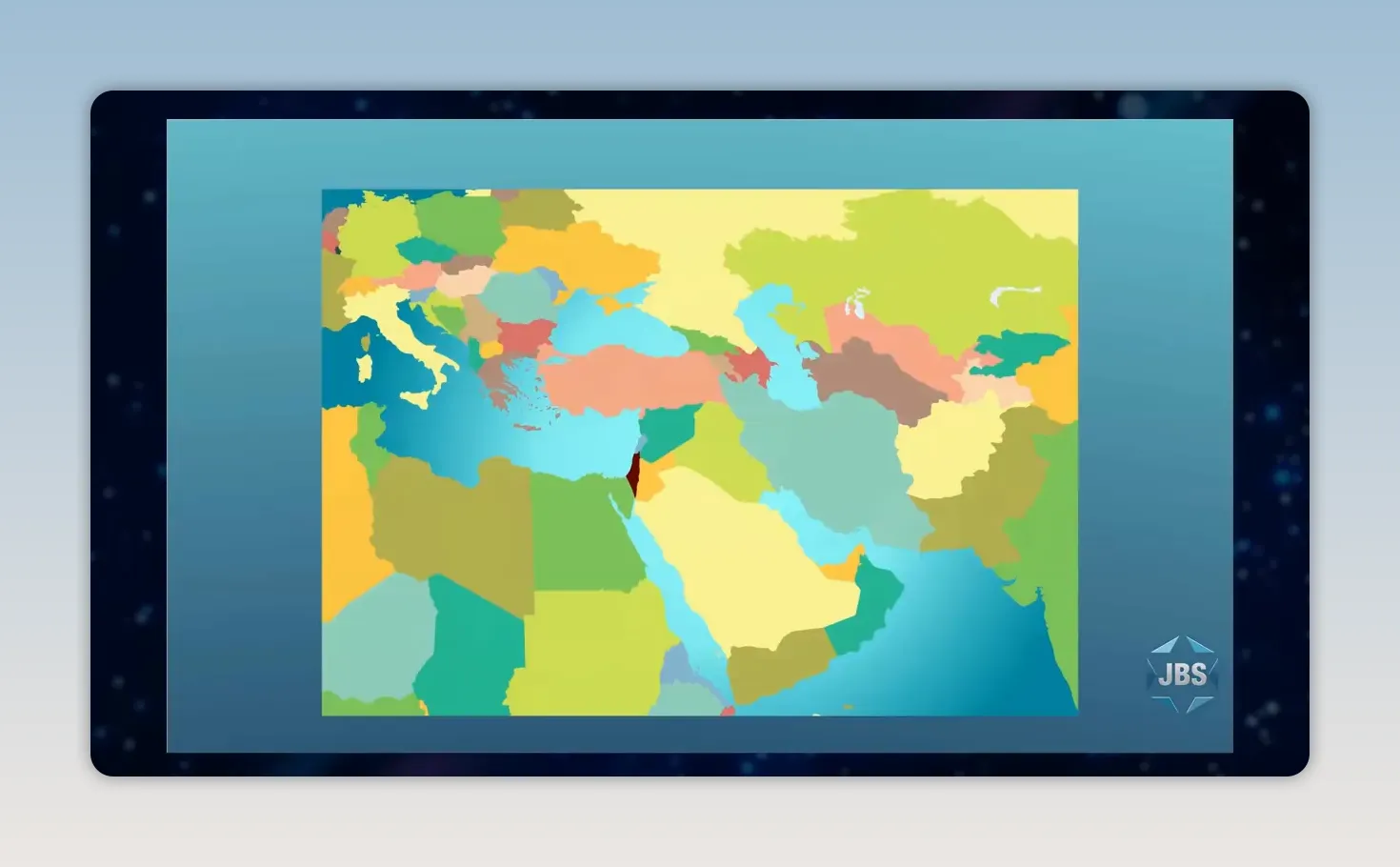
That should have made Jewish survival in the land even harder. Powerful empires moving through the region had every reason to conquer it, control it, and absorb its inhabitants. By normal historical logic, the Jewish people should have become another layer in the archaeological cake.
Instead, Jewish history maintains an unusual connection between the people and the land. The biblical passages presented here describe the land becoming desolate during exile and becoming fruitful again when the people return.
Mark Twain’s nineteenth-century travel writing famously described the land as bleak and underpopulated in places. That description should be read in the context of his journey and his style, but it became memorable because it fit the broader claim that the land seemed to wait through long centuries of Jewish absence.
The claim is not that land has feelings. The claim is that the relationship between this people and this land has never behaved like an ordinary historical relationship.
The Seventh Wonder: Return
And now the happy one. After centuries of dispersion, Jewish return to the Land of Israel becomes the final piece of the picture.
Deuteronomy and Jeremiah speak of a future gathering from the nations. For most of Jewish history, that sounded like a dream, a prayer, or a line recited at the end of Passover: “Next year in Jerusalem.”
Then history started moving fast.
In 1900, only a tiny percentage of world Jewry lived in the Land of Israel. Today, Israel is home to nearly half of the world’s Jews. In the decades following the Holocaust and the establishment of the State of Israel in 1948, Jews arrived from Europe, North Africa, the Middle East, the former Soviet Union, Ethiopia, the Americas, and everywhere in between.

That return happened under conditions that were hardly easy. Israel began with limited resources, war, terrorism, economic pressure, and the enormous challenge of absorbing immigrants at a rapid pace. Yet the country built farms, cities, universities, hospitals, a technology sector, and a thriving cultural life.
The land that had been dismissed by many travelers as barren became associated with agricultural innovation, exports, high-tech growth, and a bustling modern society. The transformation is not a fairy tale. It came through sacrifice, work, arguments, courage, and plenty of Israeli chutzpah. But it happened.
Three years after the Holocaust ended, a Jewish state was born. That alone should make us stop and catch our breath.
The return does not erase Jewish life outside Israel. The diaspora remains a major part of Jewish life. But the demographic center of gravity has shifted in a way that would have been nearly unimaginable for countless generations.
Why These Seven Wonders Matter
This is not an argument that Jewish history has been easy. It has been brutally hard. Nor is it an excuse to ignore the complexity of history, politics, or demographics. Facts deserve careful study. Sources deserve checking. Big claims deserve serious thought.
But when the seven patterns are placed side by side, the full picture is tough to shrug off:
- An ancient people survives.
- It survives while repeatedly exiled and dispersed.
- It remains remarkably small in number.
- It endures persistent Antisemitism.
- It influences the moral and spiritual imagination of the world.
- It retains a unique bond with its homeland.
- It returns to that homeland after centuries away.
Any one of those facts might be unusual. All seven together make Jewish history feel almost impossible.
That is why the old question from Blaise Pascal still lands with such force. Asked for proof of the supernatural, he pointed to the Jewish people. More than three centuries later, the question has not gotten smaller.
A Jew who does not believe in miracles is not a realist.
Whether one sees the hand of God, an astonishing national resilience, or both, Jewish history offers a serious challenge to the idea that history is merely random. The story is still unfolding. And that is the wildest part of all.
RESOURCES:
This article was created from the video Ken Spiro – 7 Wonders of Jewish History | https://www.youtube.com/watch?v=yq-woKtUoIY with the help of AI.
Watch More: Jewish History...
- Abraham – One Man Chose a Different Path
- Timeline of Jewish History
- Tower of Babel & the Origin of Languages
- 1177 BC: How the First Globalized World Fell Apart
- Nineveh: The Greatest City Erased from History
- Babylon in 570 BC: Inside the City That Shaped the World
- Nebuchadnezzar, Solomon’s Temple & the Fire that Changed Jerusalem
- Hezekiah’s Tunnel: Faith, Fear & Water Beneath Jerusalem
- “Rivers of Babylon” Written in Exile 2600 Years Ago
- Nebuchadnezzar: The King Who Built Babylon, Lost Everything & Returned
- Secret of Jewish Survival & Esther’s Courage
- Canaan to Rome: The Ancient History of Israel
- Arch of Titus: Rome’s Monument of Triumph & Jewish Heartbreak
- Roman Empire: The Rise, The Madness, The Fall of a Civilization
- Fall of Rome: How the Ancient World’s Greatest Empire Changed Shape
- When Nations Turn Against Israel, What Happens to Them?
- ‘All Things Are Mortal But the Jew’ – Mark Twain
- 7 Wonders of Jewish History: A Story That Should Not Be Possible
- Samaritans: Last 800 Guardians of Mount Gerizim
- Amalek Command: Why It's Misunderstood
- PART 1 | The Land of Israel & Ottoman Palestine (HEB)
- Part 2 | The Land Reached Its Peak & Byzantine Palestine’s Demographic High Point (HEB)
- PART 3 | Arab Conquest: How the Land Gradually Became Muslim (HEB)
- 5000 Years of Jewish History (5-Min Clips)