
The search for Temple treasures is not some dusty side story from ancient history. It is a living mystery that reaches from Jerusalem’s Old City to the corridors beneath the Vatican. It carries questions about faith, memory, archaeology, ownership, and the astonishing survival of the Jewish people.
Could vessels from the First or Second Temple still exist? Could the Menorah taken after the destruction of Jerusalem be hidden in Rome? Could other Temple treasures be waiting beneath Jerusalem itself?
After more than 20 years of research, interviews, travel, archival digging, and a lot of what feels like biblical detective work, I believe these questions deserve serious attention. Not blind certainty. Not wild internet rumors. Serious attention.
Takeaways
- Claims about Temple treasures require careful investigation, not internet rumors or easy conclusions.
- Several modern testimonies allege that Jewish sacred artifacts remain hidden in Rome or Jerusalem.
- The Ark’s location remains unproven, though one theory places it beneath the Temple Mount.
- Archaeology repeatedly confirms the deep Jewish connection to Jerusalem across thousands of years.
Why the Search for Temple Treasures Matters
My path into biblical archaeology was personal before it became professional. I worked in legal research, patents, and trademarks. Research was already in my blood. But after moving to Israel, my interest in Jewish history, the Temple, and the Ark of the Covenant took over.
As a Cohen, with priestly heritage in my family, the story of the Temple felt close. But the real driver was spiritual. I was returning to Judaism, trying to grow, trying to make things right, and trying to come closer to God.
The search is not only about gold or ancient objects. It is about Jewish memory, responsibility, and the holiness connected to these things.
Books about the tunnels beneath the Temple Mount lit a fire in me. I began studying where the Temple stood, where the Ark may have been hidden, and what became of the Temple treasures after the Roman destruction of Jerusalem.
That journey eventually led to The Ark Report and The Vatican and Me. It also led into a world full of testimonies, strange stories, diplomatic connections, old manuscripts, and unanswered questions.
Are the Temple Treasures in the Vatican?
Here is the careful answer. I have not personally seen the Temple vessels. So this remains a theory. But based on the historical trail, the stories I have gathered, and the testimonies that have come to light, I believe there is powerful reason to think that some Temple treasures exist today.
Some may be in Jerusalem. Some may be in Rome. And some may be in places no one has publicly acknowledged.
The Menorah gets the most attention, and rightly so. It is the most famous symbol connected with the Temple. But it was not necessarily the only Menorah. Jewish sources describe duplicate or even triplicate vessels for Temple service, since an item could become ritually impure and need replacing.
The broader list of possible Temple treasures includes:
- Menorahs associated with Temple service
- Silver trumpets
- Smaller altar vessels
- The parochet, or Temple curtain
- The golden headplate worn by the High Priest
My theory is not based on one dramatic tale. It is based on a collection of accounts, historical references, recent anecdotes, and a long effort to track how sacred Jewish antiquities moved through the centuries.
One story by itself is a story. A growing pattern of stories is something worth investigating.
For centuries, Vatican officials were often said to have flatly denied holding Temple treasures. Today, in my experience, the answer is more often neither confirmation nor denial. That may sound small, but it is nothing.
Vatican Testimonies: Remarkable Claims, Not Proven Facts
Some of the most intense accounts concern people who claimed to have entered restricted underground areas in or around Vatican City. These are allegations and personal testimonies, not independently verified archaeological proof. Still, they are detailed enough that I believe they should not simply be laughed away.
One account involved Rabbi David Madashal, a French Jewish student in the 1960s who was studying at a Vatican university. According to the story I was told, he became friendly with the son of a senior Vatican official. That friend allegedly offered to take him to a subterranean chamber containing golden Jewish Temple vessels, on the condition that he convert to Christianity.
The offer was framed as a test. He was told he could see objects taken from his forefathers. The account describes a long underground route, difficult passages, a cavern-like setting, and an entrance that required passing beneath a cross.
He did not convert. He did not enter the room to inspect the objects. But he later shared the story with Israeli authorities, including police and intelligence officials, according to the account.
The Jewish people survived nearly 2,000 years without recovering these objects. Our future is not locked inside a vault.
That point matters. The Jewish future does not depend on whether the Vatican possesses Temple treasures. The Torah, faith, the Land of Israel, the rebirth of Hebrew, and the return of Jews to Israel all speak for themselves.
Yet recovering sacred objects, if they are genuinely identifiable and recoverable, would still carry tremendous historical and spiritual weight.
What I Saw Beneath St. Peter’s Basilica
I have gone several levels beneath St. Peter’s Basilica through official channels. The experience was intense. Think less like a casual historical tour and more like entering a highly protected facility.
- There were multiple security layers, clearance checks, controlled doors, and access cards.
- Every few meters, another glass barrier. It felt like a scene from a spy movie, except it was very real.
- I was treated graciously, respectfully, and professionally. That is important to say.
- The people I encountered were kind. But the place itself revealed how enormous and complex the underground world of Rome really is.
I saw ancient Roman material, including pagan statuary, mosaics, burial-related artifacts, and remains that looked genuinely ancient. I did not see Jewish Temple treasures during that visit.
My understanding is that any area connected to the alleged Jewish artifacts would be elsewhere, beyond the section I was permitted to enter. So my visit did not prove the theory. It showed that deep subterranean areas, restricted collections, and enormous archaeological layers beneath the Vatican are very real.
Rumors About the Menorah Need a Reality Check
Every so often, a headline races around claiming that the Vatican has agreed to sell or return the Menorah. I have looked into some of these rumors. The short answer is simple: do not treat them as confirmed news.
There have been real discussions about Jewish heritage objects and possible public displays of antiquities. But that is not the same thing as a deal to return the Temple Menorah.
My Jewish Heritage Project has focused especially on Byzantine-era Jewish artifacts in Vatican collections. These are historical objects whose route to Rome can, in some cases, be traced through documents and correspondence. They may have been part of a larger papal heritage collection that has not been publicly displayed for centuries.
A public exhibition of such material would be meaningful. It could bring Jewish and Christian history into the open and help tell the story of Christianity’s Jewish roots. But let’s keep the facts straight. An exhibit of Byzantine objects is not proof that the Temple treasures have been found.
The Strange Story Beneath St. Anne’s Church
One of the most fascinating stories in Jerusalem involves St. Anne’s Church near Lion’s Gate on the Via Dolorosa. After the Six-Day War, a professor and coin expert was reportedly asked to assess a collection of Byzantine coins kept by the church.
According to the account, he finished his work early and was left alone in a locked room. With no one responding at the door, he explored the area and found what he described as a nearly hidden doorway. Behind it was a dark staircase.
At the bottom, he reportedly found a large table covered with small vessels. He described Hebrew writing and identified the items as Second Temple-era vessels, including smaller objects connected with altar service.
Then came the dramatic turn. A monk reportedly found him there, shouted that he was forbidden to be in the room, and had him removed.
Imagine finding a hidden room below Jerusalem, seeing objects that seem to belong to the Temple, and then being told to leave immediately.
Later, when the church wanted his written assessment after the coins were stolen, he reportedly asked to be taken back to the room. The request was denied, and the people involved denied knowledge of the chamber.
Is the account proven? No. But it is a modern story, not a medieval legend. And it is one of several reasons the question of Temple treasures beneath Jerusalem remains alive.
The Cave Story in Central Jerusalem
Another account reaches back to the 1930s. A Jewish farmer was reportedly plowing a field in Jerusalem when the ground gave way beneath him. He fell into a cave and, according to the story, saw gold objects and Temple vessels inside.
He came out, covered the opening, and drew a map. The burden of the secret became too heavy, so he brought the information to rabbis. The map was eventually shown to the Chofetz Chaim, who reportedly concluded that the account was true but said it was not yet time to reveal the items.
The map was destroyed. The story was forgotten for years. Then, according to the account, memories returned after the farmer’s death.
I spent years following the reported landmarks and believe I identified the general area. The location involves complicated ownership and sensitive land issues. That is why the only responsible approach is noninvasive testing, not reckless digging or dramatic stunts.
Temple treasures are not a game. Jerusalem is not a movie set. If there is something there, it must be handled carefully, legally, respectfully, and with the right expertise.
Where Could the Ark of the Covenant Be?
The Ark is on a completely different level from the Temple treasures. Nobody should pretend to know with certainty where it is. Only Elijah the Prophet knows for sure.
But based on my research into biblical texts, rabbinic sources, topography, and historical traditions, I believe the Ark may still be beneath the Temple Mount.
More specifically, I do not place it beneath the Dome of the Rock. My theory places the Holy of Holies farther to the south or southwest, in an area between the Dome of the Rock and the Al-Aqsa Mosque.
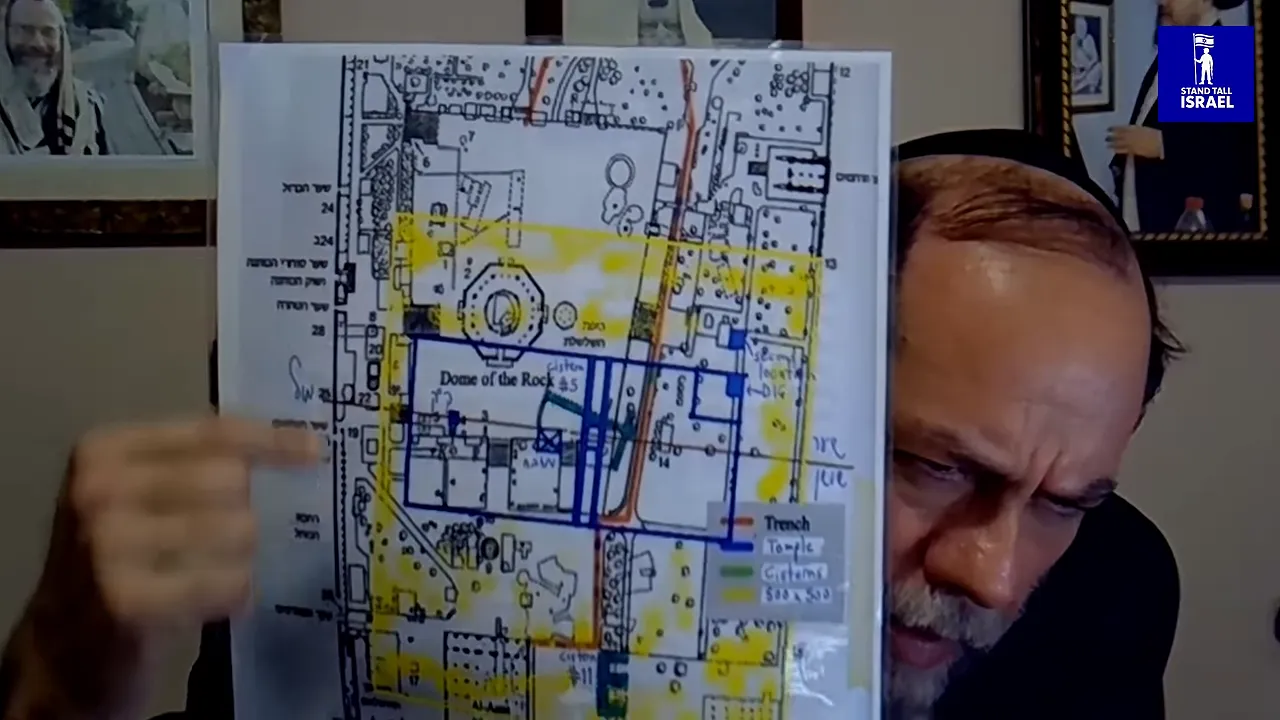
The argument is that the Ark was lowered into a chamber beneath the Holy of Holies before the Temple’s destruction. The Temple service, altar, and sacred geography were connected. In this understanding, the Ark remained directly below the proper Temple location for roughly 2,700 years.
New mapping claims and remote-sensing discussions are interesting, especially where they suggest possible outlines beneath the Temple Mount. But they are not the final word. The Temple Mount is one of the most politically, religiously, and archaeologically sensitive places on earth.
Curiosity is good. Recklessness is not. The holiness of the site demands humility.
Jerusalem’s Jewish History Is Not a Mystery
The location of the Temple treasures may be disputed. The location of the Ark may be debated. But the Jewish connection to Jerusalem is not some vague theory waiting to be invented.
Archaeology keeps confirming it. Inscriptions, coins, ritual baths, ancient streets, seals, walls, and countless excavated objects all tell the same basic story. Jews were not foreign colonizers with no roots in Jerusalem. The Jewish people are deeply connected to this land, this city, and this history.
That is why the search for Temple treasures matters beyond archaeology. It pushes back against false narratives. It reminds us that Jewish history in Jerusalem is not a modern political claim. It is written into the ground.
The Search Continues
Maybe some Temple treasures are in Rome. Maybe others are hidden beneath Jerusalem. Maybe some are gone forever. And maybe, when the right time comes, doors that seem sealed will finally open.
For now, the work continues through research, diplomacy, historical records, careful investigation, and faith. No hype. No fake news. No pretending that a theory is a proven discovery.
But also, do not surrender the question just because it is difficult.
The Temple treasures may still be waiting. And the story of Jerusalem is far from finished.
>> VISIT WEBSITE: IsraelInTheir Land.com
RESOURCES:
This article was created from the video Is the Vatican HIDING the Lost Temple Treasures? | Rabbi Harry Moskoff | https://www.youtube.com/watch?v=neNojrEpUCE with the help of AI.
PHOTOS & VIDEOS Use According to Section 27 A