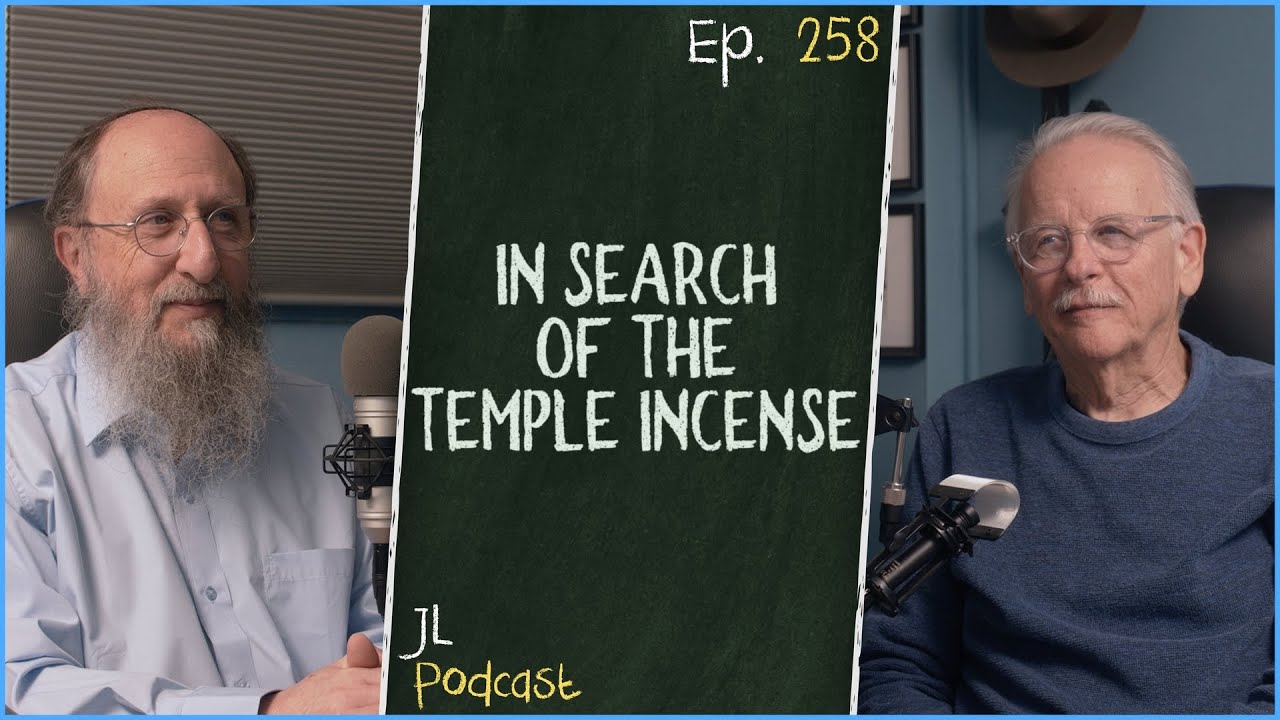
Holy Temple Incense is one of the Torah’s most beautiful mysteries. It is also one of its most powerful. A carefully prepared blend of spices. A sacred cloud rising inside the Sanctuary. A service so beloved before Hashem that it has the power to sweeten harsh decrees, unite what has been fractured, and lift the whole world toward its true purpose.
And, yes, this is a subject that can make a person very excited. There is history here. Archaeology. Torah. Deep spiritual teachings. The mysteries of the Copper Scroll. The legacy of the late Vendyl Jones. And an extraordinary new documentary project that is following these threads right to the places where they may have unfolded.
The story of Holy Temple Incense is not merely about a fragrance from the past. It is about the future. It is about understanding what the Holy Temple service means for Israel, the nations, and a world hungry for wholeness.
The goal is not nostalgia. The goal is redemption, a world in which humanity recognizes Hashem and learns to live in harmony with His will.
The Sacred Cloud of the Ketoret
The Hebrew word for the incense offering is Ketoret. The Torah describes its preparation in Exodus chapter 30. Four ingredients are named explicitly: stacte, onycha, galbanum, and pure frankincense. But the complete formula contains eleven ingredients, with the remaining seven preserved through the Oral Torah handed down to Moses at Sinai.
This was not an ordinary mixture of pleasant spices. Holy Temple Incense was prepared with great precision, ground in a particular manner, and made in a quantity sufficient for the entire year. It belonged solely to the service of the Holy Temple.
When it was offered, the Ketoret filled the Sanctuary with a cloud. That cloud called to mind the revelation at Mount Sinai, when the mountain was enveloped in cloud, and the presence of Hashem was revealed to Israel. In the Holy of Holies, the Kohen Gadol was not simply performing a ritual. He was entering a space that recalled the most profound encounter between heaven and earth.
The cloud of incense teaches that the Holy Temple is not a museum of ancient symbols. It is a meeting place between this world and the One who created it.
The sages teach that the Ketoret held a special place among the Temple services. It represents the elevation of the material world. Plants, resins, spices, fragrance, fire, and human intention all come together in a single act of service.
That is why the Holy Temple Incense speaks so directly to the human condition. Torah does not ask us to flee the physical world. It teaches us to sanctify it. The challenge is not to reject the world, but to reveal the holiness concealed within it.
Why Holy Temple Incense Could Stop a Plague
The Torah provides a dramatic example of the Ketoret‘s spiritual power in the aftermath of Korach’s rebellion. A plague broke out in the camp of Israel. Aaron took a fire pan with incense and ran into the midst of the people. He stood between the living and the dead, and the plague stopped.
This is not a magic trick. It is a window into the nature of the offering. The Holy Temple Incense can bring repair where destructive forces are at work. It expresses unity, balance, and the restoration of a damaged relationship between humanity and Hashem.
One traditional teaching helps explain this. Among the ingredients was galbanum, a spice with an unpleasant odor when standing alone. Yet it was included in the sacred blend. The message is dazzling. The community is not complete by excluding those who seem distant, damaged, difficult, or spiritually unrefined. The holy mixture requires every element to be brought into its proper place.
Even what seems bitter can become part of something holy when it is brought into the service of Hashem.
This is a major theme of Holy Temple Incense. The Ketoret does not deny that the world contains disorder. It transforms disorder through service, repentance, and the return of every spark to its source.
Keturah, Fragrance & a Changed Destiny
The Torah’s language often carries layers upon layers of meaning. One striking connection is the name Keturah, the woman the sages identify with Hagar after Hagar’s return to Abraham. Her name is linked with Ketoret, the incense.
Names matter. A changed name can signal a changed destiny, a new spiritual direction, and a repaired identity. Keturah is associated with righteousness and with the fragrance of the incense. Her story carries the possibility of reconciliation after pain and separation.
There is something very tender here. The fragrance of Holy Temple Incense points to restoration. It points to the ability of a person, a family, or even a fractured world to return to purity and purpose.
The Discovery Near Qumran
The subject of Holy Temple Incense became even more compelling through the work of the late Vendyl Jones, a remarkable researcher who spent decades searching for Temple treasures. In 1992, during an excavation in the Judean Desert region, a large cache of reddish organic material was uncovered in a cave.
At first, people casually called it “red dirt.” But it did not behave like dirt. A simple test showed that it dissolved on the tongue, indicating that it was organic material rather than ordinary soil. The material had been stored beneath stones and appeared to have been deliberately hidden.
It also appeared to be unfinished. It had not been placed into the special vessels that would have been used for a sanctified Temple offering. This suggested it had been prepared but buried before it could be fully completed for sacred use.
Scientific testing produced extraordinary results. Dr. Rabbi Antelman, an eminent chemist associated with the Weizmann Institute of Science, conducted a mass spectrometry analysis. The reported findings identified all eleven ingredients associated with the Ketoret blend.
Later pollen analysis was also said to identify the components, including ma’aleh ashan, the “smoke-raiser,” a plant ingredient traditionally understood to make the smoke rise in a straight column.
The question is not only what was found. The question is why it was hidden, who hid it, and what its preservation may be telling us today.
The material was tested under rabbinic guidance. Because it was not considered a completed, sanctified offering ready for Temple service, permission was granted to test a sample. When it was heated through an acid process, an intense fragrance reportedly filled the laboratory. Later recollections of the scent included cinnamon and frankincense, both fitting the mixture’s known character.
The story is astonishing. But it also raises questions. Why has this evidence not received broader attention? Why was a possible remnant of Holy Temple Incense preserved in this particular desert region? And what is its relationship to the famous Copper Scroll?
The Copper Scroll’s Unfinished Mystery
The Copper Scroll was discovered in 1952 in Cave 3 near Qumran. Unlike the other Dead Sea Scrolls, it is not a religious teaching, a biblical manuscript, or a narrative text. It is an inventory. It lists locations and enormous quantities of gold, silver, vessels, and treasures.
That dry, practical quality is exactly what makes it so tantalizing. There is no fictional plot. No attempt to entertain. It reads more like a catalog of items and hiding places.
Some scholars have dismissed it. Others believe it preserves a genuine record related to treasures from the Holy Temple period. The vast quantities described seem fantastic to modern ears, but ancient Israel in the era of King Solomon was not a poor or insignificant kingdom.
The Copper Scroll was written in Hebrew, though its language and script differ notably from those of other desert documents. Interpretation is not always simple. A word may be translated in more than one way, and tiny differences can affect whether a passage refers to a vessel, a location, or something else entirely.
One early translation included a reference that some understood to concern incense stored in vessels. This is one reason the cache discovered by Vendyl Jones has drawn such interest. The possible relationship between the Copper Scroll, Temple treasures, and the preserved blend of Holy Temple Incense remains one of the great unsolved questions.
Sometimes a mystery is not a dead end. Sometimes it is an invitation to look more carefully.
A new documentary is now exploring this entire journey. It follows the historical evidence, visits the caves and the Dead Sea region, examines relevant artifacts, and brings together scholars and researchers to consider the Ketoret from every angle.
It is not merely a film with a talking head or two. It is a real journey of discovery, including an effort to visit the original Copper Scroll in Jordan and explore the questions that still surround its history.
Use It Correctly: The Lesson of King Uzziah
The holiness of the Ketoret also teaches a sobering lesson. King Uzziah, known in the Tanakh as a powerful king of Judah, attempted to offer incense even though this service was not part of his role. He was immediately afflicted with tzaraat, a serious spiritual and physical condition often inaccurately translated as leprosy.
His story is a reminder that Holy Temple Incense is not a spiritual accessory. It cannot be seized, copied, or used for personal ambition. Holiness requires humility. Service requires boundaries. And the desire to come close to Hashem must be joined to the willingness to do things His way.
That distinction matters today. People often want spiritual intensity without discipline, inspiration without responsibility, or revelation without covenant. Torah offers something much deeper. It gives a path. It gives commandments. It provides a way to bring holiness into daily life without reducing it to self-expression.
Rabbi Avraham Sutton’s Major Work
For those seeking to understand the inner dimension of Holy Temple Incense, a major work by Rabbi Avraham Sutton is of enormous significance. His forthcoming volume, The Spiritual Significance of the Incense, promises to fill a serious gap in available Torah literature on the Ketoret.
Rabbi Sutton is a major Torah scholar, teacher, and author. He is known for works including Innerspace, Spiritual Technology, and the two-volume Handbook of Jewish Thought. He also completed and edited unfinished works of Rabbi Aryeh Kaplan with such sensitivity and precision that the continuity is seamless.
His new work is described as extensive, scholarly, and spiritually rich. It explores the historical, halachic, mystical, and universal dimensions of the Ketoret. It is also dedicated to Vendyl Jones, whose influence reached far beyond archaeology.
Knowledge of the Ketoret is coming to the forefront at exactly the moment when the world needs to understand what repair, unity, and holiness really mean.
The Noahide Path & The Noach Project
The message of Holy Temple Incense reaches beyond Israel alone. The Holy Temple is called a house of prayer for all nations. Its service expresses the elevation of all humanity, not the spiritual isolation of one people from another.
This is why the Noahide path is so important. The seven Noahide laws are the universal covenant made with Noah after the flood. They are not a lesser path. They are a holy path for Gentiles who seek to serve Hashem sincerely and live according to His moral order.
A newly published book, The Noach Project: Navigating the Path of the Seven Noahide Laws, Stories, Key Lessons, and Resources, gathers personal accounts from Noahides around the world. These are people from many countries and backgrounds who found their way to Torah, to the seven laws, and to a life centered on the Creator.
What makes the book especially moving is its honesty. People share their struggles, questions, discoveries, losses, family challenges, and moments of grace. Each story is followed by practical lessons.
- Hashem opens doors when a person searches sincerely.
- One need not convert to serve God faithfully.
- Torah-based books can become teachers at exactly the right moment.
- Holiness does not require isolation from family or responsibility.
- Pain can be the beginning of healing and transformation.
- A steady teacher and a consistent path matter in a confusing world.
The Rambam teaches that Israel has a responsibility to make the seven Noahide laws known to the nations. Israel has 613 commandments and a unique calling as a priestly people. But every human being can live in covenant with Hashem.
Do not try to please every voice in the world. Seek to please Hashem. That is where clarity begins.
Jacob, Esau & the Repair of History
The fragrance of Holy Temple Incense also points toward the final repair of history. This is connected to the story of Jacob and Esau. Jacob represents Israel’s spiritual mission, but that mission was never meant to reject the physical world. It was meant to elevate it.
Isaac saw strength, courage, and potential in Esau. He hoped for a person with “the hands of Esau” and “the voice of Jacob,” someone who could bring spiritual truth into the hard realities of the world.
But Esau chose a different direction. He became Edom, a name connected with red earth and with a life increasingly consumed by physical power, domination, and material appetite. Jacob, later called Israel, was given the task of bringing physicality under the guidance of the soul.
The goal is not endless conflict. The ultimate repair for Jacob and Esau is reconciliation under Hashem’s sovereignty. The wrestling match must finally become an embrace.
That is the larger message of the Ketoret. The world is not beyond repair. Its scattered pieces can be gathered. Its bitterness can be transformed. Its physical power can be redirected toward holiness.
Be Alive While You Are Alive
There may be endless mysteries in the universe. There may be secrets governments keep, unanswered questions in archaeology, and worlds that we barely understand. But the immediate task is right here.
The Kotzker Rebbe once taught that he knew the secret of bringing the dead back to life. The difficult question, he said, was how to make the living truly alive.
That is the work before us. To become awake. To serve Hashem with sincerity. To treat people with kindness. To deepen our knowledge of Torah. To raise the sparks of holiness hidden in this world.
Holy Temple Incense teaches that every part of creation can become fragrant when it is returned to its proper purpose. May the study of the Ketoret lead to greater truth, greater unity, greater repentance, and the rebuilding of the Holy Temple in our days.
May we all shine a little more light, draw closer to Hashem, and help make this world the dwelling place it was meant to be.
RESOURCE: Discussing the Holy Temple Incense and the Noach Project | https://www.youtube.com/watch?v=e9snBu9Dtx0