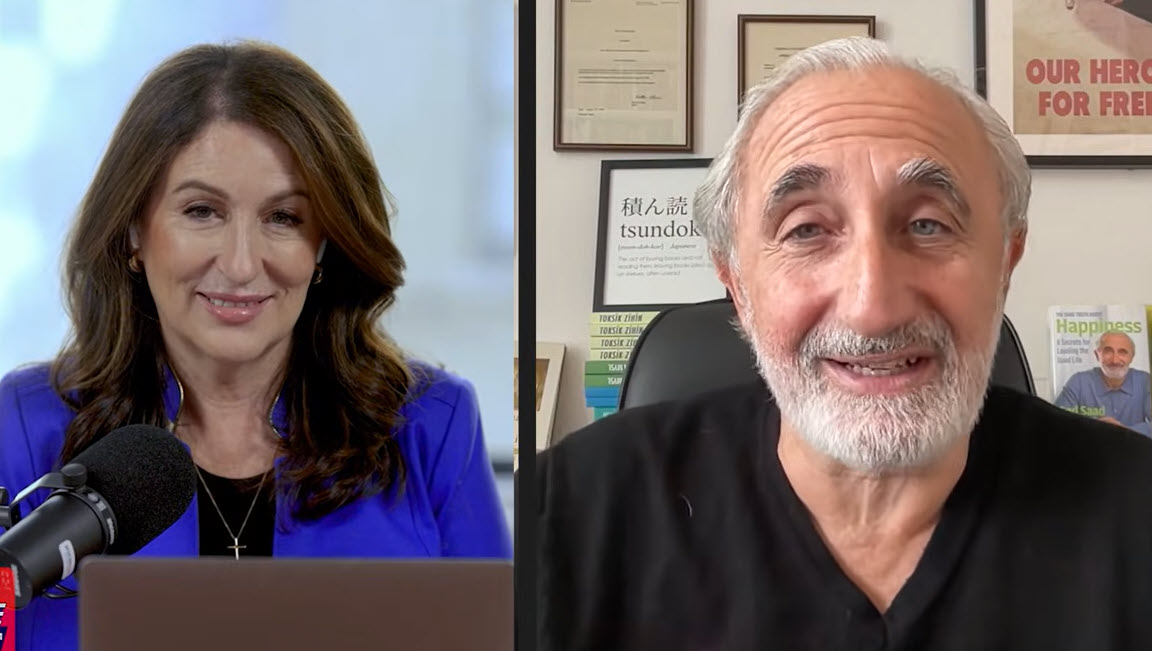
Dr. Gad Saad joins Miranda Devine on Pod Force One to explain his concepts of “suicidal empathy” and “mind viruses,” linking them to everything from Trump Derangement Syndrome to gender ideology, cultural relativism, Antisemitism, and his own childhood escaping civil war in Lebanon.
Suicidal Empathy & the Parasitic Mind
Saad traces “suicidal empathy” back to his earlier book The Parasitic Mind, where he argued that just as brain worms can hijack animals, humans can be hijacked by parasitic ideas that rewire both thinking and feeling. He uses the example of a wood cricket infected by a hairworm that compels it to jump into water and die so the parasite can complete its life cycle. He extends this neuroparasitological framework to human ideological capture.
- The “parasitic mind” targets the cognitive system and distorts rational thinking.
- “Suicidal empathy” targets the emotional system, hyperactivating empathy so it becomes self-destructive instead of adaptive.
- Properly modulated empathy is an evolved virtue in a social species. In contrast, dysregulated empathy misfires like obsessive compulsive disorder, which Saad frames as an adaptive threat-scanning system pushed into pathological overdrive.
He also links empathy to the theory of mind, noting that autistic children typically fail theory-of-mind tests, and argues that critics misrepresent him as wanting a world without empathy when he is actually warning about poorly targeted, hyperactivated empathy.
Trump Derangement Syndrome & Emotional Thinking
When Devine asks if Trump Derangement Syndrome (TDS) is an example of suicidal empathy, Saad says it is better seen as a particular form of parasitic thinking that reveals a misapplication of emotion over cognition.
In his view, when evaluating a political leader, people should primarily use their cognitive systems, yet those with TDS respond with aesthetic and affective reactions rather than policy critiques.
- He notes that people with TDS typically say Trump “disgusts” them or call him grotesque or an eighth-grade brawler, rather than citing disagreements with monetary or fiscal policy.
- Saad calls this an “aesthetic injury,” especially among “highfalutin” progressive elites who cultivate particular manners, speech patterns, and identities, then feel existentially threatened when someone with none of those affectations reaches the highest office.
- He argues that Trump’s overt hypermasculinity clashes with ideas from specific liberal colleges that treat masculinity as inherently pathological, provoking hostility in those who reject evolved gender roles.
Saad also contrasts the support he receives from military and special forces personnel with criticism from progressive academics, framing this as a parallel to reactions to Trump’s persona.
Civilizational Seppuku & Cultural Relativism
Saad introduces the term “civilizational seppuku” to describe what happens when suicidal empathy operates at the level of entire societies.
Drawing on Japanese honor culture and the ritual suicide of seppuku as a path to reclaim lost honor, he argues that Western elites engage in a kind of collective self-destruction to atone for supposed civilizational shame.
- In this mindset, the West is portrayed as inherently evil, transphobic, and Islamophobic, and built on slavery, which creates a moral drive to demonstrate infinite tolerance and self-sacrifice.
- He applies this framing to religious and political leaders, including the Pope and bishops who criticize strict immigration and deportation policies while living behind guarded walls, calling their stance a luxurious performance of suicidal empathy.
- Saad emphasizes that parasitic ideas, such as cultural relativism, first erode belief in absolute moral truths, leaving people unable to condemn practices like female genital mutilation without being called racist.
He credits Franz Boas with originating cultural relativism from a “noble reflex” aimed at avoiding biological misuse. Still, he argues that, in practice, it has “murdered” reality by denying biology and objective morality in favor of utopian visions where everyone holds hands and sings “Imagine.”
Mind Viruses, Gender Ideology & Social Change
From Saad’s perspective, multiple mind viruses have been incubated over decades in universities and then exported into the broader culture.
He places postmodernism and cultural relativism among these parasitic ideas, arguing that they collectively loosen cognitive and emotional defenses, leading people to accept increasingly detached-from-reality positions.
- He points to current confusion around basic sex categories in sports, noting that for the estimated 117 billion humans who have ever lived, distinguishing male and female in sexually reproducing species was straightforward until very recently.
- Saad argues that requiring specialized experts and elaborate frameworks to sort athletes into male and female categories shows how far from reality society has drifted once mind and emotions are “parasitized.”
- He likens illegal immigration debates to conflating a house cat and a wild lion just because both are felines, using this analogy to criticize the claim that all immigrants and all forms of immigration are morally and practically equivalent.
He dates several of these mind viruses: cultural relativism at roughly 100 years old and postmodernism at about 50 to 60 years old, and compares COVID to a catalyst like the shingles trigger that draws out underlying dormant problems rather than creating them from scratch.
Immunity, Parenting & the Honey Badger
Devine asks whether some people are immune to mind viruses and how parents might protect their children. Saad says his research with graduate students explores individual differences that may confer resistance, likening them to genetic variations that influence disease susceptibility.
- He suggests that attending certain liberal arts colleges increases the risk of ideological infection, though some people emerge either intact or even more skeptical, or “radicalized” in the opposite direction.
- For parents, he stresses active involvement rather than a magic formula, recounting how his grade-six daughter posted Black Lives Matter materials on a science teacher’s board, prompting him to write a firm but polite email that led to the removal of the BLM sign.
- Saad highlights the importance of “activating your inner honey badger,” referencing the small but ferociously fearless animal that even lions avoid, and uses it as a metaphor for standing firm on first principles without backing down.
He clarifies that this honey badger posture is not a call to physical violence but to intellectual courage, encouraging students to politely challenge professors’ sweeping claims, such as allegations of ongoing genocides, by asking for data.
Childhood in Lebanon & Becoming a Honey Badger
Saad grounds his honey badger persona in both temperament and formative experiences as a Lebanese Jew during the civil war.
He describes his family as part of a tiny Jewish community deeply embedded in Lebanese society, yet increasingly endangered as sectarian tensions escalated.
- He recalls early experiences of antisemitism, including crowds shouting “death to Jews” after Egyptian President Gamal Abdel Nasser’s death and a classmate proudly declaring a desire to become a “Jew killer” in front of teachers and peers who laughed and applauded.
- Saad recounts that his older brother, a multiple-time Lebanese judo champion, was pressured to retire because it was considered shameful for a Jew to dominate a combat sport, prompting the brother’s move to France before he later represented Lebanon in the 1976 Montreal Olympics.
- He narrates the family’s perilous departure from Lebanon during the war, protected by an armed PLO militia escorting them through checkpoints where ID cards labeled Jews as “Israeli” rather than Lebanese, which could easily have resulted in their deaths.
Later, his parents’ difficulty adjusting to life in Canada led them to return to Lebanon for business, where they were kidnapped and tortured by Fatah in 1980, leaving his father with facial paralysis and scars and leaving Gad, then a teenager, fearing for his mother’s safety and honor.
Hospitality, Reciprocity & Human Complexity
Despite his criticism of political Islam and certain ideologies, Saad makes a careful distinction between individuals and doctrines.
He emphasizes that Muslims also protected his family at critical moments, and he praises the deep cultural norm of hospitality in Arab societies.
- He describes Bedouin hospitality in the desert as an evolved tit-for-tat system: protecting a stranger today encourages reciprocity when roles reverse.
- Saad interprets the PLO militia’s decision to safely escort his family to the airport as honoring an implicit contract of protection rather than simple transactional cruelty.
- He also notes that friends in Lebanon who helped secure his parents’ release warned them never to return, and his parents respected that warning.
For Saad, these experiences fuel his determination to warn Western societies against reproducing the sectarian and ideological conditions from which his family escaped.
Religion, Skepticism & Happiness
Saad describes himself as deeply attached to his Jewish identity but not highly observant, partly because early encounters with rigid ritual elicited skepticism.
As a child in synagogue, he questioned why certain rituals required standing, sitting, or precise candle-lighting times and felt frustrated by “just do it” responses.
- He jokes that it is hard to believe the creator of the universe fixates on whether candles are lit at 4:21 or 4:22, using this to illustrate his lifelong resistance to orthodoxy and groupthink.
- He attributes his ability to use humor, sarcasm, and satire when addressing dark topics to a naturally sunny disposition, which led him to write a lesser-known book on happiness between The Parasitic Mind and Suicidal Empathy.
- Although temperamentally optimistic, he says he is increasingly pessimistic about the West’s trajectory because he does not see a sufficient autocorrective reflex to reverse current cultural trends.
He notes that many readers and viewers have asked about his secret to staying upbeat while dealing with grim subjects, which he traces partly to his nature and partly to deliberate perspective-taking.
Social Media, Politics & Machiavellian Intelligence
Saad argues that the current “cocktail” of mind viruses is especially toxic in an age of social media and widespread connectivity, which accelerates dissemination but does not create the underlying ideas.
He also discusses how political and business actors often intuitively use evolutionary psychology principles, even if they never studied the field.
- He associates Machiavellian intelligence with the ability to read people and adapt one’s behavior, noting that successful salespeople and negotiators adjust their pitch to each audience, a trait he also attributes to Donald Trump.
- Devine suggests that Trump’s habit of speaking warmly about leaders like Kim Jong Un or Vladimir Putin functions like method acting, allowing him to convince himself that he likes them in order to make deals, and Saad calls this description “perfectly stated.”
- Saad points out that business practitioners often embrace evolutionary psychology insights more readily than academics steeped in social constructivism, because businesspeople care about what works rather than defending ideological commitments.
He also criticizes public intellectuals who, in his view, shift positions on gender issues only when the cultural winds change, arguing that some are motivated more by elite acceptance than by a commitment to truth.
Antisemitism, Self-Serving Bias & Jewish “Sharks”
In the final segment, Devine asks whether Antisemitism might be the ultimate mind virus because of its persistence and recurrence.
Saad agrees that while all bigotry is harmful, Jew-hatred is remarkably enduring and taps into deep psychological mechanisms beyond theology.
- He invokes the self-serving bias, where individuals attribute success to internal factors and failure to external ones, and argues that antisemitism offers a universal external scapegoat for both personal and collective failures.
- Saad gives examples of conspiratorial thinking that blames Jews for everything from pornography to world events, including a case where Egyptian officials reportedly called sharks involved in tourist attacks “Jewish sharks” or “Zionists.”
- He cites Amy Chua’s idea of “market-dominant minorities.” He notes that Jews have consistently outperformed their numbers in many societies, leading resentful majorities to rationalize their own missed opportunities by blaming Jewish influence.
He doubts there is a “vaccine” that can eradicate bigotry. Still, he insists that societies must counter toxic narratives aggressively, especially in educational institutions, such as confronting instructors who repeat classic blood libels about Jews using children’s blood.
Fighting Back & Standing for Truth
Saad says his growing pessimism stems from how often attempts to defend threatened groups or principles are turned against him as evidence of sinister motives.
He describes receiving death threats after speaking out about persecuted Christians, only to be accused of trying to manipulate Christians and Muslims against each other as a “Jewish puppeteer.”
- He argues that this reflex to blame the messenger, rather than the perpetrators of violence, makes it harder to remain optimistic about reasoned discourse and moral clarity.
- Despite that, he calls for relentless engagement, telling Devine that people must keep entering the public arena to challenge destructive ideas and refuse quiet compliance, which he equates with “truth dying a bit” each time a falsehood goes unchallenged.
Devine ends by joking that perhaps the “Jewish sharks” story is the most absurd and revealing illustration of how mind viruses work.
RESOURCES:
This article was created from the video Dr. Gad Saad on Avoiding Liberal Brain Rot – Curing the Woke Mind Virus | https://www.youtube.com/watch?v=Cup7zMTbroI with the help of AI.
PHOTOS & VIDEOS Use According to Section 27 A
Watch More: WEST COLLAPSE - Death Wish Meets Death Cult...
- Muslims, Jews & the West’s Self-Hatred – Benedict Beckeld
- Why Israel Rejects Western Guilt | Dan Schueftan
GAD SAAD
-
- 'Suicidal Empathy': When a Civilization Can’t Name the Threat | Gad Saad
- Suicidal Empathy & Mind Viruses | Gad Saad
- Woke–Islamic Alliance? Immigration, Suicidal Empathy & Future of Western Culture | Gad Saad
- Gad Saad Destroys Piers Morgan’s Islam Narrative with Facts!
- Psychology of Irrational Empathy: Fueling Cultural Chaos | Dr. Scott Atlas & Gad Saad
- The West's Suicidal Empathy | Gad Saad
- Raymond Ibrahim—Islam, Islamic Conquests & Christendom | Gad Saad | MUST WATCH!
- Israel, Islam, the Jews & the West | Gad Saad
- Americans Have No Idea What the Islamic World is Planning… | Gad Saad | URGENT MESSAGE TO THE WEST
- 'Islam, Israel & the West': Truth, Freedom & the Fight for Civilization | Ex-Muslim
MORE