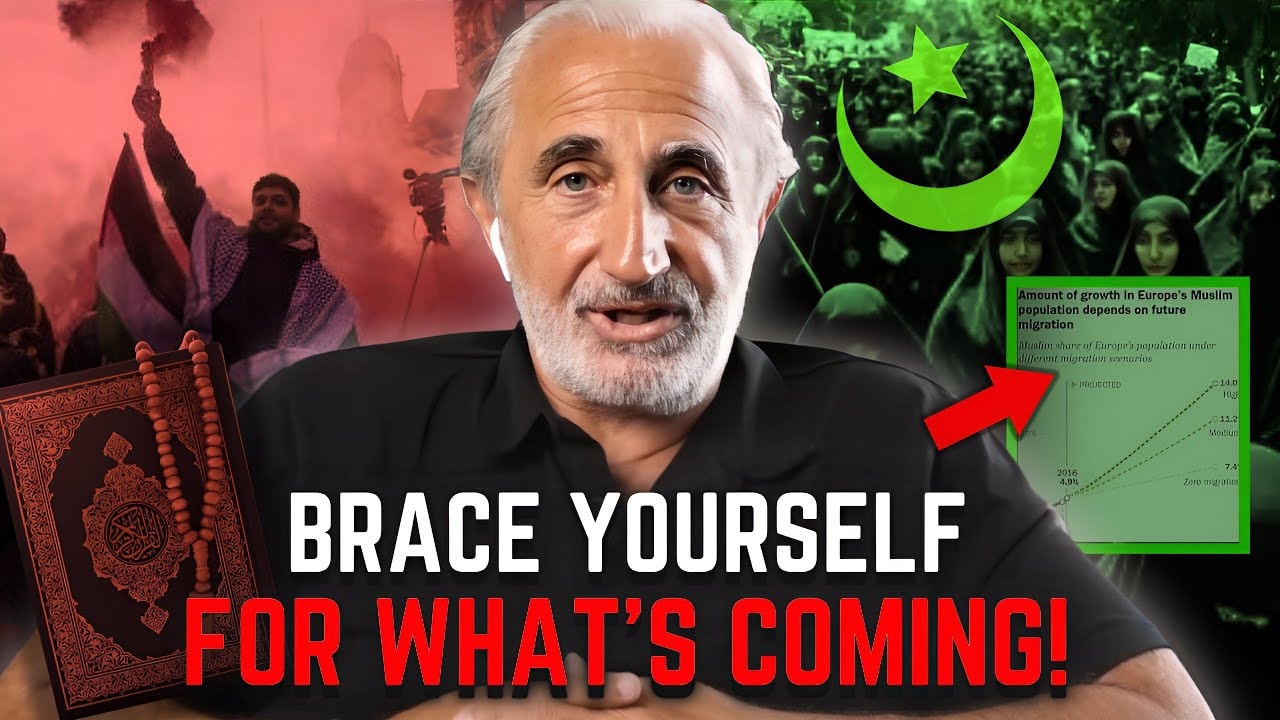
In a powerful and insightful discussion, Gad Saad sheds light on the complexities of the Middle East conflict and the broader ideological struggle involving Islam.
This article draws on Saad’s compelling analysis to explore the historical and contemporary realities shaping the region, challenging common misconceptions and urging a deeper understanding of the underlying forces at play.
The Legacy of Golda Meir’s Words
Golda Meir, Israel’s first female prime minister, famously captured the heart of the Israeli-Palestinian conflict with two poignant quotes. She observed that if Palestinians loved their children as much as they hated Israeli children, peace would be possible. She also stated that if Israel laid down its arms, there would be genocide, but if Palestinians did so, there would be peace.
These quotes illustrate that the conflict is not merely about land or territorial disputes but about deeply rooted existential fears and ideologies. Saad emphasizes that misunderstanding this dynamic leads to oversimplified narratives and missed opportunities for peace.
Understanding the Islamic World’s Duality: Dar al-Islam vs. Dar al-Harb
A central theme in Saad’s analysis is the Islamic concept of division between the Dar al-Islam (House of Islam) and Dar al-Harb (House of War). According to this worldview, the world is divided into lands under Islamic rule and lands yet to be conquered.
Once a land has been conquered by Islam, it remains, in religious law, part of the House of Islam—even if later lost politically. Conversely, lands that have never been under Islamic rule are considered domains to be brought under Islam, often by force. This framework explains the persistent drive for expansion and the intolerance toward non-Islamic societies in the region.
Historical Context of Islam’s Conquests
- Egypt: Coptic Christians, once the majority, now comprise about 10% of the population.
- Syria and Lebanon: Both countries, once predominantly Christian, have seen dramatic demographic shifts toward Muslim majorities within a single lifetime.
- Iraq and Persia: Ancient cultures and religions were supplanted by Islamic dominance.
Saad highlights that Islam’s historical expansion is unparalleled, often involving brutal conquest and forced conversions. The “sword of Islam” symbolizes this reality—not a metaphor for peaceful coexistence, but a literal ultimatum: convert, die, or live as a subordinate dhimmi (non-Muslim protected person), often treated as a second- or third-class citizen.
The Jewish Presence in the Middle East: A History of Endurance
Jews have lived in the Middle East for thousands of years, long before Islam’s arrival.
Saad points out that the notion of “Palestinians” as a distinct people is relatively recent and mainly emerged in the 1960s. Historically, the term “Palestine” referred to the Jewish inhabitants of the region, and the modern Palestinian identity is often intertwined with neighboring populations such as Jordanians and Egyptians.
Despite immense pressure and hostility, Jewish communities persist in the region, underscoring their deep-rooted connection to the land. Saad urges that teaching children—both Jewish and Muslim—about this shared history could pave the way for coexistence and mutual respect.
Debunking the Myth of Genocide
One of the most contentious accusations against Israel is the charge of intending genocide against Palestinians.
Saad dismantles this claim by noting that if Israel truly sought to exterminate Palestinians, it could do so rapidly given its military capabilities. Yet, the Palestinian population has increased fivefold, which contradicts the narrative of an ongoing genocide.
Instead, Saad argues, Palestinians are indoctrinated with the goal of “liberating” the entire land from the Jordan River to the Mediterranean Sea, a phrase synonymous with eliminating the Jewish presence. This ideological commitment to the removal of Jews, rather than peaceful coexistence, fuels the ongoing conflict.
The Broader Oppression of Indigenous Peoples in the Middle East
Saad expands the discussion beyond the Jewish experience to highlight the plight of other indigenous groups in the region, including Assyrians, Kurds, Coptic Christians, and others. All have faced various degrees of oppression and displacement at the hands of Arab Muslim majorities.
This historical pattern of erasure and subjugation illustrates that the Jewish experience, while unique, is part of a larger narrative of cultural and religious conquest in the Middle East.
The Call for Mizrahi Jewish Voices at the Forefront
Saad passionately advocates for Mizrahi Jews—Jews from Middle Eastern and North African backgrounds—to take a leading role in explaining the realities of the region.
He criticizes the dominance of American Jewish voices in public discourse, arguing that Mizrahi Jews bring firsthand experience and historical perspective crucial to understanding and communicating the complexities of the Middle East.
By elevating Mizrahi voices, Saad believes the global conversation about Israel, Judaism, and the Middle East can become more authentic, nuanced, and effective.
Towards Understanding & Coexistence
Gad Saad’s analysis challenges us to see beyond simplified narratives about the Middle East conflict. The issues are deeply rooted in history, ideology, and identity, far more complex than territorial disputes alone.
Understanding the Islamic worldview, the historical shifts in demographics, and the indigenous presence of Jews and other groups is essential. More importantly, fostering mutual recognition and respect—teaching children that coexistence is possible—may be the foundation for a lasting peace.
As Saad eloquently puts it, the path forward requires honesty, education, and the courage to confront uncomfortable truths. Only then can neighbors truly learn to love each other and build a shared future.
War Is Coming to Every Corner in the West
My appearance on the Legal Insurrection podcast gave me the chance to lay out a sober and uncomfortable diagnosis.
The West has, in recent decades, embarked on what I call a profound self‑immolation. Call it suicidal empathy, ideological parasitism, or simply political and cultural myopia. Whatever label you choose, the consequences are not hypothetical.
The West has, in recent decades, embarked on what I call a profound self‑immolation. Call it suicidal empathy, ideological parasitism, or simply political and cultural myopia. Whatever label you choose, the consequences are not hypothetical.
If current trends continue, the West faces an inevitable autocorrection, and it will not be pleasant.
Two Great Wars that Shaped My View
Two decisive conflicts explain why I talk the way I do.
The first war is literal: the Lebanese Civil War. I grew up in Lebanon, in a small Jewish community within an Arab culture.
We lived peacefully, until we didn’t. Families were kidnapped, tortured, and neighbors were butchered. That dissolution from peaceful coexistence into street‑to‑street violence is my first lesson: Societies can appear stable for a long time, then suddenly collapse.
The second war is intellectual: the war on reason. As a professor who spent decades trying to bring evolutionary biology into the social sciences, to “Darwinize” the business school, I encountered fierce resistance.
- Many social scientists insist that humans transcend biology, that evolution somehow stops at the neck.
- I saw, and still see, a systematic rejection of simple, empirically grounded explanations for human behavior.
- That rejection has allowed pernicious ideas to gain traction.
How I Reason About Looming Conflict
When people ask why I predict clash and turmoil, I don’t rely on panic or prophecy.
I use what I call nomological networks of cumulative evidence:
- Triangulating across cultures
- Time periods
- Methodologies
- Species to see whether a pattern holds
If toy preferences show sex‑specific patterns across human cultures and other primates, it’s reasonable to infer a biological component.
Apply that same methodology to political or religious ideologies, and complicated patterns emerge.
“If you let in millions of people into your country through open‑door immigration policies and these people do not share any of your foundational values… it probably doesn’t take a fancy professor to put it all together for you.”
We can disagree about timelines—five days, five years, fifty years, or even centuries—but if indicators point in the same direction, the extrapolation becomes hard to ignore.
Ronald Reagan’s idea of a rendezvous with destiny is apt. The West must decide whether it will preserve its founding freedoms or drift toward an era in which those freedoms are eroded.
The Parasitic Mind: Idea Pathogens & Neuroparasites
I wrote The Parasitic Mind to give a framework for what I call idea pathogens: infectious intellectual constructs that invade and derail thinking.
To explain how an idea can hijack behavior, I turned to biology and parasitology.
The metaphor that resonates the most is the wood cricket and the hairworm. The hairworm infects the cricket’s nervous system and compels it to seek water, leading the cricket to drown itself so the worm can reproduce. The infected cricket willingly commits suicide for the parasite’s reproductive benefit.
“The hapless, poor, zombified, parasitized wood cricket will happily jump and commit suicide in the service of the reproductive interests of the hairworm.”
When people adopt causes or identities that directly contradict their own interests, for example, some queer activists supporting movements that wish them dead, that’s wood‑cricket behavior.
The idea parasite rewires moral priorities and compels self‑destructive allegiance.
Postmodernism as the Granddaddy Parasite
The root parasite is postmodernism: the intellectual program that denies objective truth while proclaiming its own set of truths.
- Postmodernism allows other parasites to flourish—social constructivism, radical identity politics, and corrosive intersectionality—because it dismantles the very concept of objective evidence.
- Social constructivism, another major parasite, insists humans are blank slates whose every preference is only the product of culture.
- That denies biological realities and strips discourse of grounding facts, making societies vulnerable to poorly grounded moral panics and policy errors.
How Academia Enabled the Infection
These parasitic ideas were invented and nurtured in university departments. Why?
- Specific academic niches are decoupled from reality’s corrective mechanisms.
- If you espouse nonsense in engineering or finance, the world slaps you hard and quickly.
- In parts of the humanities, gibberish can masquerade as profundity—and gullible audiences, students, and credentialing systems reward the performer.
It doesn’t take many ideologues to infect an institution: like any pathogen, a small inoculum can produce a large outbreak.
The result is a generation of graduates steeped in intellectual fashions that don’t hold up under empirical scrutiny.
Identity, Collectivism & the Loss of Individual Dignity
The West was built on an idea of the individual: dignity, rights, and freedoms that belong to persons rather than tribes.
Today’s trends reverse that priority. Identity politics and tribal labels: I’m Muslim, I’m queer, I’m trans, I’m this or that. They recast citizens as members of immutable collectives.
That move from individual dignity to collectivist identity is historically toxic. It’s the same dynamic that has produced Rwanda’s, the Balkans’, and Lebanon’s descent into carnage.
When collective markers trump individual agency, societies become brittle.
People evaluate others by their tribal scorecard rather than their character or behavior. This stratification invites conflict.
Immigration, Assimilation & the Question of Compatibility
A central, practical issue is immigration and cultural compatibility.
Distinguish between individual adherents and ideologies. I count many Muslim friends among my closest allies; my critique is not of individual Muslims but of Islam as a codified ideological system and the historical patterns that system has produced.
If a polity admits millions from cultures or religions whose doctrines and practices are inconsistent with liberal freedoms, then the long‑run trajectory becomes predictable: erosion of rights and, eventually, conflict.
The Constitution guarantees freedom of religion and speech, but no polity is obliged to import ideologies that seek to abolish its founding liberties.
Analogies make this point. A house cat and an African lion are both felines, but you wouldn’t cuddle both. Bad categorization is dangerous.
Are We Too Late? The Uncomfortable Prognosis
I’m not a fatalist by temperament, but realism forces hard conclusions.
There are two possible trajectories:
- Peaceful autocorrection: The West wakes up, repudiates the parasitic ideas, reforms policy and institutions, and reasserts its founding values without bloodshed. This is possible but increasingly unlikely given current trends.
- Violent autocorrection: The corrective comes through conflict. When people finally realize the depth of the threat, the political and social response will be messy and likely violent.
Some parasites can be removed peacefully; public opinion has already turned against pronoun performativity in many quarters. But significant systemic issues, such as mass migration from unreformed societies, are less amenable to peaceful solutions in the absence of political will to act.
What Can be Done? A Practical Roadmap
Here are pragmatic, intellectually honest measures that can strengthen our defenses against idea pathogens:
- Reclaim epistemology: Reassert objective standards of evidence, deploy nomological networks, and stop treating every moral or social claim as equally valid without proof.
- Defend individualism: Reaffirm that personhood and rights are individual, not tribal, and that collective identities cannot supersede personal dignity.
- Reform higher education: Incentivize disciplines that are accountable to reality and penalize intellectual fashions that lack empirical grounding.
- Pragmatic immigration policy: Admit migrants who will assimilate to liberal values; be honest about the cultural consequences of mass admissions from societies at odds with those values.
- Build a mind vaccine: Teach critical thinking, scientific literacy, and how to spot ideological parasitism—inoculation against the next wave of bad ideas.
None of this is easy, and the key obstacle is not intellectual—it is moral and political will. Democracies can choose to act, but only if citizens demand it.
Wake Up Before the Wakeup Call
I do not relish giving somber warnings. I prefer humor, and I am often called the “happy warrior.” But some problems demand gravity.
The West has committed self‑damaging errors of empathy and ideology. If we want to avoid a future marked by violence and loss of liberty, we must recognize the infection, understand its mechanisms, and inoculate our institutions and minds.
“The West has committed the greatest self‑immolation in human history.”
Read, think critically, and push back against intellectual fashions that refuse evidence. If you want the framework and the tools to do that, The Parasitic Mind lays them out—and my next book, Suicidal Empathy, will probe why our best impulses sometimes lead to our worst outcomes.
The choice is still ours: Preserve the West’s founding freedoms, or watch them be eroded.
— Gad Saad
RESOURCES:
This article was created from the video Gad Saad “Americans Have No Idea What The Islamic World Is Planning…” | https://www.youtube.com/watch?v=JcKYm2w8eJo with the help of AI.
PHOTOS & VIDEOS Use According to Section 27 A
Watch More: WEST COLLAPSE - Death Wish Meets Death Cult...
- Muslims, Jews & the West’s Self-Hatred – Benedict Beckeld
- Why Israel Rejects Western Guilt | Dan Schueftan
GAD SAAD
-
- 'Suicidal Empathy': When a Civilization Can’t Name the Threat | Gad Saad
- Suicidal Empathy & Mind Viruses | Gad Saad
- Woke–Islamic Alliance? Immigration, Suicidal Empathy & Future of Western Culture | Gad Saad
- Gad Saad Destroys Piers Morgan’s Islam Narrative with Facts!
- Psychology of Irrational Empathy: Fueling Cultural Chaos | Dr. Scott Atlas & Gad Saad
- The West's Suicidal Empathy | Gad Saad
- Raymond Ibrahim—Islam, Islamic Conquests & Christendom | Gad Saad | MUST WATCH!
- Israel, Islam, the Jews & the West | Gad Saad
- Americans Have No Idea What the Islamic World is Planning… | Gad Saad | URGENT MESSAGE TO THE WEST
- 'Islam, Israel & the West': Truth, Freedom & the Fight for Civilization | Ex-Muslim
MORE