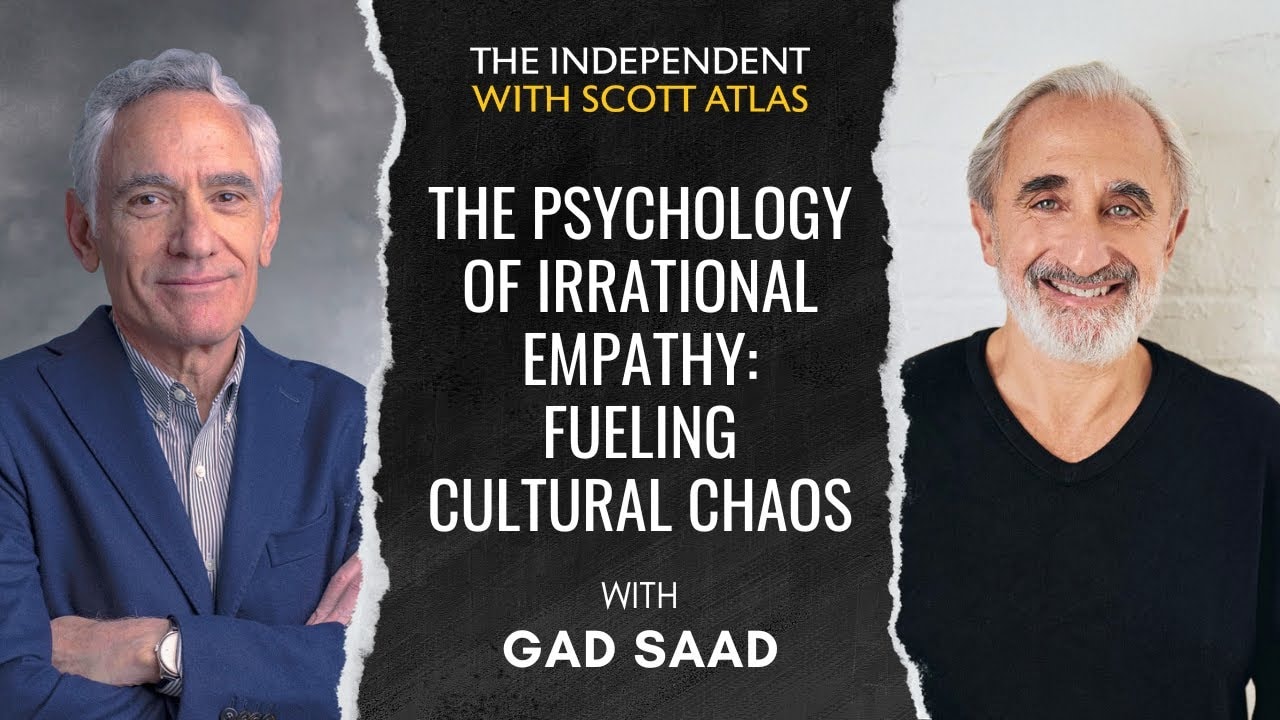
Recently, I joined Dr. Scott Atlas on his show, The Independent, to explain a framework I’ve developed over decades:
- How ideas can act like biological parasites
- How universities can incubate these “mind viruses”
- Why misplaced empathy is now driving disastrously illogical policies across society
Below, I summarize the key arguments I made on the program, illustrate them with examples, and offer practical ways to defend truth and common sense.
From Hairworms to Ideas: The Parasitic‑Mind Metaphor
To explain why otherwise intelligent people sometimes adopt absurd beliefs, I borrowed from a surprising corner of biology: neuroparasitology.
Some parasites actually hijack host brains to further their reproductive interests. A famous example: a hairworm infects a wood cricket and somehow flips the cricket’s circuitry so the insect willingly jumps into water, effectively committing suicide so the parasite can reproduce.
The wood cricket will merrily jump into the water, commit suicide in the service of the neuroparasite that has hijacked its brain.
That image is my epiphany. While humans can be infected by real brain parasites (Toxoplasma is one), they can also be infected by idea pathogens.
I call the result the parasitic mind, ideologies that hijack emotions, values, and reasoning to propagate themselves, often to the detriment of the host.
How Universities Incubate Mind‑Viruses
My academic journey, a PhD at Cornell, and work across business and behavioral sciences, showed me that evolutionary explanations for human behavior are frequently dismissed by supposedly rational scholars.
I first saw this clearly in a social psychology class after reading Homicide, a work that demonstrates the power of an evolutionary lens to explain recurring human behaviors.
Instead of welcoming biologically grounded explanations, many academics treated them as heresy.
- Over the last 30 years, I have watched ideas that originated in insular academic subcultures spread into the broader culture.
- What begins as an eccentric theory in a humanities seminar can, through prestige and institutional authority, become mainstream policy or political reflex.
- There is a cultural dynamic inside many universities that accelerates this process: a decoupling from reality inside the ivory tower.
- Professors who speak only to one another and reward obscurity create an environment where fashionable nonsense can flourish unchallenged.
I’ve had colleagues scoff at public engagement: “We don’t do our research so it’s sexy enough for Joe Rogan,” ignoring that explaining ideas to the public is often part of our professional duty.
Why We Defer to Credentialed Nonsense
Two psychological factors make academic mind‑viruses dangerous.
- Fundamental attribution error and authority bias: When a credentialed professor speaks in esoteric terms, many listeners conclude the speaker must be profound rather than the speaker being wrong. Students and leaders often assume expertise implies infallibility.
- Intimidation and deferential culture: Society teaches us to respect scholars. That reverence becomes a liability when the learned are decoupled from empirical reality and when leaders are laypeople intimidated into deferring to them.
That’s why we must judge ideas by their merits, not by the speaker’s awards, job title, or followers.
Suicidal Empathy: When Compassion Turns Destructive
- Empathy is an adaptive social emotion, one of the engines that hold societies together.
- But like any adaptive mechanism, it can hyperfire.
Think of obsessive‑compulsive disorder: scanning for contamination is adaptive; washing one’s hands to the point of injury is not. The same logic applies to empathy.
- I call the pathological extreme “suicidal empathy,” an empathy that is misapplied, disproportionate, or weaponized.
- When empathy becomes the overriding value, to the exclusion of all others, it leads to catastrophic policy and moral errors.
Examples abound:
- Prioritizing sympathy for violent gang members over the rights and safety of their victims or veterans who fought for the country.
- Forcing biological women to share sports or locker rooms with biological men ignores basic sex differences and safety concerns.
- Body positivity taken to the extent of glamorizing morbid obesity and denying clear medical evidence about health risks.
- Judicial or social responses that excuse or relativize criminal behavior because of identity narratives, e.g., framing offenders only as victims of systemic forces.
These are not cases of ordinary compassion. There are mismatches between empathy’s rightful targets and the emotional machinery being hijacked by an ideology that values signaling virtue above practical harms.
Why Virtue Signaling Spreads & Why People Conform
Multiple forces make suicidal empathy contagious:
- Secondary gains and signaling: Being seen as tolerant or compassionate confers social rewards, status, acceptance, and moral prestige. That creates incentives to publicly espouse empathetic positions regardless of sincerity.
- Social proof and conformity: People use others’ behavior as a shortcut to decide what to do. The famous Solomon Asch experiments show how strongly social pressure can override obvious evidence. In Asch’s study, ordinary people conformed to an obviously wrong majority answer just to fit in.
- Contextual triggers: Evolutionary priming matters. When people feel survival‑threatened, they’re more likely to stick with the herd; when mating motives are salient, they’re more likely to stand out. This helps explain why some moments produce mass conformity and others encourage dissent.
Conformity is not so much a moral failing as an evolved toolkit. The problem arises when that toolkit is exploited by ideological parasites and institutional incentives.
How to Defend Truth: Nomological Networks & Epistemic Humility
So how do we push back?
Two practices emphasized:
1. Build Nomological Networks of Cumulative Evidence
When you want to persuade, don’t rely on a single study or a warm intuition.
Assemble evidence from multiple domains, across cultures, across species, across time, and across methodologies that triangulate on the same conclusion. I call this a nomological network.
Example: the debate over whether toy preferences are socially constructed or biologically influenced. A powerful nomological network would include:
- Developmental studies show sex‑typed preferences in infants too young to be socialized.
- Primate research shows similar sex differences in play in monkeys and apes.
- Cross‑cultural data from non‑Western societies reveal the same patterns.
- Historical artifacts show continuity over millennia.
- Biological cases like congenital adrenal hyperplasia that alter hormones and push girls toward masculinized toy preferences.
When evidence converges from these diverse sources, you’ve done more than offer an argument. You’ve established a robust, hard‑to‑deny case.
2. Practice Epistemic Humility & Precise Claims
Be explicit about what you know and what you don’t. I’ve been on Joe Rogan many times and have hours of public content. Yet you’ll never catch me confidently pontificating about domains where I have no expertise. That discipline prevents careless statements that can be weaponized against you and undermine credibility.
People who worry about being canceled can often avoid it by sticking to what they can defend with strong evidence and by admitting uncertainty when appropriate. It’s not a guaranteed shield; extremists may still try to cancel dissenters, but it’s a powerful epistemic posture.
Politics, Awakening & the Long Fight
The popular political reactions we see, for example, the electoral surge behind figures like Donald Trump, are in part a pushback against cultural perversions that defy common sense. The pandemic accelerated this awakening by exposing how quickly institutions and experts can make catastrophic errors and demand public acquiescence.
But beware complacency. These parasitic ideas incubated over decades; one election or one administration won’t cure them. Trump’s election showed the appetite for pushback, but they are not a permanent vaccine. The struggle will require sustained cultural, educational, and intellectual work.
Practical Steps for Individuals & Institutions
- Teach and practice critical thinking: Evaluate evidence, not credentials; interrogate incentives.
- Build robust evidence before making public claims: use nomological networks rather than single‑study arguments.
- Encourage public intellectual engagement: scholars should explain important findings to the public rather than speaking only to peers.
- Resist virtue signaling as a substitute for honest moral reasoning: ask what policies actually accomplish, not which signal they send.
- Protect free inquiry in universities: guard against ideological monocultures that decouple research from reality.
Stand Up, Think Clearly & Speak Truthfully
We’re living through a cultural contest between epistemology and emotion‑driven signaling. The parasitic mind metaphor explains why smart people sometimes do dumb things: ideas can hijack our emotional and cognitive systems the way parasites hijack brains.
The antidotes are straightforward if not easy: build cumulative, cross‑disciplinary evidence; cultivate epistemic humility; teach people to judge ideas by arguments rather than by authority; and refuse to let virtue signaling replace moral and intellectual rigor.
If you care about restoring common sense to policy, education, and public life, then don’t wait for someone else to act. Speak honestly, document your claims broadly, and encourage others to do the same. That is how a culture heals, not by silence, not by fashionable compassion detached from consequence, but by reasoned empathy grounded in reality.
RESOURCES:
This article was created from the video The Psychology of Irrational Empathy – Fueling Cultural Chaos (THE SAAD TRUTH_1852) | https://www.youtube.com/watch?v=Qxywj4-PsuQ with the help of AI.
PHOTOS & VIDEOS Use According to Section 27 A
Watch More: WEST COLLAPSE - Death Wish Meets Death Cult...
- Muslims, Jews & the West’s Self-Hatred – Benedict Beckeld
- Why Israel Rejects Western Guilt | Dan Schueftan
GAD SAAD
-
- 'Suicidal Empathy': When a Civilization Can’t Name the Threat | Gad Saad
- Suicidal Empathy & Mind Viruses | Gad Saad
- Woke–Islamic Alliance? Immigration, Suicidal Empathy & Future of Western Culture | Gad Saad
- Gad Saad Destroys Piers Morgan’s Islam Narrative with Facts!
- Psychology of Irrational Empathy: Fueling Cultural Chaos | Dr. Scott Atlas & Gad Saad
- The West's Suicidal Empathy | Gad Saad
- Raymond Ibrahim—Islam, Islamic Conquests & Christendom | Gad Saad | MUST WATCH!
- Israel, Islam, the Jews & the West | Gad Saad
- Americans Have No Idea What the Islamic World is Planning… | Gad Saad | URGENT MESSAGE TO THE WEST
- 'Islam, Israel & the West': Truth, Freedom & the Fight for Civilization | Ex-Muslim
MORE