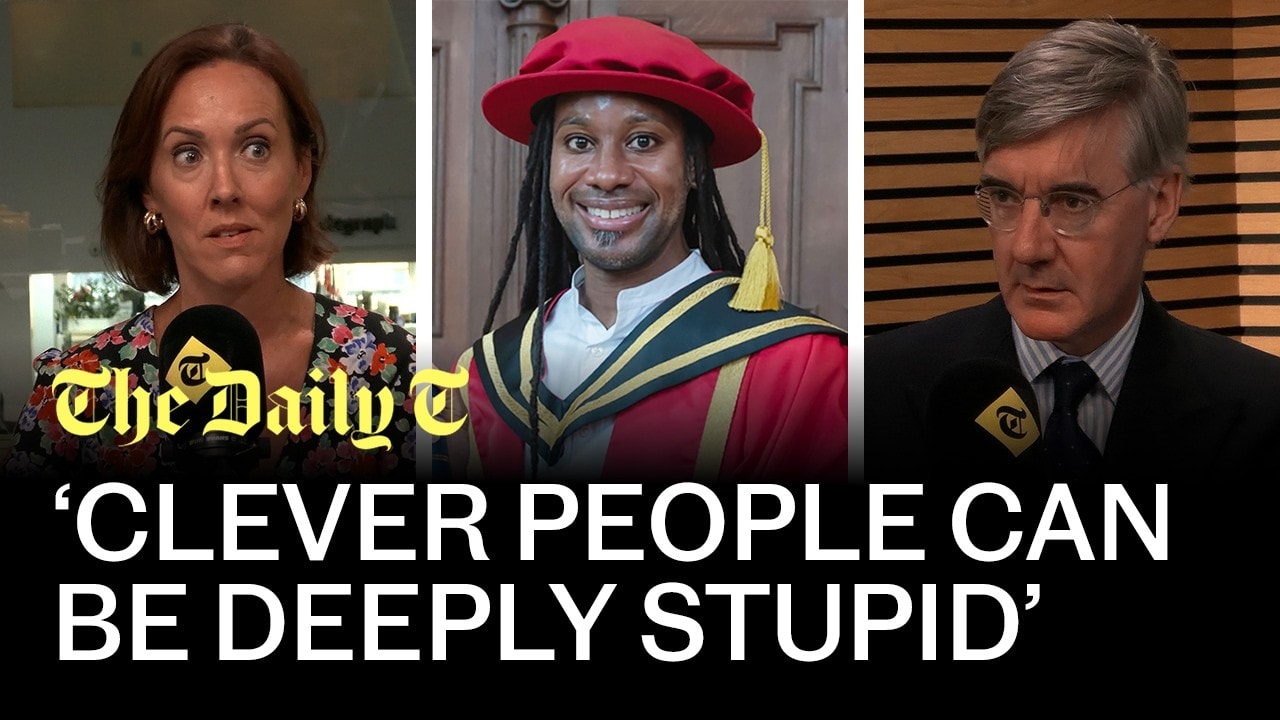
The Jason Arday controversy has grown far beyond one professor, one CV, or one university investigation. It has opened up a much bigger question about Cambridge University: what happens when an institution so proud of excellence appears to put fashion, image, and ideology ahead of basic academic standards?
That is the uncomfortable heart of this story. The allegations around Jason Arday are serious, but the wider concern is just as serious. Students expect good teaching. Universities should expect honest qualifications, rigorous research, and proper scrutiny. None of that should be controversial.
Yet the reaction to the Jason Arday case has revealed an atmosphere where asking ordinary questions can be treated as a moral offense. Ask whether a candidate’s claims stand up. Ask whether work was properly cited. Ask whether students were taught well. And suddenly, rather than receiving answers, critics can find themselves accused of bad motives.
“I don’t care what color you are. Are you good enough or aren’t you?”
That ought to be the beginning and end of university hiring. Merit matters. Teaching matters. Scholarship matters. And students deserve better than being caught in the middle of an institutional rush to look virtuous.
Takeaways
- Jason Arday’s allegations have intensified questions about Cambridge’s hiring, scrutiny, and academic standards.
- Students deserve capable teaching, fair marking, and lecturers with properly verified scholarly credentials.
- Universities should widen opportunity without treating identity as a substitute for merit.
- Legal pressure can prevent smaller publications from reporting matters of legitimate public interest.
The Allegations Surrounding Jason Arday
Jason Arday became one of Britain’s most celebrated academic success stories. His remarkable personal story, public profile, and rapid career progression made him an appealing figure for major institutions. But the allegations now being examined have cast doubt over aspects of that carefully built reputation.
Reporting has raised questions about claims made in his professional background, the quality and authorship of academic work, and allegations of plagiarism connected with his PhD. Jason Arday has also faced claims from a former student at Roehampton University about the quality of his teaching and his response when she challenged a mark.
These are allegations, not findings of guilt. That distinction matters. Everyone has a right to answer claims made about them and to be treated fairly. But universities also have a duty to examine serious concerns properly, especially when they involve senior academics responsible for teaching, marking, and supervising students.
“The issue is not celebrity. The issue is whether the scholarly bar was met.”
The former Roehampton student described lectures that were meant to last several hours but, she claimed, sometimes involved little more than an hour of teaching. She also alleged that sessions drifted into unrelated chat rather than giving students usable academic material.
One detail sticks in the mind. The student described another person on the course struggling in the library because she did not have enough solid notes to begin an assignment. That is not a minor complaint. It goes to the basic deal between a university and its students.
Students work hard for GCSEs and A levels. Many are the first people in their families to attend university. They take out loans and pay significant tuition fees. They deserve lecturers who are prepared, qualified, engaged, and capable of assessing their work fairly.
Students Pay the Price
The Jason Arday case is not simply about a professor’s career. It is about the students affected when universities fail to apply proper standards.
Cambridge may involve more independent learning than school. That is absolutely true. A university is not supposed to spoon-feed every answer. Students are expected to read, think, debate, research, and use the library. But independent study is not an excuse for inadequate teaching or unreliable marking.
If a lecturer cannot properly assess the work placed before them, then the value of the qualification itself comes into question. If students do not receive meaningful instruction, they are left to carry the consequences alone.
“You can expect students to work independently, but you cannot excuse poor teaching or poor marking.”
The former Roehampton student also claimed that Jason Arday responded to her question about a lower-than-usual grade by accusing her of “white privilege.” Her point, as described, was straightforward: she had been receiving higher marks and wanted to understand the difference.
Whether any particular marking decision was right or wrong is not the point here. The problem is the alleged use of a loaded ideological label to close down a question that should have received a calm academic answer.
A student should be able to ask, “Why did I receive this mark?” without being told that the very act of asking proves a moral defect. That is not education. It is intimidation dressed up as theory.
When DEI Becomes a Substitute for Judgment
The deeper worry in the Jason Arday story is that Cambridge may have wanted a symbol as much as it wanted a scholar.
Universities have spent years talking about diversity, equity, inclusion, decolonization, representation, and privilege. Some of those conversations can be worthwhile. Every institution should make fair opportunities available. Every student should feel able to succeed on merit.
But there is a sharp line between equal opportunity and lowering standards. There is also a sharp line between welcoming people from every background and treating identity as proof of talent.
“Positive discrimination can very quickly become plain old discrimination.”
A 2020 letter signed by students in Cambridge’s Faculty of Education called for hiring practices to be “decolonized.” Jason Arday was hired two years later, after the retirement of Professor Susan Robertson. Nobody should leap from those facts to a conclusion about one individual appointment. But the wider culture matters.
Senior academics should not be pushed around by campus campaigns or made to panic because a fashionable phrase has entered circulation. Their job is to exercise judgment. They are meant to say no when an idea is vague, unworkable, or incompatible with academic rigor.
What exactly does “decolonizing hiring” mean in practice? If it means ignoring competence in favor of race, it is not progressive. It is racist. If it means widening the pool of applicants while judging everyone honestly, that is a very different thing.
There is no contradiction between diversity and excellence. The danger comes when administrators pretend there is.
The Emperor’s New Clothes in Academia
Part of the trouble is that clever people can be terrified of appearing uncool or uninformed in front of other clever people. Nobody wants to be the person who raises a hand and asks what “white privilege” means in a specific situation. Nobody wants to say that “decolonization” has become a slogan rather than a useful policy.
So the jargon rolls on. People nod gravely. Human resources teams build policies around it. Academics hesitate. And students learn that certain phrases are not to be questioned.
“The emperor’s new clothes only work when everyone is frightened to say what they can plainly see.”
This is especially odd because universities are supposed to be places where ideas are tested, challenged, and sometimes thrown out. A good academic culture does not ban uncomfortable questions. It invites them.
The same point applies to debate over meritocracy, admissions policies, and the makeup of academic departments. Research can be debated. Data can be challenged. Conclusions can be disputed. But shutting down a discussion by immediately applying labels such as “racist” or “bigot” does not strengthen an argument.
It simply ensures that fewer people will speak honestly.
Lawfare, Privacy & the Chilling Effect
Another troubling feature of the Jason Arday case is the role of legal pressure. The Times Higher Education reporter Jack Grove had reportedly been investigating concerns over Arday’s academic work for months. A letter from lawyers at Carter Ruck challenged the reporting and reportedly suggested the story was racially motivated.
Legal representation is a right. Newspapers can get things wrong. Journalists should check claims carefully, offer a fair right of reply, and be held accountable for false or defamatory reporting.
But there is a difference between correcting inaccuracies and using expensive legal threats to make legitimate reporting impossible.
“A small publication can be right and still be unable to afford the fight.”
This is why so-called SLAPPs, strategic lawsuits against public participation, have become such a concern. A publication does not need to lose a legal case to be silenced. The cost, stress, and risk of a long fight may be enough to stop a story before it is published.
That creates a terrible imbalance. The people with money and powerful lawyers can control the public conversation, while smaller outlets may have to sit on matters that deserve scrutiny.
Cambridge’s reported position that an internal investigation was confidential raises another important issue. Universities may need confidentiality while conducting fair processes. But confidentiality cannot become a magic curtain behind which major institutions avoid public accountability.
Cambridge’s Leadership Must Answer
Pressure has naturally turned toward Cambridge’s vice chancellor, Deborah Prentice. She leads an institution with a global reputation and substantial resources. That leadership role brings responsibility when serious concerns emerge about a high-profile appointment and the culture that enabled it.
There are other problems in the background too. Cambridge has faced criticism after losing a whistleblowing tribunal connected to allegations of misogyny and concerns about efforts to suppress complaints. Reporting has also highlighted questions about a member of the same faculty who was previously a supporter of Hizb ut-Tahrir, a group banned in the UK.
Each matter has its own facts and should be treated fairly. But taken together, they create a picture of a university that needs to stop congratulating itself and start asking difficult questions.
“Academic excellence is not a branding exercise. It is a duty.”
Cambridge cannot simply present itself as the home of brilliance while appearing complacent about standards, free speech, whistleblowing, or staff vetting. Its reputation depends on public trust. Its funding depends on public trust. And its students’ futures depend on public trust too.
Merit Must Come First
The lesson from the Jason Arday scandal is wonderfully simple, even if universities have made it terribly complicated.
- Check qualifications thoroughly.
- Investigate plagiarism allegations seriously and fairly.
- Hire on ability, achievement, and integrity.
- Protect students from poor teaching and unreliable marking.
- Allow people to question fashionable ideas without fear.
- Do not confuse diversity targets with academic standards.
A university can welcome every background, every race, and every kind of life story while still demanding excellence from everyone. In fact, that is the only genuinely fair approach.
Jason Arday’s case deserves a proper process, not a social media mob. But Cambridge deserves no free pass either. If it promoted a compelling story without doing the boring but essential work of checking the facts, then it let down students, staff, donors, and the very idea of academic achievement.
There is nothing compassionate about giving someone a job they are not equipped to do. There is nothing inclusive about denying students the education they paid for. And there is nothing progressive about treating fair questions as forbidden.
Merit is not an old-fashioned inconvenience. It is the foundation of trust.
Jason Arday & the Question Universities Cannot Dodge
Jason Arday became one of the most celebrated names in British academia. Appointed as a professor of sociology of education at Cambridge in 2023, he was widely presented as the university’s youngest Black professor, with a remarkable personal story of overcoming major developmental challenges to reach the top of higher education.
But a growing controversy around Jason Arday has turned that inspiring public image into a much bigger question about academic standards, institutional incentives, and the stories elite universities are eager to tell about themselves.
The central issue is not whether people from disadvantaged backgrounds belong at Cambridge. Of course they do. Nor is it whether autistic people can excel in academia. Many of the most brilliant minds in universities are autistic. The issue is whether institutions still put intellectual rigor first, even when a candidate’s story is immensely useful for branding, representation, and public relations.
Takeaways
- Allegations concerning Jason Arday have prompted scrutiny of academic publishing, fundraising claims, and institutional oversight.
- Personal stories can inspire, but they should never replace careful checks of scholarly work and evidence.
- Reasonable accommodations should improve access without lowering the standard for clear thinking.
- Universities need the confidence to prioritize intellectual excellence over symbolism and public relations.
Why Jason Arday Became a Star
The Jason Arday story had all the ingredients institutions love. A young Black academic. A striking account of autism and delayed literacy. A rapid rise through higher education. Big media profiles. Public praise. A career that appeared to offer hope to parents, students, and anyone who likes an underdog story with a glorious ending.
A powerful story can open doors. It cannot do the work of evidence.
That distinction matters because the public reputation of Jason Arday was not built only on his research. It was built on the emotional force of his life story. That is not inherently wrong. Plenty of academics have unusual journeys. But a university appointment, especially at Cambridge, should ultimately rest on the quality, originality, and integrity of someone’s scholarship.
According to Kathleen Stock’s assessment, that is where the whole thing starts to look troubling. She argues that the professional acclaim around Jason Arday was wildly out of proportion to the quality of the work she examined.
Her criticism is blunt. She describes a gap between the celebrity surrounding Jason Arday and what she sees in his publications, books, and talks. In her view, the articles rely heavily on familiar critical race theory language, while some books drift between chatty self-help material and academic jargon without producing clear arguments or fresh insight.
Universities should celebrate achievement, but they must be able to explain exactly what has been achieved.
The Allegations That Changed the Story
The controversy did not begin as a social media pile-on. Allegations of plagiarism had circulated for years, raised publicly by academics including Dave Harris and Martin Hammersley. They reportedly pointed to concerns such as repeated data, apparent unattributed material, strange inconsistencies, and poor writing in published work.
Those raising questions said they contacted Jason Arday, Cambridge faculty leadership, his PhD supervisor, and journal editors. Yet, as described in the discussion, the concerns were often brushed aside or treated as racially motivated attacks.
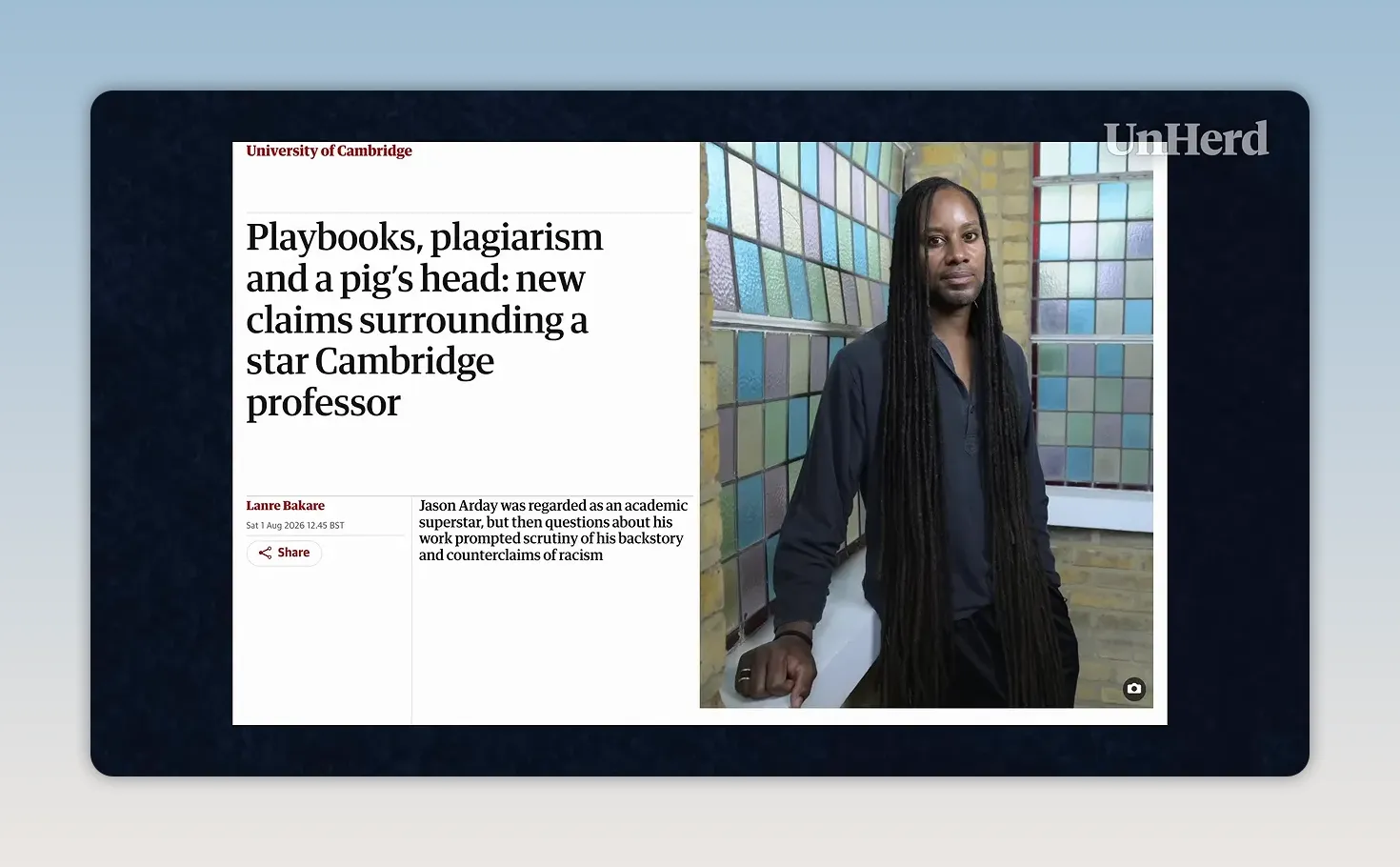
This is where the story gets uncomfortable. It is easy to dismiss criticism when the first person amplifying it is controversial or politically unpopular. Nathan Cofnas, who revived attention around the issue, has made highly contentious statements about race and intelligence. That understandably led many people to assume that any criticism of Jason Arday was simply racist smearing.
But the identity or politics of the messenger do not settle the truth of the claim. A bad person can raise a real question. A good cause can be attached to weak evidence. And institutions should be especially careful not to confuse criticism of a scholar’s work with prejudice against a scholar’s identity.
The proper answer to a serious allegation is not “Who asked it?” but “Is it true?”
Extraordinary Claims Need Ordinary Checks
Beyond the academic work, several claims associated with Jason Arday have attracted growing scrutiny. These include accounts of raising more than £5 million for charity, running 600 miles from Edinburgh to London in six days, working with WaterAid in Africa, and suffering frightening intimidation at Cambridge.
None of these claims should be dismissed merely because they sound unusual. People do extraordinary things. But extraordinary claims should come with solid documentation, clear timelines, and corroboration. That is just basic grown-up procedure.
The alleged endurance run is a useful example. Edinburgh to London is not 600 miles by the most direct route, and completing that distance in six days would represent a spectacular athletic feat. The account was later described differently, with rests taken between stages and a revised timeframe. Likewise, the charity fundraising claim was later associated with a larger group effort rather than an individual total.
Then there are the reported threats at Cambridge. Jason Arday told the Guardian that he had been confronted twice by a masked intruder, including an alleged incident involving a knife. The Guardian reported that CCTV captured no intruder, no suspicious person was reported by others in the faculty, and the panic alarm was apparently not answered despite security personnel being present. The report also stated that the alleged incidents were not reported to police at the time.
If a claim changes every time someone checks it, confidence does not rise. It falls.
This does not require amateur detective work or gleeful speculation about motives. It requires institutions to do what they are supposed to do: verify important claims before using them to elevate someone to national prominence.
Kindness Is Not the Only University Value
The sharpest argument here is not really about Jason Arday as an individual. It is about the culture that may have made such a rise possible. Stock argues that universities have become nervous about saying no. Nervous about judging work harshly. Nervous about enforcing standards when a diagnosis, protected identity, or moving personal narrative is involved.
That creates a confusion between access and lowered expectations.
Universities should remove practical barriers. A blind student may need accessible material. A student with mobility needs may require accessible rooms. Those are sensible adjustments. But clear writing, coherent arguments, sound reasoning, and intellectual honesty are not optional extras in a humanities education. They are the point.
As Stock puts it, structure is thinking. If a lecturer is expected to ignore spelling, grammar, incoherent sentences, arbitrary paragraphs, and muddled reasoning, what exactly is being assessed?
Support should help people show what they can do. It should not ask everyone else to pretend poor thinking is good thinking.
There is nothing kind about pushing people into roles they are not ready for, then leaving them exposed when the gap becomes obvious. It is not kind to other qualified applicants who missed out. It is not kind to students who expect excellent teaching and supervision. And it is not kind to the person made into a symbol, especially if the institution knew the symbol was shakier than it looked.
Representation Without Patronizing People
One of the most serious points raised is that low expectations can wear the costume of progress.
If an institution treats Jason Arday mainly as an uplifting story about race, disability, and adversity, rather than holding him to the same serious standards as every other professor, that is not respect. It is patronizing.
There are brilliant Black academics. There are brilliant autistic academics. There are brilliant scholars who learned late, struggled early, or took unusual paths. Reducing any of them to a feel-good headline is insulting because it implies that the story matters more than the intellectual contribution.
The discussion around Jason Arday also reveals a strange split in modern academic culture. One side speaks in the language of love, empathy, inclusion, and healing. The other can be intensely hostile when anyone challenges the approved narrative. Criticism becomes harm. Questions become aggression. Skepticism becomes proof of bad character.
That is a terrible environment for scholarship. Universities need disagreement. They need people who ask annoying questions, check footnotes, compare claims, and refuse to clap on cue.
What a Better University Looks Like
The way forward is not cruelty. It is clarity.
A university should be welcoming without becoming sentimental. It should support students with real disabilities without treating intellectual weakness as something lecturers must quietly work around. It should value diversity without using people as diversity mascots. And it should investigate allegations of misconduct carefully, fairly, and without political panic.
For hiring and promotion, the questions ought to be simple:
- Is the research original, clear, and intellectually substantial?
- Are the claims in a candidate’s record accurate and verifiable?
- Can the person teach, supervise, and contribute at the required level?
- Would the appointment still make sense without the emotional backstory?
That final question is especially useful. Strip away the glowing profile, the moving narrative, the social media praise, and the institutional branding. What remains? If the answer is excellent scholarship, wonderful. If the answer is mainly symbolism, there is a problem.
Elite universities exist to train minds rigorously and produce genuine contributions to knowledge.
The Jason Arday controversy may yet prove to be more than a single scandal. It could force a long-overdue conversation about what universities are for, who they serve, and whether they still believe that brilliance, rigor, innovation, and clear thinking matter.
That conversation will be messy. Good. Universities are not supposed to be comfortable little factories for approved stories. They are supposed to be places where claims are tested, ideas are challenged, and truth matters more than applause.
Jason Arday’s Death & the Cost of Abandoning Merit
The case of Jason Arday raises painful questions about truth, institutional judgment, personal responsibility, and the human cost of public collapse. Jason Arday had reached one of the highest levels of academic prestige, with a professorship at Cambridge University and a memoir headed for publication. Then allegations surrounding his scholarship and personal claims placed that success under a harsh light.
This is a sad story. But it is also a warning. When institutions elevate people with grand public praise before doing the hard work of verification, everyone involved can be damaged.
Jason Arday became the center of a fierce debate across Britain’s academic world. The issue was not merely whether parts of his memoir appeared implausible. It was whether Cambridge and Simon & Schuster ignored serious red flags because they had already invested too much in a highly marketable public story.
Prestige means nothing if it is separated from proof.
Takeaways
- Jason Arday’s case centers on allegations involving memoir claims, scholarship, and institutional vetting.
- Cambridge’s public praise raised questions about whether academic standards were applied consistently.
- Simon & Schuster faced criticism for publishing a memoir despite alleged contradictions and warning signs.
- Institutions should expand opportunity without abandoning verification, rigor, and merit.
How Jason Arday Became a Major Academic Figure
Jason Arday was a British academic of African descent who secured a distinguished professorship at Cambridge, an institution widely regarded as one of the world’s most demanding universities. That appointment drew national attention. So did his public story of overcoming hardship.
His memoir, Great and Unfortunate Things, intensified that attention. Yet the story began to unravel when critics compared different versions of his claims. Hanson points to sharp conflicts between a lengthy book proposal and the manuscript that was ultimately published.
Among the disputed claims were accounts of severe illness, extraordinary athletic feats, and personal accomplishments that critics argued did not line up with reality. Hanson highlights claims involving hundreds of miles run in a matter of days and dozens of marathons completed in just over a month.
Big claims demand serious checking, especially when careers and reputations rest on them.
It is one thing for a memoir to contain a fuzzy memory or a dramatic retelling. It is something else entirely when core details conflict with one another or appear physically impossible. That distinction matters because Jason Arday’s public narrative was deeply tied to his academic rise.
Scholarship Questions Surrounding Jason Arday
The controversy did not stop with the memoir. Hanson argues that closer scrutiny of Jason Arday’s academic record revealed more serious problems. He cites allegations that a dissertation contained more than 100 passages lifted from other scholars and writers.
If true, that is not a small mistake. Academic work depends on trust. Scholars can debate evidence, argue fiercely about ideas, and reach opposite conclusions. But they cannot build a serious career on work presented as original when it belongs to someone else.
Scholarship requires rigor, honesty, and the humility to give credit where credit is due.
That is why the Jason Arday controversy became larger than one memoir or one hiring decision. It raised a basic question: how could a university with Cambridge’s standards celebrate someone as an exceptional scholar while such allegations were already circulating?
Hanson’s answer is blunt. He argues that Cambridge did not simply make an innocent mistake. He believes the institution promoted Jason Arday as part of a broader diversity, equity, and inclusion agenda, even though the available record should have prompted much closer examination.
Cambridge’s Praise & the Problem of Institutional Blindness
Cambridge publicly praised Jason Arday as an exceptional researcher in race, inequality, and education. The university also emphasized his potential contribution to improving representation for people from disadvantaged backgrounds and minority ethnic communities.
Those goals are worthy. Expanding opportunity matters. But opportunity and lowered standards are not the same thing. In fact, they should never be confused.
The fair standard is simple: judge every candidate with care, consistency, and evidence.
Hanson argues that institutions create a cruel trap when they elevate a person beyond what their record can support. The institution gets a glowing headline. The individual gets a powerful title. But the pressure builds if the work cannot withstand serious scrutiny.
That is the central institutional lesson from Jason Arday’s case. A university should not use a person’s background as a substitute for verifying qualifications. Doing so is unfair to the institution, unfair to other qualified candidates, and unfair above all to the person being placed under an impossible spotlight.
Why Public Scrutiny Was Not the Same As Persecution
After Jason Arday’s death, some people blamed journalists, conservatives, and critics for the pressure surrounding the scandal. Hanson rejects that argument. He maintains that exposing alleged plagiarism, factual contradictions, or questionable credentials is not persecution. It is part of public accountability.
There are many examples of public figures whose careers collapsed after fabrication or plagiarism allegations. Hanson points to journalist Stephen Glass, whose writing career was destroyed after revelations of fabricated reporting. He also refers to historian Stephen Ambrose, whose reputation suffered after plagiarism allegations.
The point is not that public disgrace is easy. It clearly is not. The point is that professional scrutiny applies across political viewpoints, backgrounds, and fields.
Accountability may be painful, but it is not the same thing as cruelty.
Jason Arday’s death should be discussed with care and basic human decency. Suicide is a tragedy. No public controversy makes a life disposable, and no one should treat such a death as a political trophy. Still, Hanson argues that responsibility for a personal decision cannot simply be transferred to every person who raised legitimate questions.
Simon & Schuster’s Expensive Gamble
Hanson also directs attention toward Simon & Schuster. The publisher released Jason Arday’s memoir shortly before his death and reportedly gave him a $1.4 million advance. Hanson argues that such an advance is highly unusual for a memoir expected to sell only a modest number of copies.
That large investment matters because it may have influenced the publisher’s choices. According to Hanson, the publisher had access to a detailed proposal that did not match the final manuscript. He argues that both versions contained claims that should have prompted stronger fact-checking.
Instead, Simon & Schuster moved forward.
A publisher’s first duty is not to recover an advance. It is to protect the truth.
Hanson suggests that the controversy may have looked commercially useful. A celebratory memoir could be repositioned as a sensational book about a scholar whose claims had already become a public scandal. But that kind of calculation is deeply troubling when a real person is at the center of the story.
The Jason Arday case shows why publishers cannot treat a contested personal narrative like a carnival attraction. A memoir is presented as nonfiction. If a publisher sees major contradictions, it has a duty to slow down, investigate, and ask hard questions before printing.
The Larger Lesson About Merit & Responsibility
This story is not an argument against diversity. It is an argument against using diversity as an excuse to abandon standards. A healthy institution can seek talent from every background while still demanding originality, competence, honesty, and demonstrated achievement.
Those ideas belong together. They are not enemies.
Hanson’s broader claim is that Cambridge and Simon & Schuster helped create a situation that was unsustainable. Cambridge allegedly elevated Jason Arday with praise that the record could not support. Simon & Schuster allegedly published a memoir despite serious warning signs. Then, when scrutiny intensified, the entire structure came down.
Real inclusion does not require pretending that merit no longer matters.
Jason Arday’s story should make universities, publishers, and public institutions pause. Celebrate achievement, absolutely. Open doors, absolutely. But do the work. Verify the record. Demand the same standards from every applicant. And never turn a human being into a symbol so useful that no one dares ask whether the story is true.
RESOURCES:
Exposed: How the Jason Arday scandal unravelled Cambridge | The Daily T | https://www.youtube.com/watch?v=RFr9gbOYym8
Kathleen Stock: The scandal of Jason Arday | https://www.youtube.com/watch?v=2YsCTD83W0s
Victor Davis Hanson: The Truth About Jason Arday’s Death | https://www.youtube.com/watch?v=wR2YCuPYoTc
“Here’s how I exposed Jason Arday and Cambridge” | David Starkey Talks to Nathan Cofnas | https://www.youtube.com/watch?v=C27UXFdz0sA
This article was created from the video with the help of AI.
Watch More: Academia...
- US Universities, Harvard & the Hogwarts Code of Conduct
- ACADEMIC COLLAPSE: Jason Arday & the Cambridge’s Crisis
- Jewish Students Harassed on Campus
- Cornell Prof. Praises Hamas October 7 Attack
- Massacre Scholarships: Prank Call to Harvard University
- Columbia University is Pro-Palestine | Prof. Speaks Out
- Survey: American Youth Favors Hamas Taking Over Israel
- Game: Hamas Supporters—What Do They Really Support?
- Professor: Don’t Hire My Antisemitic Law Students
- Why Jewish Students Feel Terrified on Campus