The idea of Russia collapsing is tempting because it feels neat. Sanctions arrive. Companies leave. A long war burns through soldiers, equipment, money, and public patience. Then, eventually, the whole thing falls apart.
But that is not really what is happening. Russia has not survived because the pressure failed. It has survived because it stopped trying to function like a normal country.
Instead, it is becoming more militarized, more centralized, more isolated, and more dependent on coercion. That can keep a state functioning for a long time. It can also make that state more dangerous, less predictable, and much harder to govern.
Russia is not strong simply because it is big. Its enormous size is also one of its deepest vulnerabilities.
Takeaways
- Russia’s continental scale creates costly dependence on a few critical logistics corridors.
- Putin’s system suppresses credible successors, making leadership change inherently destabilizing.
- Russia’s military remains dangerous, but its paper strength far exceeds its usable combat power.
- Russia is hardening into a more coercive state rather than collapsing immediately.
Russia’s Biggest Problem Is Distance
If you want to understand Russia, start with a map. At roughly 17.1 million square kilometers and spanning 11 time zones, Russia looks inevitable. It looks like a giant state with endless resources, huge strategic depth, and an almost impossible amount of territory to conquer.
But maps can lie. Modern power is not about how much land a country controls. It is about how efficiently it can move people, goods, fuel, soldiers, money, information, and equipment. Russia has to move all of that across a continent.
About four-fifths of Russia’s population lives west of the Ural Mountains. The densely populated western edge is attached to a vast, harsh, sparsely populated interior. That creates a permanent problem: the places that matter economically and politically are far from many of the resources Russia depends on.
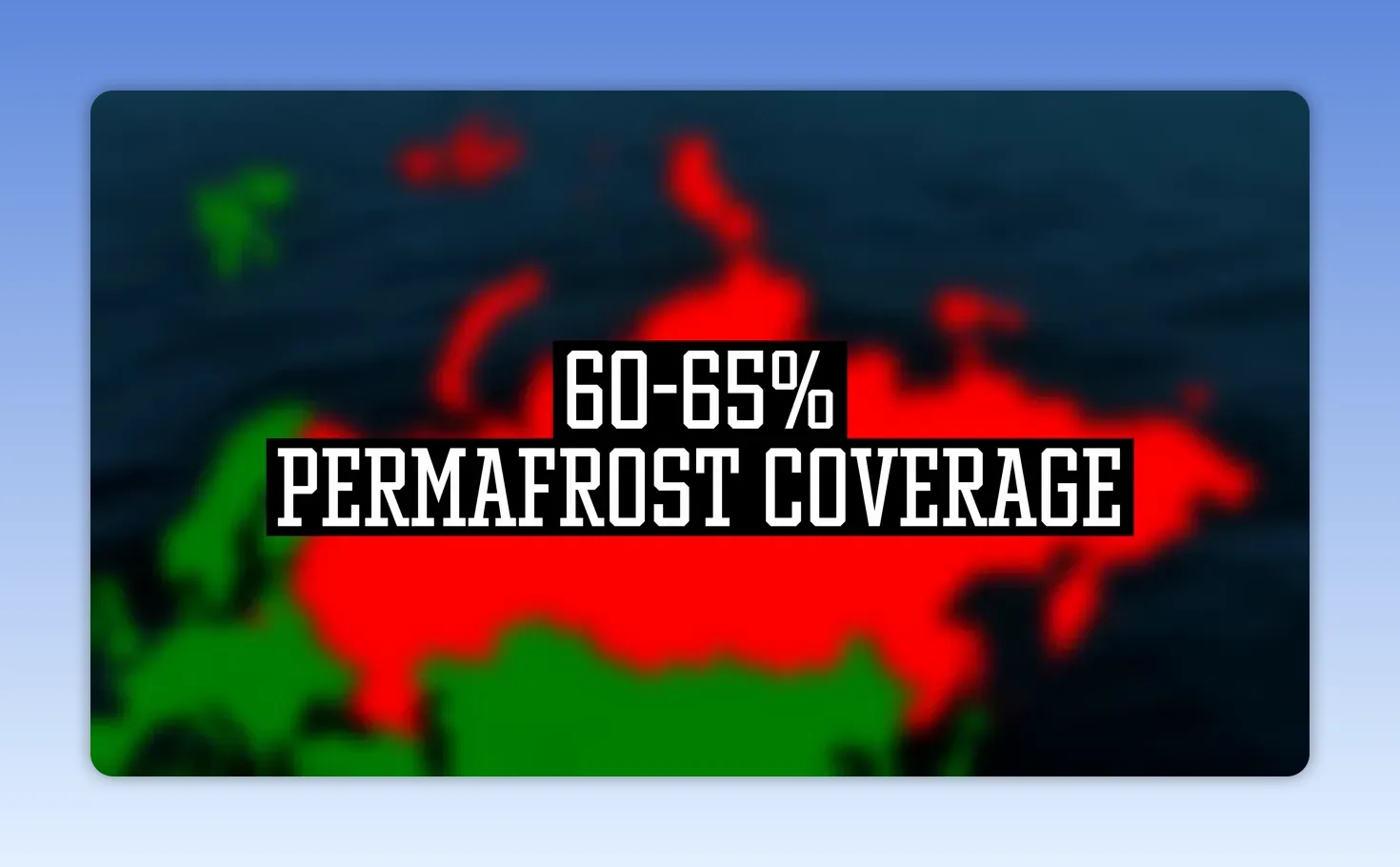
And then there is permafrost. Roughly 60% to 65% of Russian territory sits in permafrost zones, depending on how it is measured. This is not merely a climate issue. It is an infrastructure nightmare. Frozen ground shifts. Roads crack. Buildings degrade. Pipelines move. Rail lines deform.
Every eastward expansion of infrastructure means building on ground that actively fights back. Add forests, swamps, tundra, mountains, and enormous empty spaces, and redundancy becomes incredibly expensive.
That is why Russia depends so heavily on corridors. The Trans-Siberian Railway alone stretches more than 9,000 kilometers from Moscow to Vladivostok. Russia’s rail system is enormous, often estimated at roughly 85,000 to 105,000 kilometers of track. But enormous does not mean resilient.
A network can be huge and still be fragile if too much traffic flows through too few lines. Russia lacks the dense road systems and alternate highway routes found in much of Western Europe and the United States. When a key route fails, there is often no easy detour. Cargo stops or gets rerouted across vast distances.
In Russia, stopping movement is not an inconvenience. Across 11 time zones, it becomes a strategic problem.
Distance shapes the country in every major domain:
- Politically, control, enforcement, and information all lag as they travel from Moscow to remote regions.
- Militarily, Russia must sustain forces across a vast perimeter and multiple strategic directions.
- Economically, resources often sit far from consumers, industrial centers, and ports.
- Socially, regions become harder to populate, develop, and keep connected to the center.
Russia cannot negotiate with distance. It cannot vote from a distance. To truly solve the problem would mean shrinking the country, which would mean Russia would no longer be the Russia we know. So the state manages distance through railways, pipelines, centralized authority, military districts, and security services.
But every tool that reduces friction also creates a dependency. And dependency creates choke points.
A Political System Built Around One Man
The next major question is not really about elections, ideology, or parties. It is much simpler and much scarier: what happens after Vladimir Putin?
Russia has a president, a prime minister, ministries, courts, a parliament, elections, political parties, and a constitution. On paper, it resembles a normal state.
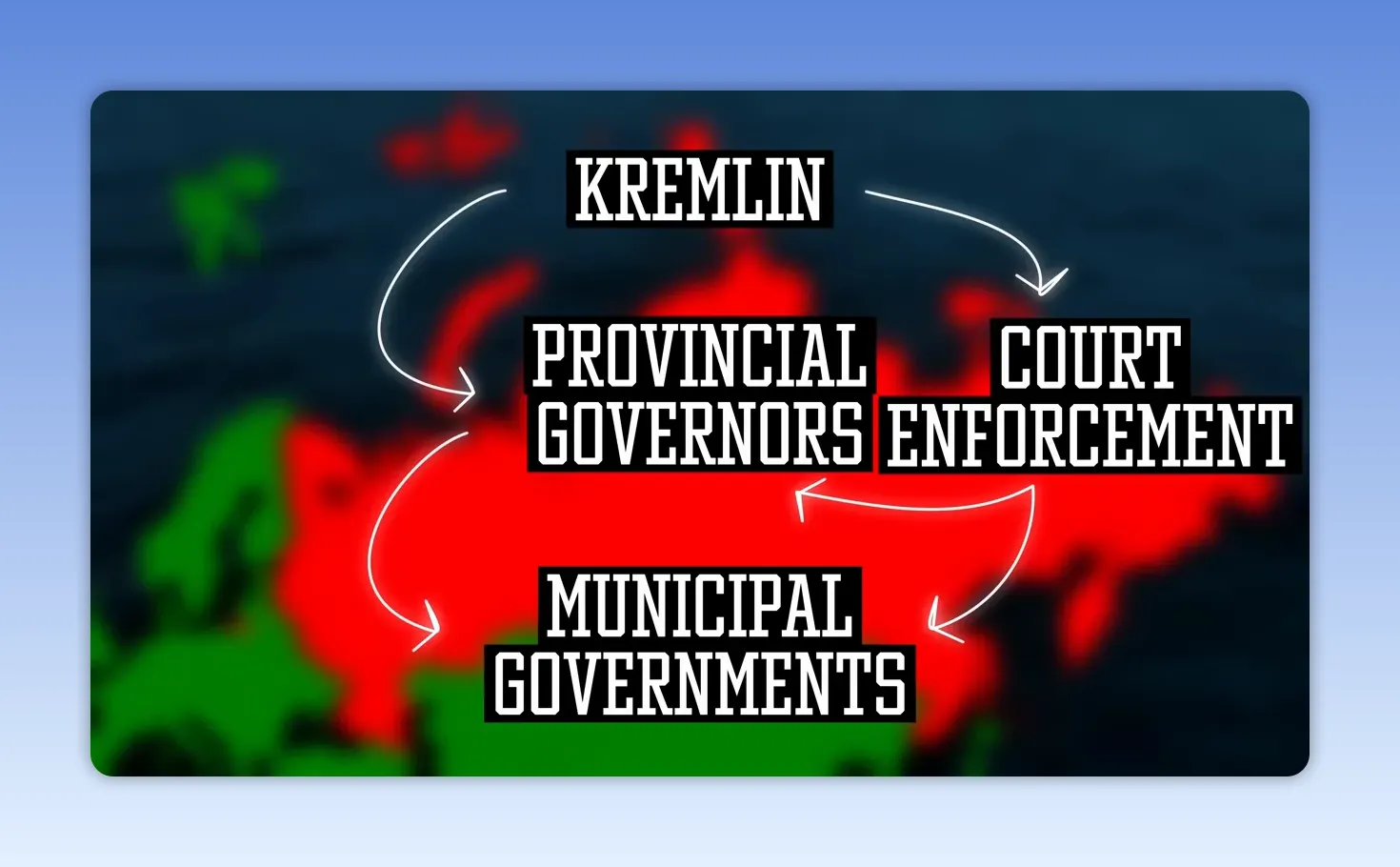
In practice, that formal structure is mostly stage dressing. Real authority moves through a vertical of power, flowing downward from the Kremlin. Regional governors depend on Moscow for funding, protection, and permission. Courts enforce political outcomes. Parliament ratifies decisions already made elsewhere.
At the heart of the system are the Siloviki, a loose collection of security service veterans, military and law enforcement figures, politically connected business leaders, and powerful insiders. Their power is not based on popularity. It comes from coercion, surveillance, prosecution, and control of important assets.
Surrounding them is a patronage system. Access to contracts, licenses, monopolies, regulatory favors, and protection from prosecution is what keeps elites inside the system. Putin sits at the center, not just as president, but as the broker who balances competing interests.
That creates three major succession problems.
Three Succession Traps
:: No Legitimate Succession Mechanism
Functional states usually have rules for replacing leaders that elites and the public broadly accept. Russia does not have that kind of trusted mechanism.
A successor would need public credibility, elite acceptance, and security guarantees for the departing ruler and his circle. But a person publicly positioned as a successor instantly becomes a threat. Rival elites may plot against them. Security services may fear exposure. Putin himself would have reason to worry.
This is why potential successors cannot become strong enough to succeed. Alexei Navalny may not have been a guaranteed successor, but he positioned himself as an alternative. That was enough to make him dangerous to the system.
:: Putin Holds the Elite Coalition Together
The Siloviki are not one unified bloc. Oligarchs want their wealth protected. Technocrats want stability. Security services want power and immunity. Regional elites want money and autonomy. Their interests collide constantly.
Putin’s central role is less about ideology than about arbitration. He decides who wins disputes, who loses, and how the deals hold together. Remove him, and those deals do not simply expire. They unravel.
Russia can replace a broker. It cannot replace the person who made all the existing deals.
:: Leaving Power Is Dangerous
Stepping down in an authoritarian system can be risky. In Russia, it is especially dangerous. Anyone leaving office carries exposure to corruption claims, political vendettas, responsibility for the war in Ukraine, and the burden of an economy strained by sanctions.
That helps explain why Putin has rewritten the rules, including constitutional changes that reset term limits. Staying in power is safer than trusting the guarantees of whoever comes next.
The system has another built-in paradox. It prevents charismatic alternatives from rising because independent loyalty threatens the vertical of power. So it promotes technocrats, administrators, managers, and loyalists without mass appeal.
That protects the regime in the short term. Over time, it destroys the leadership pipeline.
Russia can produce ministers and bureaucrats. It struggles to produce a national successor who could unify the country without threatening the system before taking power.
Why a Putin Exit Could Make Russia More Dangerous
There are three broad scenarios after Putin:
- A managed transition: possible, but least likely because it would require trust that the system does not have.
- An elite struggle: security services, technocrats, and regional power brokers compete, making policy more incoherent and repression more likely.
- Slow fragmentation: regions bargain harder, local elites act more independently, and the center relies increasingly on force.
This does not necessarily mean instant state collapse. A power struggle can end with whoever wins hardening the regime even further. That is why Russia’s collapse is not automatically the most likely outcome, or even the least dangerous one.
Political systems without a safe off-ramp tend to keep driving until something breaks.
Russia’s Military Is Big, But Usable Power Is Smaller
Russia’s military is often described with one word: massive. Roughly 1.3 million active-duty personnel, millions more in reserve depending on the count, and thousands of tanks, armored vehicles, artillery systems, aircraft, and missiles.
That is the image Russia wants the world to see. But war is not won by numbers sitting on paper. It is won by usable combat power.
The real questions are much tougher:
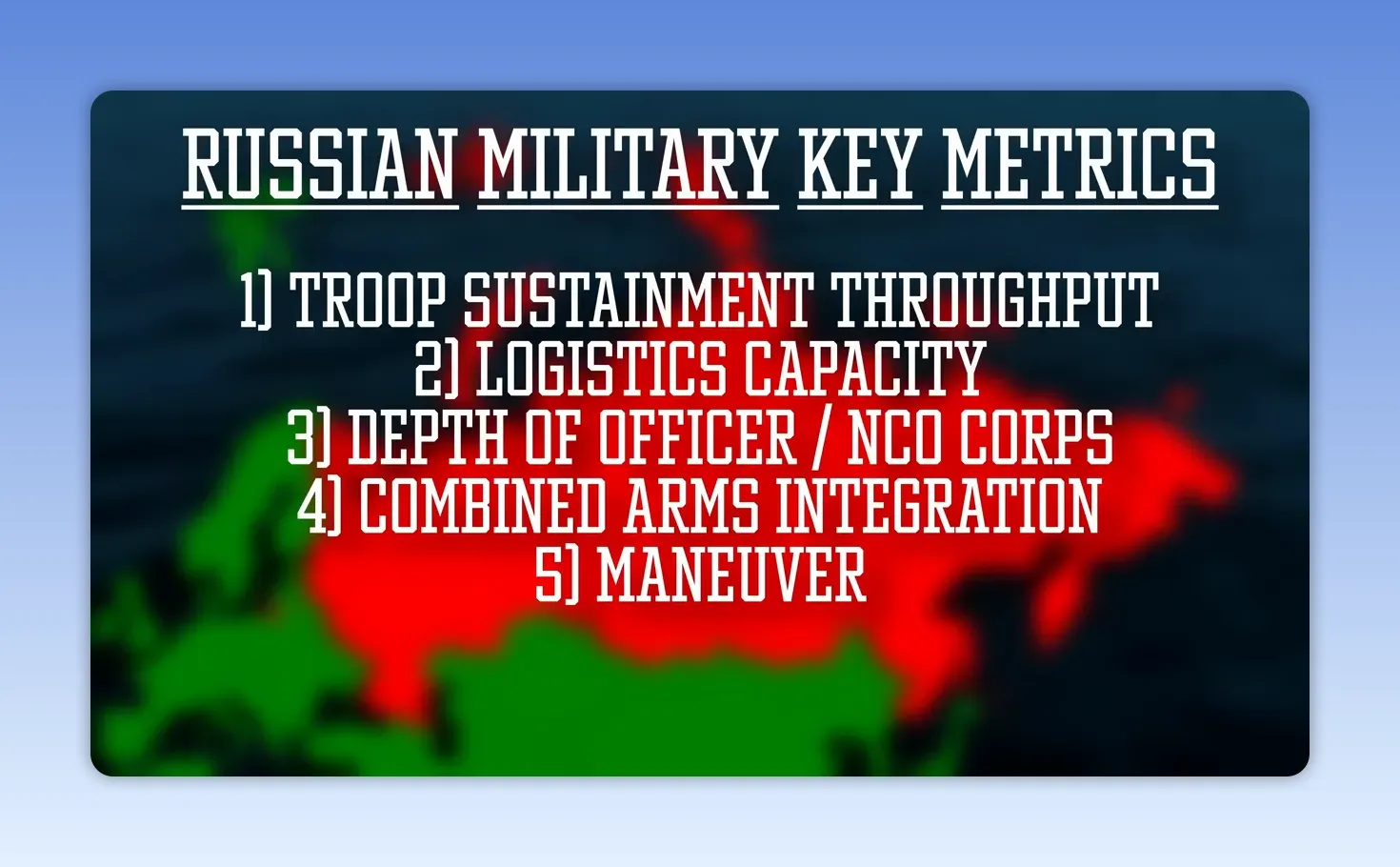
- How many troops are trained, equipped, led, and sustainable in combat?
- How much equipment can be restored, crewed, maintained, and supplied?
- How deep is the pool of experienced officers and noncommissioned officers?
- How well can intelligence, targeting, fires, maneuver, and logistics work together?
Russia inherited a Soviet model built for mass mobilization, centralized command, overwhelming firepower, and attritional warfare. The logic is brutal but straightforward: replace losses faster than the enemy and grind them down.
That model can work in a certain kind of war. But modern warfare demands flexible logistics, empowered junior leaders, integrated intelligence, precision, rapid adaptation, and strong coordination across units.
Russia planned for a short war in Ukraine. The goal was to seize Kyiv, break resistance, and force negotiations quickly. Instead, it entered a long conflict that exposed the difference between having numbers and having scalable capability.
When the maneuver failed, Russia fell back on what it knows: artillery-heavy warfare, trench systems, mass fires, and slow advances measured in meters.
Six Military Deceptions
:: Manpower Does Not Equal Combat Power
Reported troop numbers include rear-area units, logistics personnel, internal security forces, and minimally trained mobilized soldiers. The actual number of capable troops that can be effectively deployed at once is much lower.
:: Training Cannot Scale Forever
Russia can generate people faster than it can generate competent NCOs, junior officers, engineers, medics, electronic warfare specialists, drone operators, and combined-arms teams.
Training cycles have reportedly been compressed from months to weeks. That creates deployable manpower, but it does not create professional formations. Poorly trained troops do not just perform worse. They die faster.
:: Stockpiles Are Not Ready
Thousands of stored tanks do not equal thousands of usable tanks. Many vehicles are decades old, degraded, missing parts, stripped for components, or lacking modern optics and communications equipment.
Every step matters: restoration, crews, maintenance, ammunition, fuel, transport, and frontline supply. The Soviet inheritance looks massive until it starts running dry.
:: Centralized Command Struggles To Adapt
Russian command is top-heavy. Decisions flow upward, while initiative filters downward slowly. This can work in static defense and highly scripted offensives. It struggles badly with rapid maneuver, dynamic targeting, and fast local adaptation.
:: Logistics Is the Real Ceiling
An army’s real limit is not how many people it has. It is how many people it can feed, fuel, arm, repair, evacuate, and resupply every single day.
Logistics determines tempo, endurance, survivability, recovery, and equipment availability. Logistics wins wars.
Russia’s system is designed around rail-supported rear-area supply. That creates serious problems for fluid, high-tempo operations beyond rail reach. Once supply chains strain, the force begins to hollow out.
:: Corruption-Inflated Readiness
For decades, readiness reporting could be distorted. Units appeared stronger than they were. Equipment was counted as functional when it was not. Maintenance budgets disappeared. Peace can hide that kind of rot. War cannot.
Russia remains dangerous. It is effective at layered defense, attritional offensives, mass fires, long-range missile and drone strikes, and coercive escalation. But it remains weak at rapid maneuver, large-scale combined-arms operations, air-ground integration, replacing experienced leaders, and sustaining high-quality operations over time.
Russia’s army is big in the way a warehouse is big. It can hold a lot. What matters is how fast it can move things, how well those things work, and how long it can keep them running.
Why Russia’s Economy Has Not Collapsed
For years, the prediction was that sanctions would trigger Russia collapsing economically. Western firms exited. Banks lost access to key financial channels. Technology controls tightened. Aircraft maintenance, industrial components, machinery, and advanced manufacturing all faced real pressure.
And yet Russia kept paying soldiers, producing weapons, and keeping the system running.
The reason is not that sanctions failed. The reason is that Russia stopped operating as a normal economy.
Before the full-scale invasion of Ukraine, the economy rested on three pillars:
- Energy exports: oil, gas, and refined products brought in hard currency and supported federal revenue.
- State capitalism: politically connected firms dominated key sectors while the state allocated opportunity.
- Imports in critical sectors: Russia could make food, fuel, and basic goods but relied on foreign machinery, electronics, aviation parts, and precision manufacturing.
Russia entered the sanctions era with a disciplined central bank, relatively low public debt, reserves, and long experience operating under pressure. So when sanctions hit, the government responded the old-fashioned way: centralize, control, and prioritize survival over efficiency.
A War Economy on Life Support
Capital controls stabilized the ruble. Interest rates rose aggressively, then eased after the immediate panic. Exporters were required to bring earnings back into the country. The goal was not healthy growth. The goal was control.
Then defense production became the growth engine. Factories were retooled for war. Military contracts expanded. Government spending surged. In some regions, war production became the main source of jobs and income.
This can make GDP look better even while ordinary life gets worse. If the state spends enormous amounts on weapons, output rises, and jobs appear. But that does not mean the economy is healthy. It means the economy is being propped up by wartime demand.
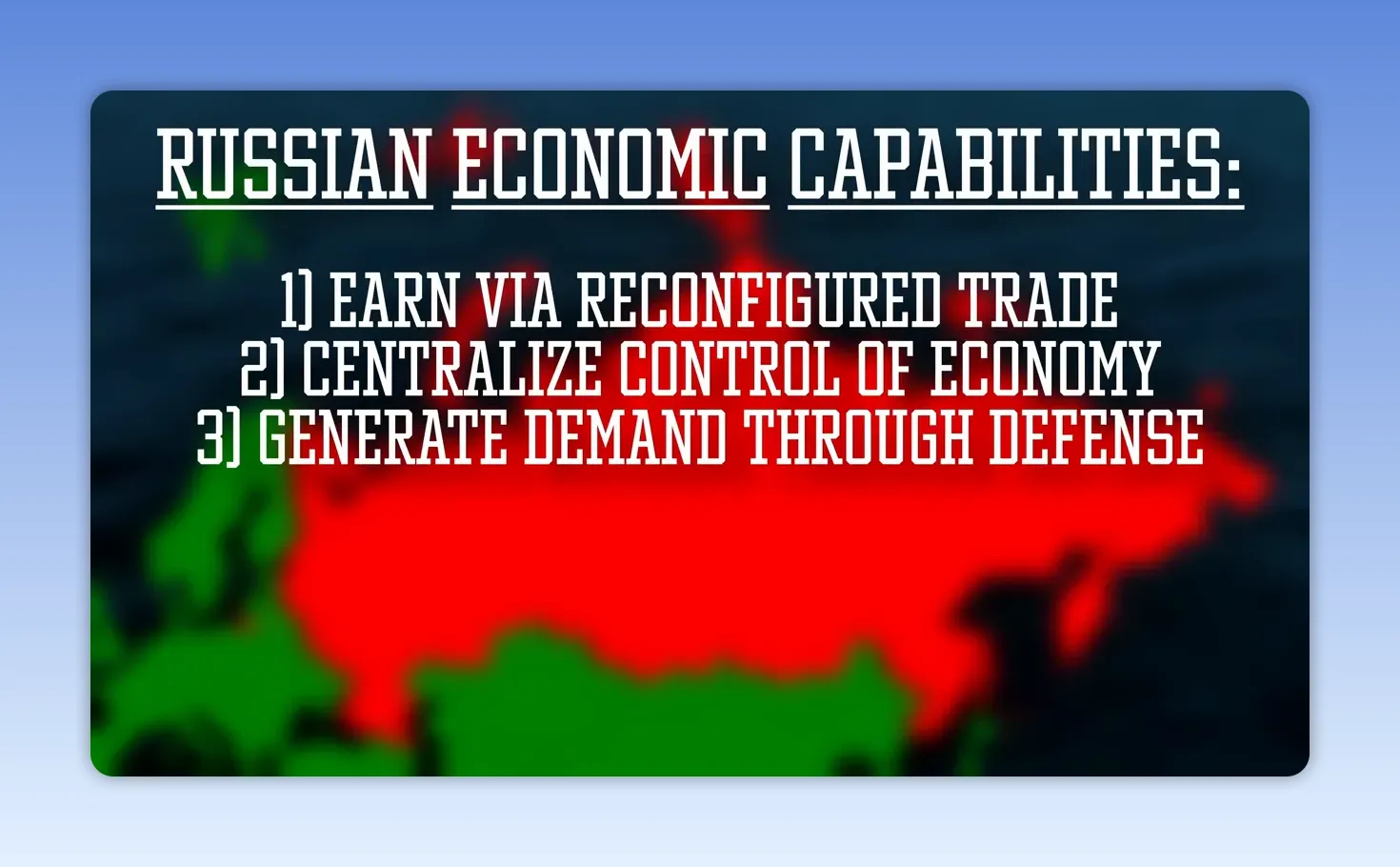
Russia also rerouted energy exports to new buyers, often at discounts. Imports moved through intermediaries, gray markets, and parallel channels. Shipping became slower, more expensive, and riskier. Efficiency fell sharply, but continuity remained.
Import substitution helped in some basic consumer goods, food, and industrial outputs. But many domestic replacements are lower quality, less reliable, more expensive, and still dependent on foreign components somewhere in the supply chain.
Life support keeps a system alive. It does not make the system healthy.
The long-term costs are piling up:
- War spending crowds out private investment, innovation, and productivity.
- Mobilization removes working-age men from the labor force.
- Casualties, injuries, and outward migration shrink the pool of skilled workers.
- Export controls steadily reduce industrial capacity as machines wear down and spare parts disappear.
- Russia becomes dependent on fewer buyers, suppliers, and economic channels.
The realistic triggers for Russia’s economic collapse are not a single dramatic event. They are combinations: sustained losses in energy revenue, critical import bottlenecks, fiscal strain, another labor shock, banking stress, or a currency panic.
Any one of those problems may be manageable. Two or three together could become extremely dangerous.
The Quiet Social Crisis
Russia’s most dangerous frontline is not only in Ukraine. It is also demographic. This crisis does not explode. It compounds.
Russia has roughly 146 million people, but where they live matters as much as how many there are. The population is concentrated in the west and in major cities, especially Moscow and St. Petersburg. Much of the east is thinly populated, aging, and economically fragile.
Moscow increasingly functions like a wealthy city-state connected to global flows, while huge parts of the country do not. That imbalance affects opportunity, loyalty, and the relationship between the center and the regions.
Russia has faced low birth rates and demographic decline for decades. The working-age population was already shrinking before the war. Fewer young people mean fewer soldiers, engineers, taxpayers, and skilled workers.
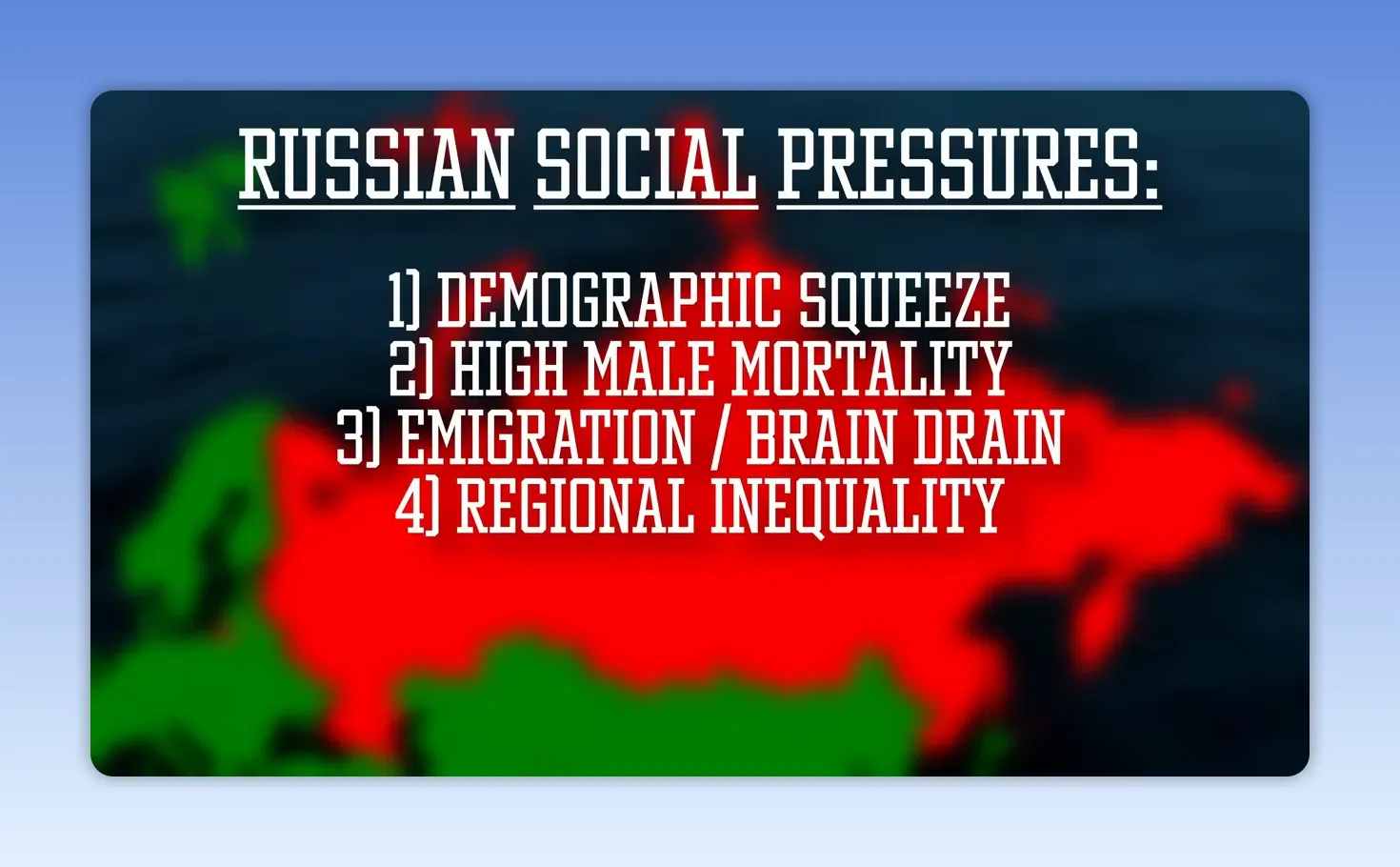
There are four pressures reinforcing each other:
:: The Demographic Squeeze
Low birth rates plus an aging population create a smaller working-age cohort. That hits labor supply, military recruitment, tax revenue, and pensions all at once.
:: Male Mortality & Health
Russia has long had a major gender gap, with women significantly outnumbering men in older age groups. Premature male mortality has historically been driven by cardiovascular disease, alcohol abuse, accidents, violence, and uneven access to health care. War casualties only amplify the existing damage.
:: Emigration & Brain Drain
Many of the people leaving Russia have been younger, urban, educated, and mobile. Those are exactly the people modern economies need most. Once migration networks form, they tend to sustain themselves. People build lives elsewhere and often do not return.
:: Regional Inequality
The political bargain in many regions has been stability in exchange for limited political voice. That bargain works while wages rise slowly, services function, and Moscow provides support.
But when real wages fall, services weaken, and remote regions bear disproportionate costs from mobilization and casualties, legitimacy starts to erode.
Unlike tanks or shells, people cannot be produced on a production line.
Russia can offer pro-natalist payments, patriotic family messaging, selective immigration, censorship, and repression of negative social data. Those policies may slowly decline. They cannot reverse it overnight.
You cannot order people to have children. You cannot instantly rebuild trust. And you cannot easily force skilled people to return after they have built a life abroad.
Information Control Is Russia’s Quietest Weapon
Russia does not need people to believe every claim made by the state. It only needs them to stop believing that anything can be known for sure.
This is the point of information control. The goal is not always persuasion. It is uncertainty. It is the destruction of shared reality.
State television remains powerful, especially among older Russians and outside major cities. Social media, messaging apps, online platforms, patriotic bloggers, war correspondents, state networks, law enforcement, and proxy commentators all create a legal system.
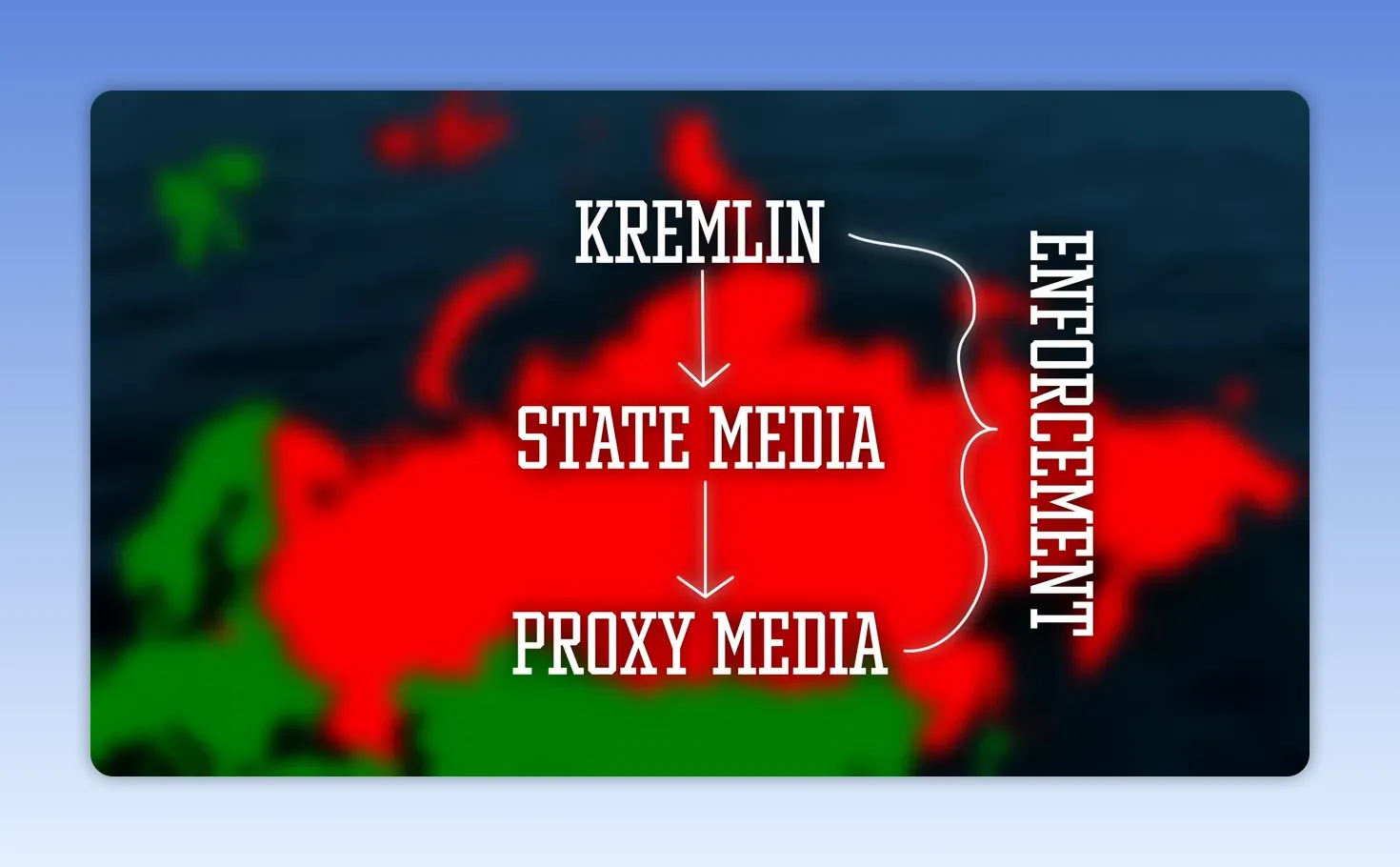
The state does not need to silence everyone. It needs people to understand where the line is. A growing web of laws punishes “false information,” labels independent outlets as foreign agents, and criminalizes narratives that challenge state interests.
The message is simple: you can speak right up until your speech matters.
Four Tactics of Epistemic Control
:: Flood the Zone
Overwhelm people with content. Contradictions do not matter. Accuracy does not matter as much as volume and speed. When people are exhausted by competing claims, they stop sorting truth from fiction.
:: Flip the Frame
Aggression becomes defense. Critics become traitors. Failure becomes heroic sacrifice. Change the language, and accountability becomes harder because words no longer mean what people expect them to mean.
:: Manufacture Ambiguity
Instead of simply denying an event, offer multiple explanations. Maybe it was this. Maybe it was that. Who really knows? Ambiguity slows decisions and fractures consensus.
:: Punish Reality
When journalists are labeled, outlets are shut down, and critics are exiled or jailed, truth becomes expensive to share. When truth is costly, public silence becomes rational.
Fear plus cynicism can be politically stabilizing because collective action requires shared belief.
This creates a split reality: private doubts and public silence. Many people may know they are being lied to, yet still avoid speaking because they do not trust others and do not know who will stand with them.
Abroad, the objective is often not to make other countries love Russia. It is to polarize societies, undermine trust, slow decision-making, and fracture alliances. Confusion creates hesitation. Hesitation buys time.
But information control has limits. Reality cannot be erased forever. The system strains when casualties become personal everywhere, economic pain becomes undeniable, elite infighting becomes visible, or state narratives contradict one another too often.
Rail Is What Holds Russia Together
Russia appears on a map as one solid, unbreakable landmass. In reality, it is more like an empire held together by corridors.
Energy networks move fuel. Telecommunications move information. Roads and waterways move people and goods. But the rail is the central system tying the whole machine together.
Rail moves oil, refined products, coal, minerals, grain, industrial inputs, military equipment, artillery, ammunition, fuel, replacement troops, and countless other necessities. Entire regions are economically viable because a rail line connects them to the rest of the country.
Roads cannot replace rail at this scale. Moving a tank brigade by road across Russia is slow, expensive, and fragile. Air transport is too limited and costly for sustained heavy logistics. Waterways are seasonal and geographically constrained.
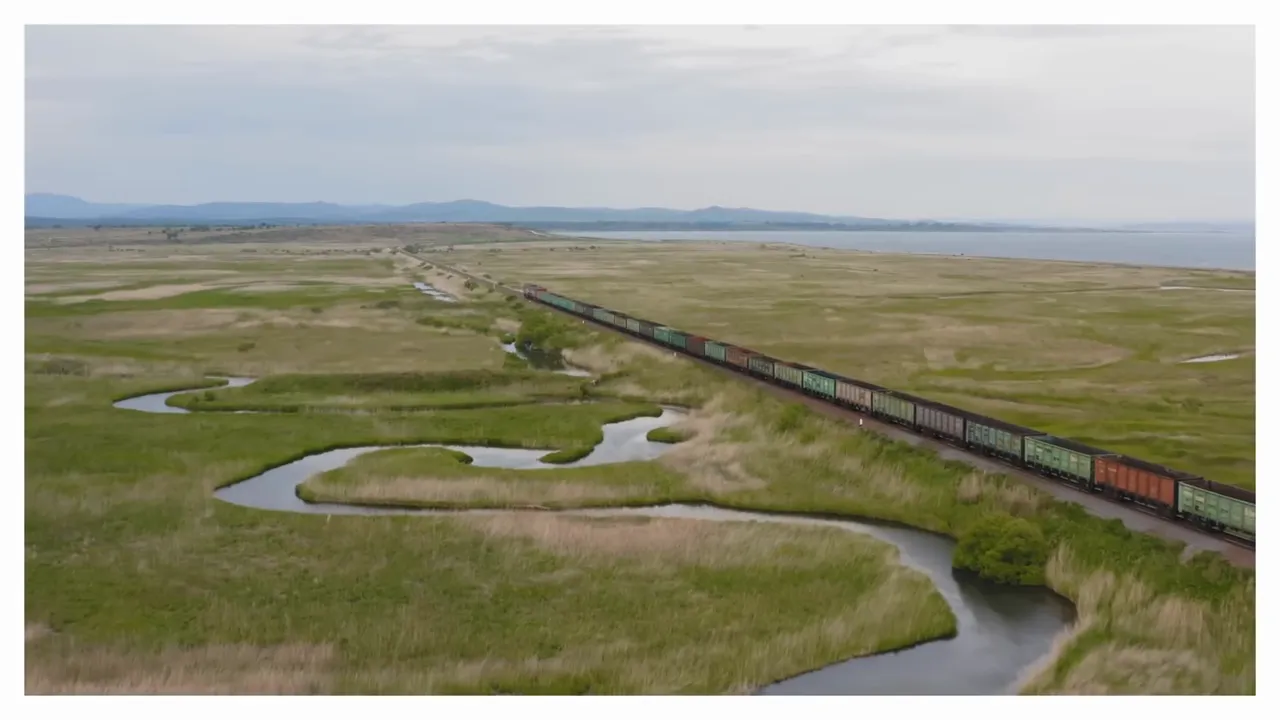
Russia’s rail network follows a spine-and-branch model. A small number of major east-west corridors carry an outsized share of traffic. Branch lines feed mines, industrial sites, ports, military hubs, and remote regions.
That is efficient. It is also vulnerable.
Rail systems usually fail at nodes, not everywhere at once. Bridges, tunnels, junctions, marshaling yards, maintenance depots, electrified segments, substations, signaling systems, and dispatch centers can all become critical points of failure.
You do not need to destroy an entire rail network. You only need to disrupt the right points at the right time.
How Rail Failure Would Spread
Russia’s rail system faces three broad threats:
- Physical disruption: sabotage, accidents, strikes, or damage to tracks, bridges, switches, and yards.
- Capacity collapse: overuse, weak maintenance, shortages of bearings, electronics, locomotives, rail cars, and specialized equipment.
- System failure: disruption to signaling, dispatch, telecom links, power supply, or coordination systems.
These failures may look slow at first. Trains do not always stop dramatically. They slow down, stack up, become unpredictable, and lose reliability. In wartime logistics, unpredictability can be fatal.
The consequences would unfold in stages:
- Logistics slows: freight backs up, schedules slip, and military resupply becomes inconsistent.
- The economy thickens: transport costs rise, regional fuel and food supplies become uneven, and industrial supply chains lose their rhythm.
- State responsiveness drops: local authorities make informal arrangements as the center struggles to move resources quickly.
- Military mobility declines: heavy formations lose flexibility while fuel and ammunition become limiting factors.
- Political cohesion erodes: the promise that Moscow can provide stability and deliver goods begins to weaken.
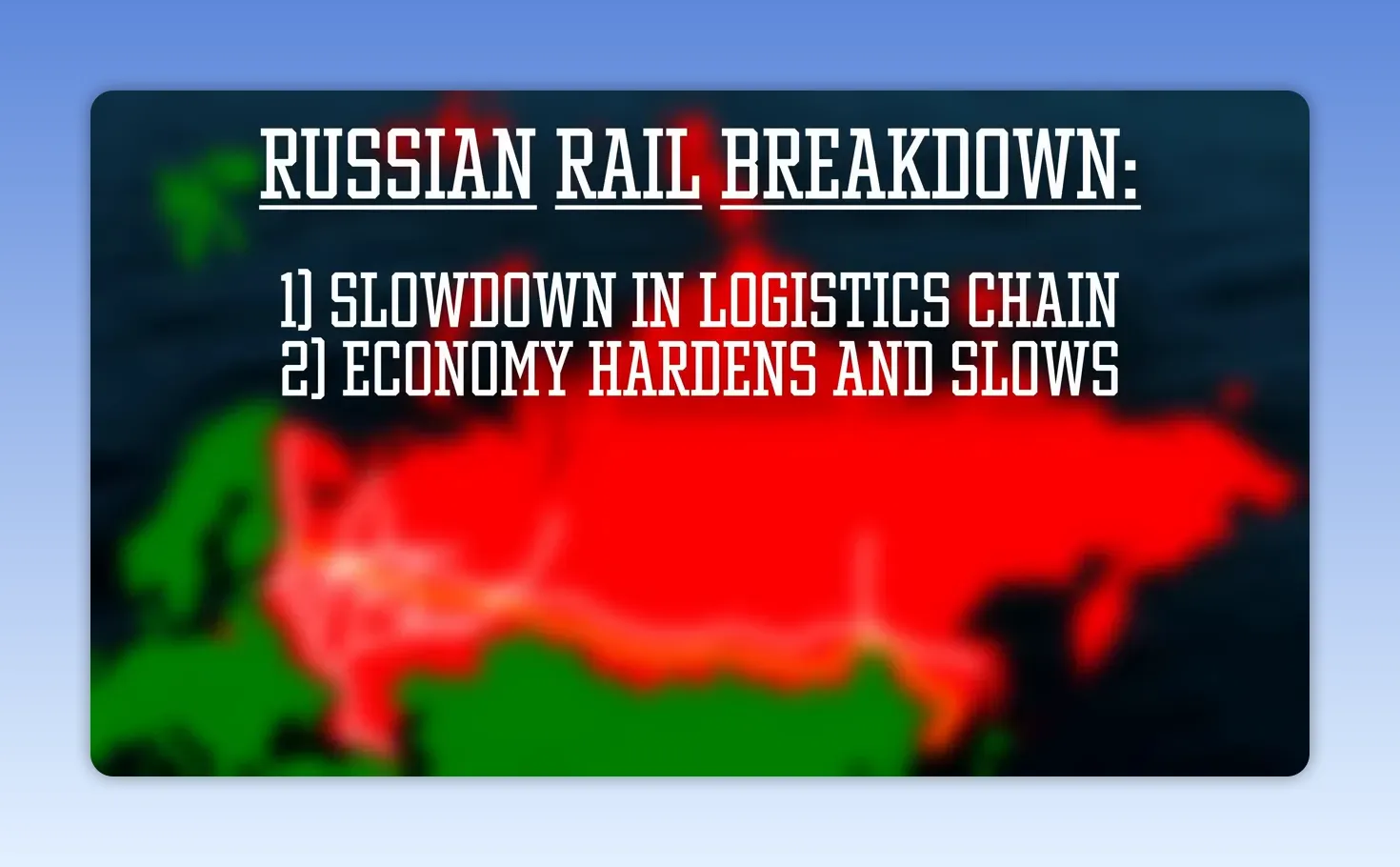
This is the key point: if a rail breaks, Russia does not instantly disappear from the map. It becomes slower, poorer, more coercive, and harder to govern. Regions do not necessarily draw new borders overnight. But they begin to fragment in function.
And function is what is actually holding the country together.
Russia Is Hardening, Not Simply Falling
The story of Russia collapsing is too simple. Russia has serious physical, political, military, economic, social, information, and infrastructure problems. But none of them have to produce a dramatic overnight collapse.
They can phase something else: a state that survives by becoming more authoritarian, more militarized, less innovative, less flexible, and more dependent on force.
Its map creates an illusion of power. Its military numbers create an illusion of readiness. Its GDP can create an illusion of health. Its political institutions create an illusion of succession. Its propaganda creates an illusion of stability.
But beneath all of that is a system fighting constant friction from geography, distance, demographic decline, economic inefficiency, elite insecurity, and fragile infrastructure.
Russia can manage these problems. It cannot truly solve most of them.
That is why the important question is not whether Russia suddenly vanishes. The more important question is what kind of Russia emerges as all of these pressures continue to build.
RESOURCES:
This article was created from the video https://www.youtube.com/watch?v=nrmnOVjP-2A with the help of AI.
PHOTOS & VIDEOS Use According to Section 27 A