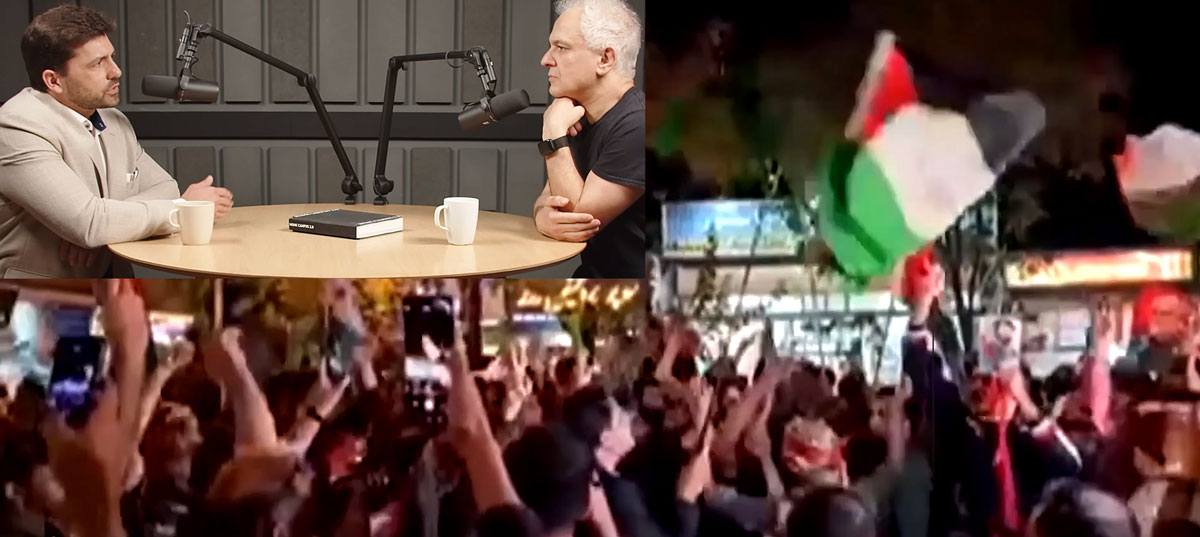
I recently sat down with the philosopher Dr. Benedict Beckeld for a wide-ranging, sometimes uncomfortable conversation about Islam, Western self-hate, immigration, and the cultural forces reshaping Europe and the West.
Benedict lays out bold claims and forces us to confront evidence, polls, lived experience, and philosophical distinctions.
Important Transcript Highlights
You’ve written about the fact that there’s no difference between Islam and Islamism. Let’s define those.
- When people say Islamism, they mean a militant political version of Islam.
- When they say Islam, they mean the sort of general religion that people keep to: halal food, going to the mosque, etc.
- But this is looking at Islam from a Western perspective, and it doesn’t do justice to what Islam actually is.
Therefore, if we want to understand what Islam is, we first must realize that this distinction is a Western one. It’s not an Islamic one.
Islamism used to be synonymous with Islam.
If you go back to the 18th century, look at some of the French Enlightenment writers.
- When they write about Islam, they sometimes say Islamism, but they mean Islam.
- Sometimes they’ll say Mohammedanism as a synonym.
This continues in the 19th century.
The idea of Islamism as meaning something separate from Islam didn’t come until the 20th century. In the 1960s and 1970s, it gained the meaning of being a political version of Islam.
Islam itself is already political, so there’s no need to make that distinction. It’s not a critique of Islam to point this out.
Muslims themselves will happily explain that Islam is not just a private faith, but it is an all-encompassing concept.
This is especially problematic regarding Protestant countries and Protestantism.
- Especially Lutheranism sees religion as being something very personal. They see it as a direct communication between the believer and God.
- Catholics are slightly less prone to this because of a church hierarchy that has a political dimension.
- Although, as Catholicism weakens in Catholic countries, people become prone to this error as well – that of thinking that there’s a difference between religion and politics.
We think of religion and politics as being two separate things, but that’s not the case in Islam.
There are obviously different strains of Islam. They’re not all the same.
But if we use general terms to distinguish Islam from Christianity or Judaism, we see a Western distinction between Islamism and Islam when people say ‘Islamism.’
Why does the left especially, say ‘Islamism?’ They do so because they’re trying to protect Islam.
This needs to be understood.
- Because if a Muslim behaves nicely and is an ordinary citizen like everyone else, he’s a Muslim.
- If all of a sudden he commits a horrible crime and puts on a suicide vest, we call him an Islamist.
- Why? To save the Muslims and say these aren’t Muslims, these are Islamists.
To save Islam by stating that this isn’t Islam, but Islamism is a way of protecting Islam. Because we have this sugary Western prejudice that all religions want peace on earth and kumbaya and love thy neighbor, etc.
Western Self-Hate
Most school teachers, being young women, are more prone to oikophobia because they’re more naturally empathetic.
Some of them will eventually mature. It does happen.
- But because of this, CARE FOR THE OTHER (not the same as oikophobia), but can lead to oikophobia.
- If you care for the other, you denigrate or de-emphasize the traditions of your society to care for the other.
And that attitude is then brought into the school and influences the next generation.
Oikophobia is very often coupled with allophilia, love of the other. People still feel the need to have some ideal, to look up to something. This is just a human drive that we desire something beyond ourselves.
So, suppose we denigrate our civilization and our own traditions.
- In that case, we look around and see this Islamic religion or a tribal African religion.
- They seem beautiful, authentic, and noble, and so on.
Then, of course, it becomes much easier for foreign elements, in this case Islamic elements, to be invited in, as we discussed.
What We Argued & Why it Matters
Our discussion centered on three interlocking claims Benedict pressed hard:
- The distinction between “Islam” and “Islamism” is essentially a Western invention that obscures how Islam often functions politically.
- Islam differs from Judaism and Christianity in ways that create a unique civilizational challenge for secular Western societies.
- Western society is weakened by self-hatred (oikophobia) and policy choices like open borders, permissive immigration regimes, and the weakening of civic confidence.
These have combined to create conditions where demographic and institutional change can happen rapidly and with long-term consequences.
I don’t agree with every historical or policy prescription Benedict gave. Still, the point of the conversation was an honest grappling: to make sure what we want to be true doesn’t override the evidence and lived experience.
Islam vs. Islamism: Why the Distinction Matters (Why Benedict Rejects It)
Benedict argued that the modern separation between “Islam” (religion) and “Islamism” (political ideology) is a Western analytic convenience with limited resonance inside Islamic societies.
Historically, terms equivalent to “Islamism” were used more interchangeably with “Islam.” The 20th-century partition — useful for some political arguments — can be misleading.
“Islam itself is already political,” Benedict said. “For many Muslims, Islam is not a private faith; it is an all-encompassing system that regulates public life.”
He emphasized that, unlike many Western conceptions of religion-as-private, Islam contains robust political and legal dimensions in doctrine and practice.
Benedict’s claim: calling violent actors “Islamists” while insisting they aren’t “real Muslims” functions frequently as a rhetorical defense of Muslims rather than an analytically accurate distinction.
Comparing Abrahamic Religions: Politics, Proselytism & Authority
To sharpen the differences between the major Abrahamic faiths, Benedict offered a compact typology:
- Christianity (broadly): largely apolitical institutionally but proselytizing — missionaries spread beliefs without creating a single political structure across states;
- Judaism: political in the sense of communal rules and law, but generally not proselytizing.
- Islam: both political and proselytizing — a combination Benedict says creates an imperial impulse when Islam becomes institutionalized in state structures.
He added a third axis: authoritative interpretation.
- Judaism developed an authoritative exegetical tradition (e.g., Rashi) that helps settle contested readings.
- Christianity developed competing institutional authorities (e.g., papacy, Protestant confessions).
- Islam lacks a single universally authoritative interpretive body.
As a result, competing—and sometimes violently opposed—interpretations persist and can be enforced politically rather than resolved scholastically.
“There is no Islamic ‘Rashi,’” Benedict said. “That opens space for radical preachers to claim interpretive authority on equal footing with moderates.”
How this Looks on the Ground: Demographics, Parallel Institutions & Social Friction
Benedict described concrete signs he and others observe in parts of Western Europe:
- Concentrated male, working-age immigrant populations in city neighborhoods
- Parallel social institutions (informal or formal Sharia courts in pockets)
- Shifts in policing and institutional custodianship
- Visible increases in public displays of hostility toward Jews
He cited October 7th and the global reactions among some Muslim communities as an inflection point that, in his view, revealed sympathetic responses among large numbers of Muslims, not only isolated extremists.
Benedict used polling data and his own field observations (walking neighborhoods, speaking local languages) to claim many Muslims in parts of Europe express sympathies that alarm him.
These empirical claims are worth checking. They strike many listeners as counterintuitive or offensive.
Benedict’s point is blunt: if public sympathy for violent actors exists on a significant scale, policy and social responses must not ignore it.
Why Should Americans Care About Europe’s Trajectory?
Benedict argued — and I agreed in part — that Americans should care for moral, cultural, and pragmatic reasons:
- Shared heritage: Western legal and political traditions are inherited mainly across the Atlantic; seeing them erode matters to those who value liberal institutions.
- Spillover effects: demographic and ideological trends in Europe eventually influence U.S. politics, immigration patterns, and cultural conversations.
- Moral solidarity: watching a civilization lose what it values should prompt moral concern even if one opposes foreign intervention.
At the same time, Benedict acknowledged the U.S. context differs:
- Stronger First Amendment protections
- Less sustained exposure to large Muslim populations in everyday life (compared to some European cities)
- Different constitutional frameworks mean policy responses viable in Europe might be neither necessary nor desirable in the U.S.
Why Should Europeans Care & Why Many Don’t
We explored why large swaths of European elites and intellectuals have been indifferent, optimistic, or positively welcoming toward mass immigration from non-Western societies.
Benedict calls part of this phenomenon oikophobia: a self-directed contempt or fear of one’s own home culture.
Oikophobia encourages alophilia — a romanticizing and idealizing of “the other.”
When combined with:
- Falling native birth rates
- Economic rationales (cheap labor, consumer demands)
- Elite cultural attitudes
This creates powerful momentum in favor of open borders and specific multicultural policies.
Benedict and I wrestled with the uncomfortable fact that many Europeans who champion cosmopolitanism and diversity have also eroded civic attachments to their own pasts, making them less resistant to rapid cultural change.
Oikophobia: Definition, Causes & Historical Roots
Benedict traced oikophobia’s intellectual lineage to Enlightenment-era France and earlier. It’s an elite tendency — historically concentrated among highly educated classes — to denigrate one’s own traditions and to romanticize foreign or “authentic” cultures. As education and cultural attitudes democratize, oikophobia migrates from elites into the middle and working classes.
Key drivers Benedict identified:
- Security and prosperity that make inward critique possible;
- Victorian and post-Enlightenment moral and intellectual fashions that prize self-critique;
- Education systems that celebrate relativism, diminish civic pride, and emphasize guilt about national pasts rather than gratitude.
What Can Be Done? Policy Prescriptions & Cultural Remedies
We moved from diagnosis to a contested set of prescriptions. Benedict suggested a mix of demographic, cultural, and political measures:
- Demography: encourage higher native birth rates (policy incentives for families);
- Immigration: dramatically restrict both illegal and legal immigration, and favor skilled, assimilable applicants;
- Civic culture: revive gratitude, teach civic history in a heroic and balanced way (acknowledging flaws while instilling pride);
- Religion and aesthetics: even secular people should appreciate religious institutions as repositories of civic cohesion and aesthetic continuity;
- Institutional clarity: resist parallel legal systems and insist on a single secular legal framework.
These proposals are controversial. Benedict acknowledged the political difficulty and moral hazards of heavy-handed responses. We debated extremes — deportation of radicalized youth, disenfranchisement measures in countries where free speech is already constrained — and stressed the difference between the U.S. constitutional context and some European systems where civil liberties have been curtailed in practice.
Why Elites Import Migrants: Motives & Hypotheses
We speculated about why Western elites have supported broad-scale immigration despite possible risks. Explanations include:
- Economic incentives: cheaper labor, sustaining service economies
- Demographic anxieties: compensating for falling native birth rates
- Ideological factors: oikophobia, moral cosmopolitanism, and a desire to perform virtue
- Institutional path-dependence and bureaucratic inertia
- Possible cynical motives (minority)
- Consciously using demographic change to reshape political coalitions
Benedict emphasized that no single motive explains everything. The policy mix is multifactorial.
He rejected the idea that large-scale anti-Jewish conspiracies drive immigration policy at the state level, while admitting fringe actors may hold such aims.
Real-World Friction: Policing, Monuments & Public Life
We discussed concrete incidents:
- Reassignments of police officers unwilling to guard Jewish memorials
- Visible public celebrations where hate is expressed
- Hanging compositions of public-service institutions
These are early-warning signs that institutions can become less willing or able to defend all citizens equally.
Benedict’s worry: once institutional custodianship erodes, reversal becomes difficult.
Oikophobia Beyond the West
We noted that variants of oikophobia appear in non-Western contexts too:
Individuals exposed to Western goods and prestige can reject their ancestral cultures in favor of imported tastes, producing localized forms of self-contempt.
The phenomena differ in origin and dynamics from Western oikophobia but are structurally similar.
On Conversation, Honesty & Public Discourse
I pressed Benedict with skeptical questions, and he pushed me with blunt hypotheticals.
We attempt to model intellectual honesty:
- Asking uncomfortable questions
- Citing data where possible
- Acknowledging the limits of empirical knowledge
Benedict emphasized his own personal freedom to speak frankly — a freedom bought, he said, by professional marginalization and personal loss — and I tried to hold to a posture of genuine curiosity throughout.
“Honesty is the easiest thing in the world,” Benedict said. “If you bother to speak plainly, often people will tell you what they actually think.”
What the Conversation Demands of Us
The discussion is deliberately provocative because the stakes are high.
Benedict’s core appeal is for clarity and courage:
- Recognize structural differences between faiths and civilizational models
- Accept uncomfortable data
- Debate policies rooted in a clear understanding of probable outcomes rather than wishful thinking
Whether you agree with Benedict’s prescriptions or not, the conversation matters because it refuses the easy comforts of moralizing that ignore empirical realities.
If you care about the West’s institutional inheritance — free speech, plural legal order, and civic solidarity — the questions we raised deserve serious, evidence-driven debate.
Thank you to Benedict for a blunt, candid conversation. I came away less comfortable — and, importantly, better informed.
Peter Boghossian – Director National Progress Alliance

Dr. Benedict Beckeld was born in Sweden and, in his early teens, emigrated with his family to New York City, where he spent his high school and most of his college years.
During that time, he spent a summer in Germany at the University of Kiel and a year in France at the Sorbonne. There, Benedict studied the languages and literatures of ancient Greece, Rome, Germany, and France.
Upon graduation, he left the United States for over a decade, completing an M.A. in Ancient Greek and Latin at the University of Heidelberg in Germany.
At Heidelberg, Benedict also served as an adjunct professor and completed his Ph.D. in Philosophy, Greek, and Latin.
While working towards the degree, he spent time as a guest researcher in France (École Normale Supérieure) and Italy (Bologna).
Upon completion of the doctorate, he took a volunteer teaching stint in Otjombinde, Namibia. This was followed by becoming a professor of Philosophy, Greek, and Latin at the American University of Paris.
In 2014, he chose to withdraw from his position and returned to the U.S., where he now resides and concentrates on writing.
Dr. Beckeld writes mainly philosophy, with forays into other media, such as a memoir and poetry. His work focuses on aesthetics, contemporary culture, political philosophy, the philosophy of history, and ancient Greece.
Trial regarding ROW COLUMNS
RESOURCES:
This article was created from the video Muslims, Jews, and the West’s Self-Hatred W/ Benedict Beckeld | https://www.youtube.com/watch?v=CJy6LWm4l34 with the help of AI.
PHOTOS & VIDEOS Use According to Section 27 A
Watch More: WEST COLLAPSE - Death Wish Meets Death Cult...
- Muslims, Jews & the West’s Self-Hatred – Benedict Beckeld
- Why Israel Rejects Western Guilt | Dan Schueftan
GAD SAAD
-
- 'Suicidal Empathy': When a Civilization Can’t Name the Threat | Gad Saad
- Suicidal Empathy & Mind Viruses | Gad Saad
- Woke–Islamic Alliance? Immigration, Suicidal Empathy & Future of Western Culture | Gad Saad
- Gad Saad Destroys Piers Morgan’s Islam Narrative with Facts!
- Psychology of Irrational Empathy: Fueling Cultural Chaos | Dr. Scott Atlas & Gad Saad
- The West's Suicidal Empathy | Gad Saad
- Raymond Ibrahim—Islam, Islamic Conquests & Christendom | Gad Saad | MUST WATCH!
- Israel, Islam, the Jews & the West | Gad Saad
- Americans Have No Idea What the Islamic World is Planning… | Gad Saad | URGENT MESSAGE TO THE WEST
- 'Islam, Israel & the West': Truth, Freedom & the Fight for Civilization | Ex-Muslim
MORE