But there is a massive historical problem sitting right in the middle of all this: we have no clear archaeological or contemporary inscriptional evidence for the Amalekites at all. Assyrian and Egyptian sources mention plenty of peoples from the ancient Levant. Amalek is not among them.
The Amalekites are everywhere in the biblical story, yet almost nowhere in the external historical record.
That does not mean the biblical material is useless. Far from it. It means we have to read it carefully, compare its different versions, and ask which traditions may preserve old memories of life in southern Judah and which were shaped by later political and theological concerns.
A plausible conclusion emerges: Amalek may have begun as a label for desert peoples near the Negev, but later biblical writers recast Amalek as an alternative identity for Edom, Judah’s deeply resented southern neighbor after the Babylonian conquest.
Key Takeaways
- External archaeological and inscriptional evidence for the Amalekites remains absent.
- David’s Ziklag story may preserve memories of eighth-century conflict in southern Judah.
- Post-exilic hostility toward Edom likely reshaped Amalek into Israel’s archetypal enemy.
- Later biblical authors expanded Amalek traditions to explain Saul’s failure and Jewish survival.
The Basic Historical Puzzle
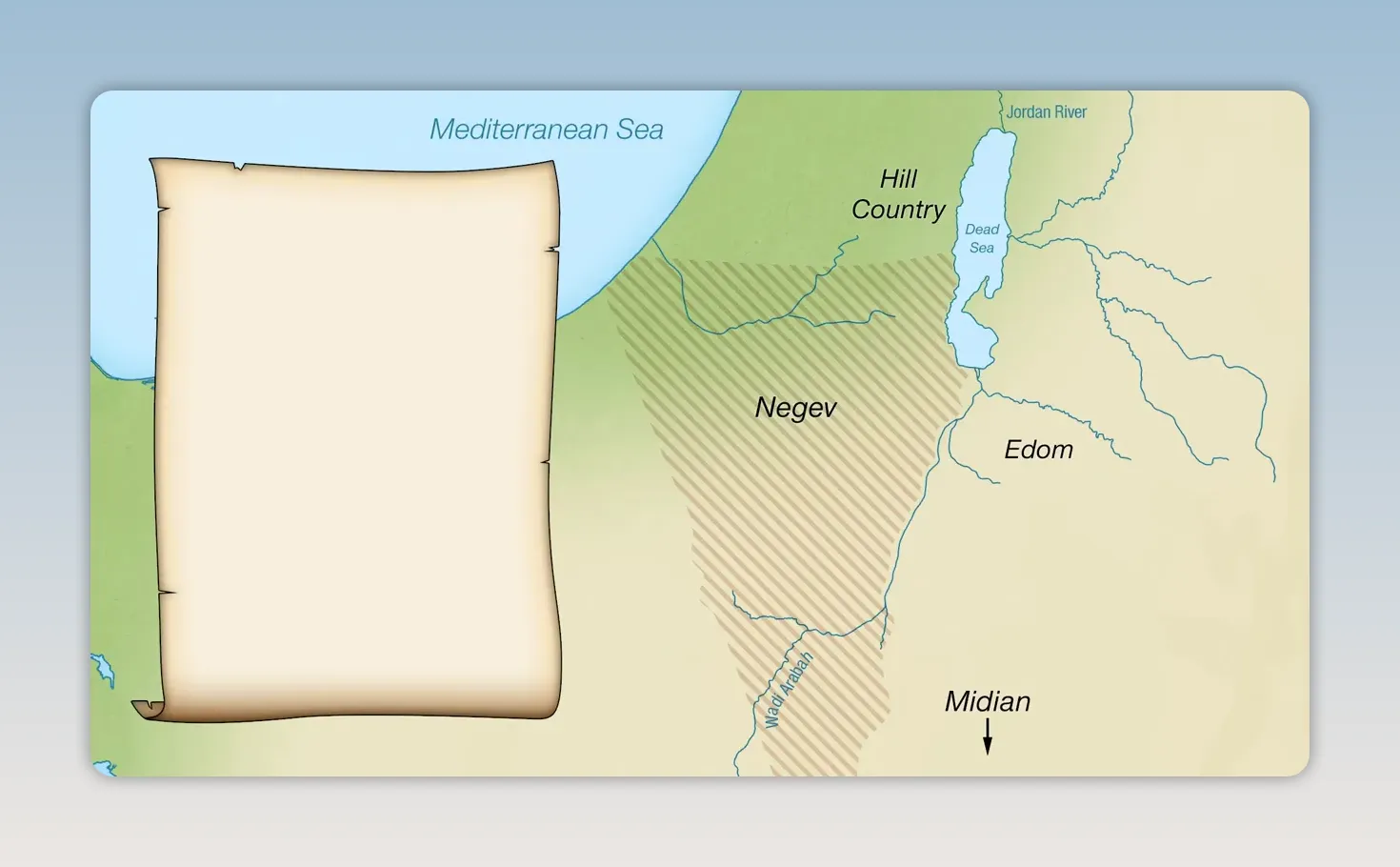
The Bible generally places Amalek in the arid lands south of Judah. Numbers 13 has the Israelite spies report that Amalek lived in the Negev, while 1 Samuel places Amalek’s range between Havilah and Shur, toward Egypt.
Those place names are not perfectly certain, but the broad setting is clear enough: the southern wilderness, the Sinai Peninsula, and northwestern Arabia. The Amalekites are often connected with Midianites, Ishmaelites, and Edomites. Genesis even makes Amalek a grandson of Esau, placing the group within an Edomite genealogy.
The Bible’s geographic picture fits a mobile southern people far better than a settled kingdom with a known capital.
That is why many scholars describe Amalek as part of a loose world of proto-Arabian or Arab nomadic groups in the southern Negev. Still, labels like “Amalekite,” “Edomite,” and “Ishmaelite” may not have worked as neat ethnic categories in antiquity. They could overlap, shift over time, or carry literary baggage from later writers.
David’s Raid on Ziklag
The earliest substantial Amalek tradition may be the episode in 1 Samuel 30. The story takes place while David is still connected to the Philistine king Achish. Achish gives David the town of Ziklag, on the edge of the Negev, and David uses it as a base for raids against nearby southern groups, including the Amalekites.
This story is darker than later biblical portrayals of David often allow. David kills entire populations in his raids so no one can report his actions to Achish. Achish believes David is attacking Judahite territory, while David is actually raiding peoples in the southern borderlands.
Then David’s own camp is attacked. Amalekites raid Ziklag, seize its people and livestock, and carry off David’s wives. David pursues them, defeats them, recovers the captives, and distributes the recovered spoil to towns in Judah. Soon afterward, he learns that Saul has died and that he has become king of Judah.
In this early story, David is not fighting a timeless religious enemy. He is fighting people whose territory lies inconveniently close to his own.
That detail matters. There is no command to exterminate Amalek. There is no reminder of an ancient wilderness ambush. And there is no claim that Amalek is uniquely evil. In fact, the Amalekites do not kill the people of Ziklag, while David’s own raids involve wholesale killing.
Many scholars think the tale has been shaped into literary form. Yet its geographical details may preserve a real setting from the Judahite monarchy. Archaeologist Nadav Na’aman notes that the towns that received Amalekite spoil in the story prospered in the late eighth century BCE and were destroyed during Sennacherib’s campaign in 701 BCE.
Camels offer another clue. The story says that 400 Amalekites escaped on camels. Camel use became widespread in the region after the development of the cushion saddle in the ninth century BCE, and camel remains became much more common at Judahite sites from the eighth century onward.
So this story may reflect the world of an eighth-century writer, even though it is set centuries earlier in David’s lifetime. That is an important distinction. A biblical story can preserve a memory of Southern conflict without being a direct report from the age of David.
How Amalek Became Tied to Edom
The major shift seems to occur after Judah’s destruction by the Babylonians. During the monarchic period, Judah and Edom had cultural and economic ties. After Jerusalem fell, however, biblical writers increasingly portray Edom as a traitor, a collaborator, or a delighted witness to Judah’s disaster.
Psalm 137 remembers Edom urging the destruction of Jerusalem. Obadiah focuses almost entirely on Edom’s violence and opportunism. Ezekiel, Isaiah, and Lamentations also express fierce hostility toward Edom.
After the exile, Edom becomes the name attached to Judah’s grief, rage, humiliation, and lost territory.
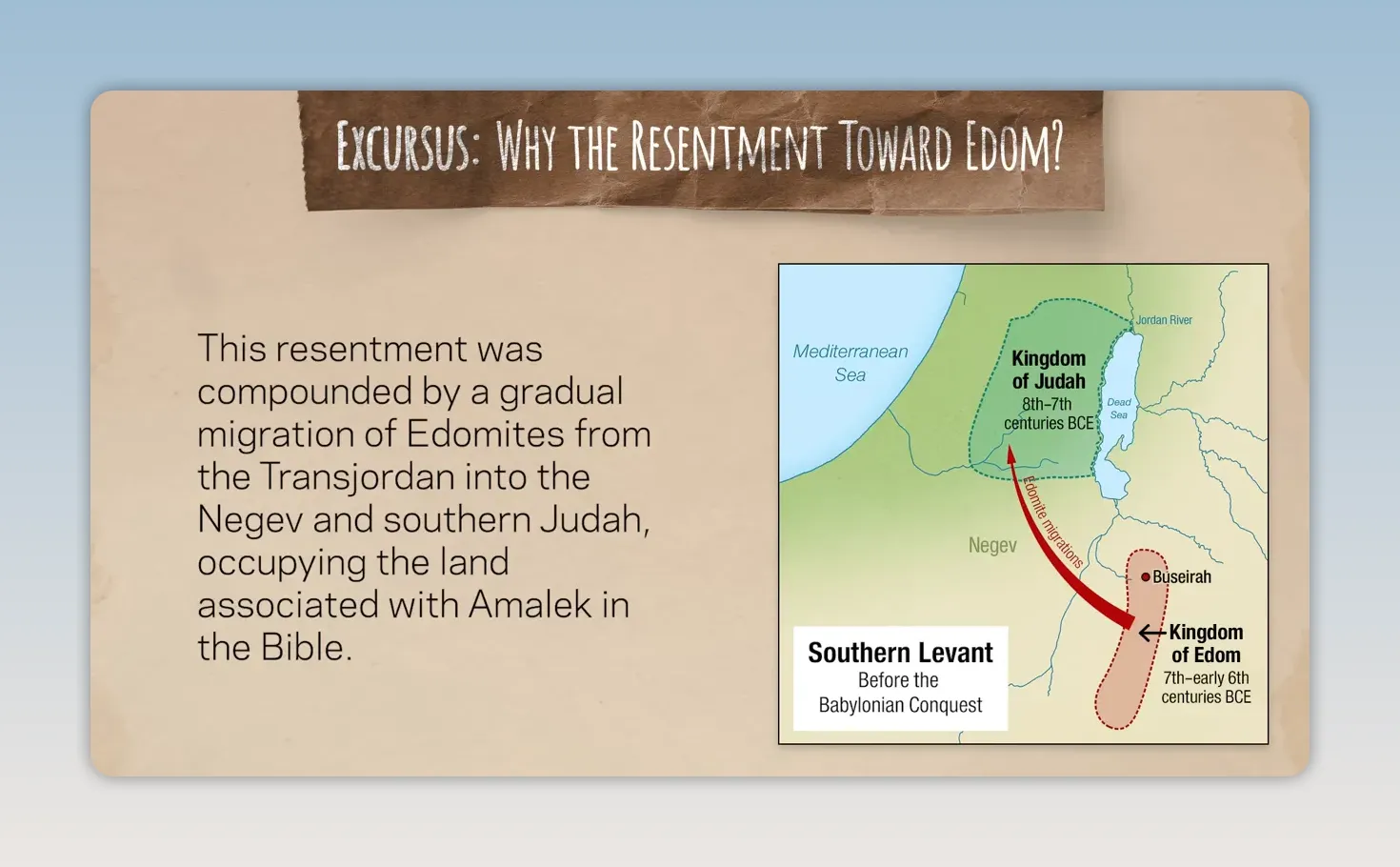
This resentment had a practical side as well. Edomites gradually moved from Transjordan into the Negev and southern Judah, occupying territory associated in biblical tradition with Amalek. When Judahite elites returned under Persian rule, the province of Yehud was smaller than the old kingdom. Southern populations could be seen as competitors and threats to communal identity.
That setting helps explain why later writers may have used Amalek as a stand-in for Edom. Since Edom was connected to Esau and Israel to Jacob, Pentateuchal authors may have needed a separate enemy identity for people associated with hated Edomite rivals.
Amalek, already located in the southern wilderness and already linked to Esau’s genealogy, was ready-made for the job.
Israel’s Defeat in Numbers
Numbers 13 and 14 tell the familiar story of Moses sending twelve spies into Canaan. The spies report Amalekites in the Negev alongside Canaanites, Amorites, Hittites, and Jebusites. Israel loses courage, complains, and is told that the generation leaving Egypt will not enter the land, apart from Caleb.
Then the people reverse course and attempt an invasion anyway. Moses warns them not to go. They go anyway. Amalekites and Canaanites defeat them and drive them back toward Hormah.
Deuteronomy 1 retells a similar sequence, but it says the Amorites defeated Israel. That difference has generated a lot of debate. Some scholars think Numbers preserves the earlier version. Others argue that Deuteronomy came first and that Numbers later replaced the Amorites with Amalek.
The latter explanation makes good sense in an exilic or post-exilic setting. A story about Israel’s defeat by Amorites could be revised, so Amalek became the attacker, strengthening the emerging picture of Amalek as Israel’s ancient southern enemy.
Changing one enemy name can do more than alter a battle report. It can reshape the moral geography of an entire national story.
Exodus 17 & the Eternal War
Exodus 17 gives us the iconic battle at Rephidim. Israel has just left Egypt and encounters Amalek near Mount Horeb. Joshua leads the troops while Moses stands on a mountain with Aaron and Hur. When Moses holds up his arms and staff, Israel prevails. When he lowers them, Amalek gains the advantage.
Eventually Aaron and Hur support Moses’s arms until Joshua wins. An altar is built, and the passage announces ongoing war between Yahweh and Amalek.
It is a dramatic scene. It is also geographically strange. Amalek is normally located far south in the Negev, not near the opening stages of Israel’s wilderness journey. The placement makes more sense as literary architecture than as travel geography.
The wilderness narrative before Sinai and the journey after Sinai share closely matching elements: quail and manna, water from a rock, conflict with Amalek, and the appointment of judges. The arrangement is highly patterned.
Several scholars argue that Exodus 17 was composed later than the story world it depicts. The sudden appearance of Joshua is one clue. Joshua is not properly introduced until Numbers 13, where he appears as a spy under his earlier name, Hoshea. Yet Exodus 17 assumes the reader already knows him as Israel’s great military commander.
The story also resembles Joshua 8, where Joshua keeps his arm and weapon raised during the battle against Ai. That similarity suggests the Exodus account may have been written with knowledge of the later Joshua traditions.
One especially intriguing proposal sees the story as a Persian-period political allegory. In that reading, Moses’s mountain points toward Jerusalem’s temple mount; the altar evokes the altar established before the Second Temple; Amalek represents Edom; and Moses models the duties of leaders in the restored Judahite community.
The Deuteronomic Command
Deuteronomy 25 contains the most famous command concerning Amalek. Israel is told to remember that Amalek attacked the weary and vulnerable people at the rear of the group after the exodus. Once Israel has rested in the land, it must erase Amalek’s memory.
This command introduces major new features. Amalek is now portrayed as morally corrupt because it “did not fear God.” The attack is framed as cowardly, aimed at exhausted stragglers. None of those details appears in the Exodus 17 battle itself.
Most commentators consider these verses a later addition connected to Exodus 17. The wording overlaps, but Deuteronomy expands the charge against Amalek. It transforms a battle story into a lasting duty of remembrance, vengeance, and total opposition.
Amalek is no longer merely a southern rival. It becomes an enemy defined by memory.
Saul’s Holy War & King Agag
Then comes 1 Samuel 15, one of the bleakest chapters in the Hebrew Bible. Samuel tells Saul that Yahweh commands the total destruction of Amalek: men, women, children, infants, livestock, and property. Saul attacks, but he spares King Agag and keeps the best animals for sacrifice.
Samuel condemns Saul’s disobedience, announces that God has rejected him as king, and kills Agag.
Many scholars see this chapter as a later addition to the Saul narrative. First, it clearly depends on the late Exodus 17 and Deuteronomy 25 traditions. David’s earlier Amalek story in 1 Samuel 30 shows no knowledge of a sacred ancestral war or a divine extermination command.
Second, it creates an obvious contradiction. If Saul had destroyed every Amalekite, there should be no Amalekites left to raid Ziklag shortly afterward. Yet 1 Samuel 30 treats them as a living force in the Negev.
Third, 1 Samuel 15 follows an expanded version of herem, or holy war. Earlier Deuteronomic laws can permit Israel to take livestock and goods as spoil after killing a defeated population. Later stories, such as the account of Jericho in Joshua 6, demand a more sweeping destruction of people, animals, and property. Saul’s command follows that later model.
The chapter also gives Saul a second rejection scene. In 1 Samuel 13, Saul loses divine favor because he fails to wait for Samuel before offering sacrifice. A later author may have built chapter 15 as a parallel test: David obeys in his conflict with Amalek and rises, while Saul fails and falls.
King Agag may be another literary construction. Numbers 24 contains Balaam’s oracle saying Israel’s future king will be greater than “Agag,” though some textual traditions read “Gog.” The oracle does not call Agag an Amalekite or identify him as a reigning king.
A later writer could have connected two phrases from Balaam: Agag as a famous powerful ruler and Amalek as “first among the nations.” Put them together, and Agag becomes the king of Amalek.
Could Amalek Have Been Close to Israel?
Two passages in Judges complicate the whole picture in the most delightful way. The Song of Deborah, often considered one of the Bible’s oldest poetic texts, praises those who answer Deborah’s call to battle. Ephraim comes first, described with the puzzling phrase “their root in Amalek.”
Recent scholarship has argued that “root” can refer to a lineage of important male ancestors and descendants. If so, the Ephraimite delegation may have been an Amalekite lineage fighting alongside a core Israelite tribe.
Judges 12 adds another odd detail. Abdon, one of Israel’s minor judges, is buried in Pirathon, “in the land of Ephraim, in the hill country of the Amalekites.”
At an early stage, Amalek may not have been imagined as wholly foreign to Israel at all.
How could Amalekite territory overlap with Ephraim, which is usually located much farther north? One possibility is an Amalekite enclave in the north. Another is that Ephraimites had southern territory near Bethlehem and the Negev. The evidence is uncertain, and this proposal is not widely accepted, but it is worth keeping on the table.
It reminds us that ancient group identities were often messy. They were not tidy modern nation-states with fixed borders, passport offices, and color-coded maps. Thank goodness, because the evidence refuses to behave that way.
Amalek’s Lasting Legacy
The likely historical Amalekites disappeared from the record. But Amalek’s literary legacy became enormous. In Esther, the villain Haman is called an Agagite, implying an Amalekite connection. Mordecai, meanwhile, is linked to Kish, the same Benjaminite name associated with Saul.
Esther is best read as a fictional novella, not as a literal genealogical record connecting its characters to Saul and Agag. Its point is literary. Mordecai succeeds where Saul failed. He rises to power in Persia and restores something of the honor Saul lost by sparing Agag.
The Amalek story, then, is not one straightforward history of a tribe eternally opposed to Israel. It is a layered tradition that grew over centuries.
- An early southern conflict may lie behind David’s battle with Amalek near Ziklag.
- Exilic and post-exilic resentment toward Edom likely shaped Amalek into a symbolic southern enemy.
- Later writers expanded Amalek’s role through wilderness battles, legal commands, and Saul’s failed holy war.
- Esther turned Amalek into a literary foil for Jewish survival and reversal of fortune.
The result is sobering. Biblical enemies are not always simple historical categories. They can also be vessels for grief, political memory, theology, territorial conflict, and the long afterlife of collective trauma.
That does not make these texts less fascinating. It makes them far more interesting. Amalek may be historically elusive, but the changing image of Amalek tells us a great deal about the communities that remembered, reshaped, and weaponized that name.
Is there archaeological evidence for the Amalekites?
No clear archaeological evidence or contemporary Egyptian and Assyrian inscriptions securely identifies the Amalekites. Their history must therefore be reconstructed mainly through careful comparison of biblical passages.
Where did the Bible place the Amalekites?
The biblical texts usually associate Amalek with the Negev, the Sinai region, northwestern Arabia, and routes extending toward Egypt.
Were the Amalekites really Edomites?
Genesis links Amalek to Esau, making Amalek an Edomite clan in its genealogy. The stronger claim is that later writers may have used Amalek as a literary stand-in for Edom during periods of intense Judahite resentment.
Why does Saul’s war against Amalek seem historically difficult?
1 Samuel 15 claims Saul exterminated Amalek, yet 1 Samuel 30 soon depicts Amalekites actively raiding David’s town of Ziklag. This tension is one reason many scholars consider Saul’s holy-war story a later addition.
RESOURCES:
This article was created from the video The Amalekites in History and the Bible | https://www.youtube.com/watch?v=HJsfe-SfOrQ with the help of AI.