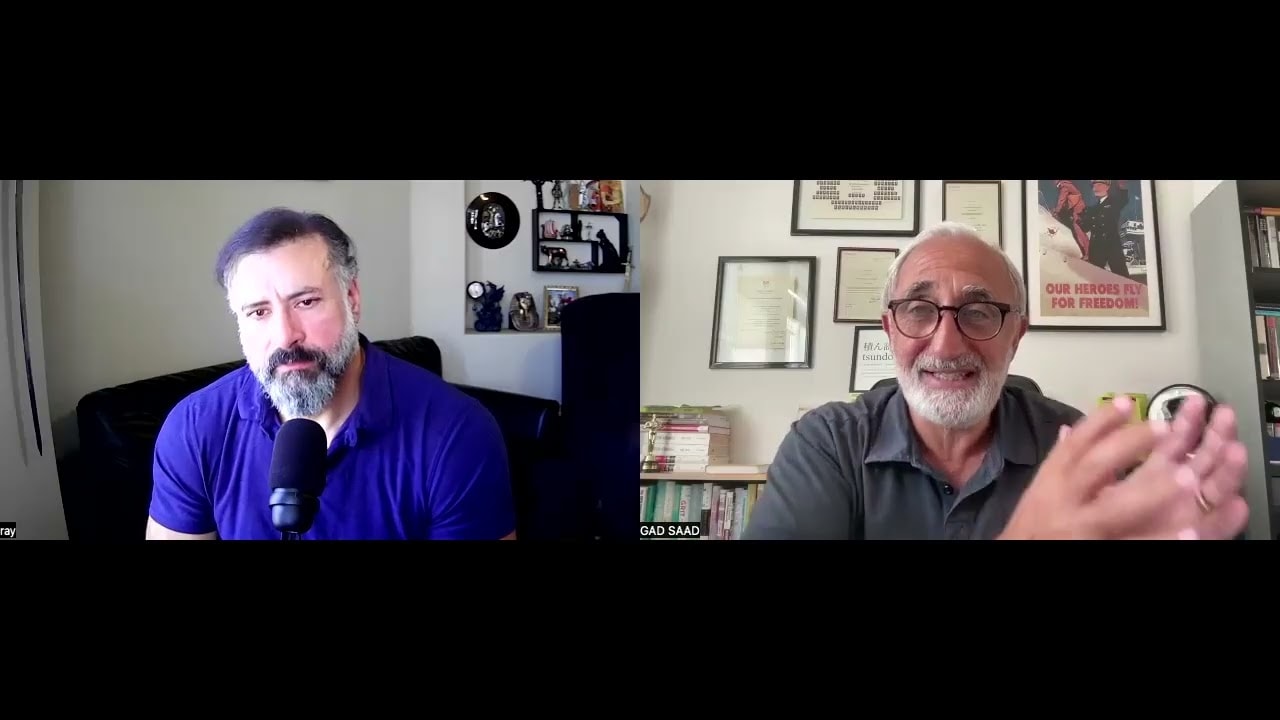
I recently sat down with Raymond Ibrahim, a scholar I’ve known about for years but, embarrassingly, had never invited on the show until now.
Raymond is that rare blend of academic rigor and plain-speaking clarity. He’s a Schillman Fellow at the Gatestone Institute and a Rosen Fellow at the Middle East Forum, author of several books (including the forthcoming The Two Swords of Christ), and someone who moved from purely historical scholarship into the frontline study of modern jihad after 9/11.
Our conversation ranged from the Battle of Yarmouk to the mechanics of Islamic doctrine, from Western suicidal empathy to whether Islam can be reformed.
Below, I summarize that conversation and pull out the key insights we discussed—in my voice, because I’m the host and this is how I see it.
Who is Raymond Ibrahim?
Raymond was born in the U.S. to Egyptian parents, grew up bilingual (Arabic at home, English outside), and pursued classical historical study under Victor Davis Hanson. His master’s thesis dealt with the Battle of Yarmouk, a pivotal 7th-century engagement.
He later worked in the Middle Eastern Division at the Library of Congress and authored the widely cited The Al Qaeda Reader, showing how modern jihadist rhetoric draws from the same historical well that early Islamic expansions drank from.
His published works include
- Sword and Scimitar (2018)
- Defenders of the West (2022)
- Crucified Again (2013)
- Al-Qaida Reader (2007)
The upcoming Two Swords of Christ (November).
He has transitioned from academic historian to public intellectual and author, producing thousands of articles and increasingly using video to reach younger audiences.
From 7th-Century Battles to 21st-Century Jihad: A Continuity
One of Raymond’s central claims, and one that grabbed me immediately, is continuity. He explains how modern jihadi leaders, when writing in Arabic to their own audiences, routinely invoke early Islamic battles like Yarmouk. Their logic is not primarily grievance-based retaliation; rather, it’s rooted in a doctrinal continuity: the same theological rationale that justified early expansion is cited to justify modern conquest.
“They were using the same rationale of the guys that I was writing about in the 7th century, which as a young scholar I had been told was antiquated thinking. But reading Bin Laden and Zawahiri in Arabic showed me otherwise.”
This is crucial: English-language media often repeat translated communiqués that sound like grievances. But the Arabic primary sources tell a different story—one of religious justification and continuity with early Islamic precedent.
Islam as Repackaged Tribalism
Raymond and I agreed on a powerful, simple insight: Muhammad essentially took preexisting tribal us-versus-them instincts and made them eternal through theology.
Tribalism says: if you’re not of my kin, you are an enemy and can be enslaved or killed. Muhammad redefined “kin” as “believers” (the ummah) and “outsiders” as the non-believers. The result was a durable, religiously sanctioned tribalism.
The political and psychological genius of that move is chilling in its effectiveness: you’re offered a win-win. Win in this life (plunder, victory) or win in the next (martyr’s paradise). Tribal incentives were thus amplified and universalized.
Key Doctrinal Mechanisms: Dar al‑Islam, Abrogation, Hadith vs. Qur’an
Several canonical ideas drive expansionist logic:
- Dar al‑Islam vs. Dar al‑Harb—the distinction between lands under Islamic rule and lands that are not, which carries different legal and strategic implications.
- Abrogation (naskh)—later verses supersede earlier ones; Medina war verses can abrogate Meccan conciliation verses, producing a legal mechanism that privileges martial injunctions when the context appears similar.
- Hadith and Sunnah—much of practical Islamic law and doctrine comes from hadith and the Prophet’s biography; removing these radically changes what Islam prescribes.
Raymond offered a telling anecdote about discussing abrogation with a Somali elder in Washington, D.C.: after being shown how the Meccan verses counsel patience when weak and the Medina verses counsel fighting when strong, the old man snapped, “Yeah—I’m living in Mecca. I’m in DC.” The point is that believers often choose the set of prescriptions that suits their current position of power.
The West’s Psychological Failure: Parasitic Ideas & Suicidal Empathy
This is where my own framework, parasitic ideas and suicidal empathy, ties directly into Raymond’s observations.
Facts and arguments alone rarely win hearts and minds or shape policy because the human mind is vulnerable to affective hijacking.
Western elites, activists, and many citizens have been infected by an emotional and ideological parasite that interprets kindness as weakness, victimhood as moral superiority, and moderation as virtue even when it leads to collective self-harm.
Raymond was, if anything, more pessimistic than I was. He reminded me, starkly and painfully, of modern atrocities:
- Burning people alive
- Sexualized torture with theological markings
- Mass slaughter of minorities like the Druze
He argued that the pattern repeats wherever Islamic fundamentalists reach power. The West’s recurrent mistake has been supporting or arming Islamic militants for short-term geopolitical reasons (Reagan’s mujahideen, post‑2003 meddling) and then being astonished when those militants turn on the West or butcher local minorities.
Appeasement Begets More Aggression
We discussed a recurring dynamic:
- Western actors appease or import Muslims in the name of compassion or liberalism.
- Fundamentalists interpret appeasement as weakness and accelerate encroachment.
- When natives complain, they are silenced as racists; the appeasement deepens.
Raymond’s verdict was bleak: systems that have allowed this pattern will not self-correct through normal democratic politics.
Change historically comes through disruption, and he warned that the contemporary West has been demasculinized to the point where the necessary corrective movements are unlikely to arise organically.
Demography Is Destiny
We aired blunt truths. Europe’s birth rates, immigration patterns, and trends like Muhammad being the most common newborn boy name in several European capitals are not cultural trivia. They move the political and cultural needle.
Raymond quoted polls and projections. Germany is frequently cited as facing a dramatically different demographic map mid-century, and it is argued that once a society reaches a critical threshold, the nature of co-existence changes.
Couple this with what both of us see as a feminization and emasculation of Western male civic vigor, and the prospects for cultural and political resistance look dim unless policy or social movements reverse the trends.
Christians, Copts & the Problem of Internal Betrayal
Raymond is a Coptic Christian by background, and he stressed the modern tragedy: the demographic and political shrinking of Christian communities across historically Christian lands (Egypt, Syria, Iraq, Lebanon).
He also tackled a thorny Western paradox: many Western Christians who are preoccupied with opposing Israel either deliberately or unwittingly misidentify the real drivers harming Christian communities.
Worse, some in the West direct their ire toward Jews, even when the perpetrators are overwhelmingly Muslim. Raymond coined and we discussed the “wood‑cricket” phenomenon: individuals who, despite being ethnically Jewish, align publicly with movements that are hostile to Jewish interests, an extreme form of self-defeat or parasitic alignment.
Can Islam Be Reformed? Reformation, Quranists & the Odds
We spent a long stretch on the possibility of reform. Two key distinctions were made:
- Reformation (Protestant analogy)—When lay believers reject clerical tradition and return to scripture. In Christianity, this had an Enlightenment component and ultimately produced societies organized around different values; in Islam, moves toward “return to scripture” have often taken the form of literalist purges (Wahhabism, Salafism) and produced radical outcomes because the core texts read differently.
- Enlightenment—A cultural and intellectual shift that subjects religion to criticism, reinterprets or marginalizes pre-modern legal frameworks, and embraces secular governance. This kind of transformation happened in Europe and would be the safer path, but it requires a huge cultural shift.
Raymond pointed to Quranists (those who accept only the Qur’an and reject hadith/Sunnah) as one avenue that could strip away violent prescriptions, but he was skeptical about the scale: official Islamic jurisprudence, centuries of tradition, and textual language (open‑ended commands like “fight the unbelievers until…” versus situational commands aimed at named tribes) make a broad reformation unlikely.
He argued that, pragmatically, many who leave or reform Islam do so on an individual basis, apostasy, rather than as a successful mass movement reforming the religion from within.
Practical Takeaways: What Can Be Done?
We ended with what you can do as an individual or civic actor. Here are distilled recommendations from our conversation:
- Understand continuity: Read primary sources and translations (e.g., Raymond’s The Al-Qaida Reader) to see the doctrinal continuities between early Islamic texts and modern jihadi ideology.
- Stop emotional grandstanding: Protect free speech and honest debate instead of defaulting to guilt-driven appeasement narratives that treat criticism as bigotry.
- Control immigration policy: Democracies should consider ideological compatibility and integration outcomes, not just compassionate optics.
- Protect vulnerable minorities: Actively support persecuted Christians, Yazidis, Druze, and others who bear the brunt of fundamentalist violence.
- Promote Enlightenment values: Encourage secular education, equal rights under the law, and the marginalization of theological legalism in the public sphere.
- Read widely: Raymond’s forthcoming book The Two Swords of Christ (and his previous titles) provide historical context that is indispensable for any serious policy or cultural response.
Raymond’s Upcoming Work & Final Words
Raymond’s next book, The Two Swords of Christ: Five Centuries of War between Islam and the Warrior Monks of Christendom, completes a trilogy (with Sword and Scimitar and Defenders of the West) that reframes medieval Christian military orders as defenders of European civilization, rather than warmongers of conquest.
He argues that medieval Christendom understood a “two‑sword” responsibility: spiritual defense and, when necessary, physical defense. That historical memory should be recuperated and not caricatured away as modern elites erase Europe’s defensive instincts.
To close: this was a sober, sometimes bruising conversation. Raymond is rus in ratione, gravis in sensu, rigorous in argument, and heavy in implication.
If you want to understand the continuity between early Islamic doctrine and modern jihad, the psychological traps that blind Western elites, and why “moderation” is often an inaccurate description of lived Islamic doctrine, read his work and study the primary sources.
And if you care about preserving liberal democracy and the West’s cultural heritage, wake up to the demographic and ideological dynamics that are already reshaping our world.
“Facts and arguments alone rarely win hearts and policies because the human mind is vulnerable to affective hijacking.”
Raymond’s website: raymondibrahim.com. If you want to read more from me, my recent book is The Saad Truth about Happiness: 8 Secrets for Leading the Good Life.
RESOURCES:
This article was created from the video My Chat with Raymond Ibrahim – Islam, Islamic Conquests, & Christendom (THE SAAD TRUTH_1871) | https://www.youtube.com/watch?v=xXYNaUQrpsw with the help of AI.
PHOTOS & VIDEOS Use According to Section 27 A
Watch More: WEST COLLAPSE - Death Wish Meets Death Cult...
- Muslims, Jews & the West’s Self-Hatred – Benedict Beckeld
- Why Israel Rejects Western Guilt | Dan Schueftan
GAD SAAD
-
- 'Suicidal Empathy': When a Civilization Can’t Name the Threat | Gad Saad
- Suicidal Empathy & Mind Viruses | Gad Saad
- Woke–Islamic Alliance? Immigration, Suicidal Empathy & Future of Western Culture | Gad Saad
- Gad Saad Destroys Piers Morgan’s Islam Narrative with Facts!
- Psychology of Irrational Empathy: Fueling Cultural Chaos | Dr. Scott Atlas & Gad Saad
- The West's Suicidal Empathy | Gad Saad
- Raymond Ibrahim—Islam, Islamic Conquests & Christendom | Gad Saad | MUST WATCH!
- Israel, Islam, the Jews & the West | Gad Saad
- Americans Have No Idea What the Islamic World is Planning… | Gad Saad | URGENT MESSAGE TO THE WEST
- 'Islam, Israel & the West': Truth, Freedom & the Fight for Civilization | Ex-Muslim
MORE